

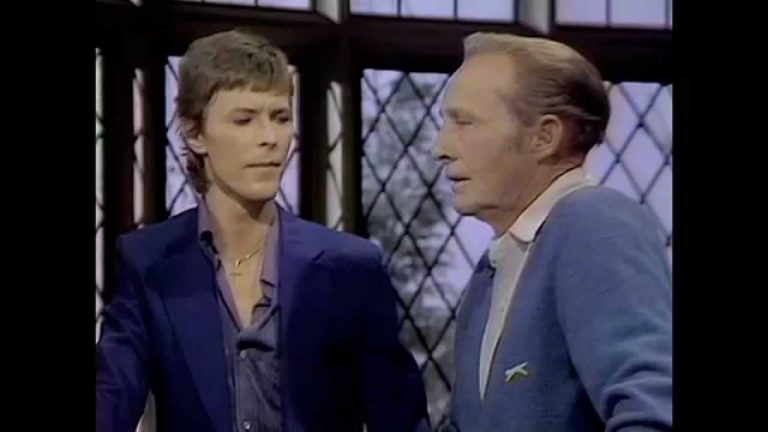
David Bowie made a guest appearance on Bing Crosby’s Christmas special in 1977. This excerpt from American Masters: Bing Crosby Rediscovered shares the behind-the-scenes story of the song “The Little Drummer Boy / Peace on Earth,” which was pivotal to Bowie’s participation. The full film premieres Tuesday, December 2 at 8 pm ET on PBS.
In Q3, Facebook Drove 4x More Traffic Than Pinterest
From Shareaholic:
With a $200 billion market cap and an active user base that rivals the entire population of China, Facebook has significant staying power.
For publishers, marketers and site owners, this is especially important because Facebook is the leading driver of social referrals to sites across the web. Also, surprisingly, over the last year, Pinterest has been giving Zuckerberg and company a run for their money as the #2 source of social referrals.
In the 3rd Quarter 2014 edition of the Shareaholic Social Media Traffic Report, we take a look at how much traffic each of the 8 most popular social networks sent publishers’ way. The data reveals “share of visits,” a percentage of overall traffic — direct traffic, social referrals, organic search, paid search, etc. — sites received, for Facebook, Pinterest, Twitter, StumbleUpon, Reddit, Google Plus, YouTube, and LinkedIn.
This June, Facebook delivered nearly a quarter of the total visits sites around the web received. While its share of traffic has marginally shrunk since then, the ubiquitous social network still drives 4x more traffic than Pinterest.
Section I: Social Referrals Over Q3 2014
Our first chart observes “share of visits” for each social network over the months of June, July, August, and September 2014. The final column quantifies how much each social platform’s share has changed from June (end of Q2) through September (end of Q3).
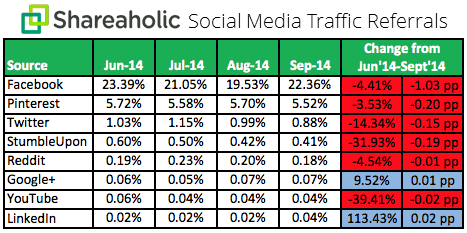
Of the eight social networks tracked, only two — LinkedIn and Google Plus — drove a greater share of traffic at the end of Q3 than they did at the end of Q2. The other six each saw their share of traffic decrease slightly, between 1.03 – 0.01 percentage points.
Content Creators Flock to Facebook for Videos
From SocialBreakers:
This just in: social media marketers have done more than just walked away from using YouTube for video content – they have sprinted. And where have they gone? Straight out of the grasp of Google and into the outstretched arms of Facebook.
Socialbakers analyzed over 180,000 Facebook video posts across 20,000 Facebook pages – here’s what we found.
Back in 2012, marketers were not even considering alternative options for sharing video content on Facebook. The standard process was to create a video, publish it to YouTube and share it via Facebook. However, the recent trend is clearly showing that content marketers are directly uploading video content to Facebook, meaning that Facebook is retaining the traffic at the expense of YouTube.

‘Investing in Music’ report shows record labels invest US$4.3 billion in A&R and marketing
From IFPI:
- Record companies’ total investment in A&R and marketing tops US$4.3 billion annually and more than US$20 billion over five years, according to IFPI’s Investing in Music report
- Labels’ investment in A&R and marketing up from 26 to 27 per cent of industry revenues over the last two years
- Report unveiled at ‘Friends of Music’ evening for MEPs in Strasbourg hosted by IFPI chairman Plácido Domingo
Record companies remain the engine room of the global music industry, investing US$4.3 billion annually in artists and repertoire (A&R) and marketing, according to a new report from IFPI on the changing face of the music business.
Labels remain the primary investors in artists, investing 27 per cent of their revenue in A&R and marketing, up from 26 per cent in 2011. Over the last five years it is estimated that record companies worldwide have invested more than US$20 billion in A&R and marketing.
More than 7,500 artists were signed to major labels’ rosters in 2013, with tens of thousands more on independent labels. One in five artists on labels’ rosters is a new signing, highlighting the role of fresh talent as the lifeblood of the industry.
Record companies invest a greater proportion of their global revenues in A&R than most other sectors do in research and development (R&D). Comparisons show music industry investment in A&R (16%) exceeding the R&D investment of industries including software and computing (9.9%) and the pharmaceutical and biology sector (14.4%) .
Investing in Music is published today by IFPI, representing the recording industry worldwide, in association with WIN, representing independent labels internationally. It is being launched at a ‘Friends of Music’ event for MEPs in Strasbourg hosted by IFPI and its chairman Plácido Domingo.
With fresh data and several case studies, the report outlines the evolving and enduring partnership between labels and artists in the digital world.
Frances Moore, chief executive of IFPI, says: “Investing in Music highlights the multi-billion dollar investment in artists made every year by major and independent record labels. It is estimated that the investment in A&R and marketing over the last five years has totalled more than US$20 billion. That is an impressive measure of the qualities that define the music industry, and which give it its unique value.”
Alison Wenham, chair of WIN, says: “Most artists who want to make a career from their music still seek a recording deal. They want to be introduced to the best producers, sound engineers and session musicians in the business. They need financial support and professional help to develop marketing and promotional campaigns.”
The report features data from record companies and case studies from around the world, including studies on Ed Sheeran, 5 Seconds of Summer, Lorde, MKTO, Negramaro, Nico & Vinz, Pharrell Williams and Wei Li-An.
Other highlights of the report include:
- The costs of breaking an artist in a major market remain substantial at between US$500,000 and US$2 million. The cost typically breaks down as payment of an advance (US$50,000-350,000), recording costs (US$150,000-500,000), video production costs (US$50,000-300,000), tour support (US$50,000-US$150,000) and marketing and promotional costs (US$200,000-700,000).
- Record companies invest in local talent and break them to a global audience. The recording industry is global in scale and exports artists internationally; but it heavily invests in local repertoire. In 12 of its leading markets, local repertoire accounts for more than 70 per cent of the sales of the top 10 albums.
- Live performance has not replaced recordings as the driver of the music industry.While record companies invest US$2.5 billion in A&R, there is little evidence of such substantial investment in new music coming from any other source. All of the five top grossing live tours of 2013 were by artists who first released albums nine or more years previously, with one group having recordings going back 50 years. Few artists can achieve a scalable, sustainable music career without producing recorded music.
- Unsigned artists want a record deal. Research conducted with the Unsigned Guide in the UK found 70 per cent of unsigned acts wanted a recording contract. The top drivers for wanting a recording contract are marketing and promotional support (76%), tour support (58%) and getting upfront financial support in the form of an advance (45%).
- Brand partnerships and synch deals have grown in importance. A recording deal unlocks a range of different revenue streams for artists and labels. These include a new generation of brand partnership and synchronisation deals, involving the use of recordings in TV, film, games and adverts.
GLOBAL A&R AND MARKETING INVESTMENT:
| 2013 | |
|---|---|
| A&R | US$2.5bn |
| A&R as % of revenues | 15.6% |
| Marketing | US$1.8bn |
| Marketing as % of revenues | 11.4% |
| Total investment (A&R + marketing) | US$4.3bn |
| Total investment as % of revenues | 27.0% |
| Total industry revenues | US$16.1bn |
Source: IFPI. A&R spend includes advances, recording and origination, video costs, tour support and staff overheads. Marketing spend includes TV advertising, co-op marketing and online marketing/promotion.
Here’s The Thing with Alec Baldwin is back – this week, Ira Glass!
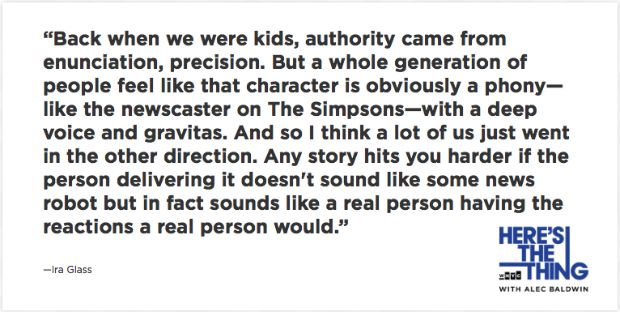
Alec Baldwin sits down with Ira Glass to compare notes on interviewing, the afterlife, and how to find one’s voice – with a microphone or a camera lens. Now the veritable kingmaker of public radio, Glass has revolutionized nonfiction storytelling by using a voice that’s personable, modest, and emotionally engaged. In this extensive interview, Glass lays it all out: politics (he’s a Democrat; finds the left insufferable), religion (went through Hebrew school; done with it), fact-checking (you can never be too careful), and that dog who went as him for Halloween.
Bob Dylan Plays Concert for One Lucky Superfan
From Rolling Stone:
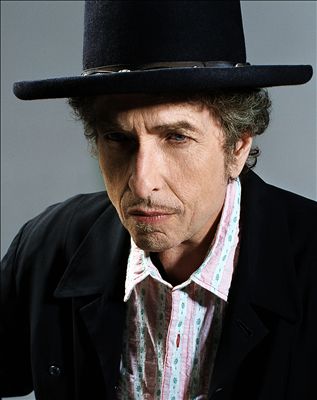
Yesterday afternoon around 3:00 p.m. 41-year-old Bob Dylan superfan Fredrik Wikingsson walked into Philadelphia’s Academy of Music, took a seat in the second row and prepared to watch his hero play a concert just for him. “At this point I still thought I was about to get Punk’d,” he says. “I thought some asshole would walk onstage and just laugh at me. I just couldn’t fathom that Dylan would actually do this.”
The incredible concert was part of an ongoing Swedish film series Experiment Ensam (Experiment Alone), where people experience things completely alone that are usually reserved for large crowds. Past films focused on lone people at comedy clubs or karaoke bars. The filmmakers thought a lot bigger for this one and made arrangements with Dylan’s camp for the private show, paying him an undisclosed amount of money. “I have no idea how much it was,” says Wikingsson. “But it was probably more than he gets for a normal gig.”
Wikingsson’s private Dylan show was filmed by eight cameras, and a 15-minute documentary of the event will hit YouTube on December 15th. “Fans might detest the fact that I’m sitting there,” he says. “But it’s going to be really cool and great looking. The sound was just incredible.”
Jarvin Cocker’s Advice For Creative Artists
Pitchfork: As someone who’s maintained a creative lifestyle for about 30 years now, what advice would you give to someone who’s considering that path now?
JC: One of the problems of our modern world is that there’s a lot of things to work through, but, at some point, everybody should take a pause from that and make something, so that it’s not just all one-way traffic. Human beings aren’t meant to be solely consumers—eventually, something has to come out. Otherwise, I don’t really see what the point of all that consumption is. The idea behind watching things and listening to things is that it stirs something within you, and hopefully that will stimulate you to then create your own thing.
I love the Internet, but it’s hard not to get lost in it. It’s not like a book where you start and get to the end. It’s like we’ve found a way to encapsulate all of human knowledge within one thing only to learn that you can’t do that. It’s an overabundance of information. Ultimately, it must be quite tough to be confronted with that. If you wanted to be a creative person and you are confronted with the sum product of mankind’s creativity up to this moment in history, that’s pretty daunting, like, “Where can I fit my voice in amongst all that?”
Pitchfork: Yeah, the idea of making something new can seem pointless because you know it’s going to be thrown on top of this endless pile of stuff.
JC: What people have to make sure of is that they’re not replicating something that already exists. You really have to ask yourself: “Is there a point in me doing this? Has this already been said before? Is this moving things along or is this just adding to the giant pile of junk that’s already there?” Social commentators give this kind of idea names like “cultural gridlock,” where things like music don’t seem to be developing so much. It’s not like the music of 1994 is that different than the music of 2014—and that’s 20 years worth.
But I believe that humans adapt to circumstance. The Internet is quite an unprecedented circumstance, so it’s going to take people a while to get their heads around it. You read things about writers, for instance, who get computer programs so that they can’t surf the Internet when they’re supposed to be writing. People are learning that you’ve got to find some way of shutting things off in order to give your own mind a chance to produce something. It’s interesting that most gadgets are called “iPhone” and “iPod,” with that “i” prefix, which is ego. But most creativity is not ego-led—a lot of it comes from the unconscious. So if you’re always checking your email or updating your Instagram profile, you’re not just looking out the window, daydreaming. You’ve got to let the subconscious in—that’s my main message to the world. I sound like I’ve been reading too many self-help books, don’t I?
Via Pitchfork
Watch Fred Armisen Improvise New York Accents For Nearly Five Minutes
Portlandia star Fred Armisen improvises a startling number of New York City neighborhood accents for five minutes.
Watch 14-Year-Old Taylor Swift In High School Video Project

At 14 years old, the same year she signed her first song publishing deal in Nashville, Taylor Swift was a natural on camera.
She and some classmates had to put together a video project, so they came up with a fictional company called Paco’s Paradise Smoothies and made a commercial for it. Swift gets the indispensable role of “Island Girl 1.”
I’m not even going to tell you when she comes in – you’ll know.
Pierre the French bulldog puppy takes a leap of faith

A French bulldog, Pierre, was only nine weeks in this video, and had never jumped off the couch before. He decided that this was the day he would attempt it, and he does it like a boss.
http://youtu.be/PiZqh2QgNJU