


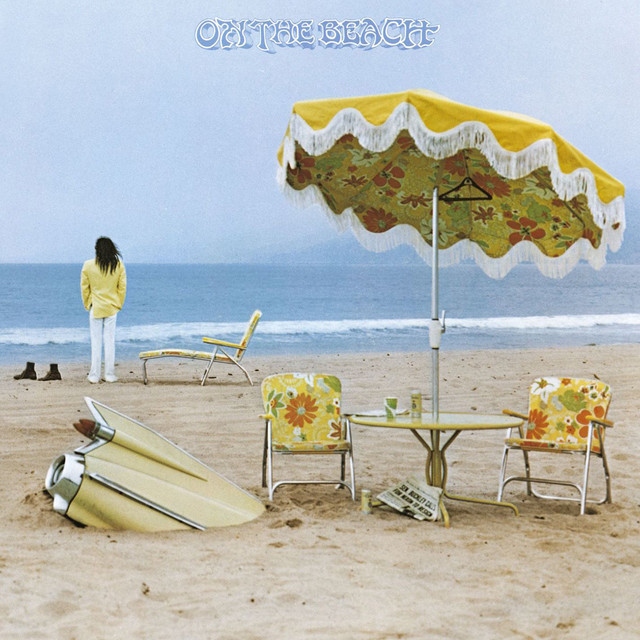
Neil Young’s On the Beach, released on July 19, 1974, captures a moment suspended in emotional twilight. Part of the so-called “Ditch Trilogy,” it trades polish for feeling, control for rawness, and clarity for depth. While it now holds its place as a fan favourite and critical treasure, the album holds stories and turns few know. Let’s dig a little deeper into five lesser-known facts that drift along with the salty wind of On the Beach.
1. The Cadillac on the Cover Was Real—and Buried
The iconic cover wasn’t a photomontage—it was fully staged. Neil Young and longtime collaborator Gary Burden hauled an actual 1959 Cadillac tail fin from a junkyard to the beach, stuck it into the sand, and added props like a yellow polyester jacket and local newspaper with the headline “Sen. Buckley Calls for Nixon to Resign.” The photo was shot on Santa Monica Beach by Bob Seidemann. Neil considered it one of his favorite covers, later saying the idea hit him like a “blot from the blue.” It matches the album’s tone perfectly: sunlit but somber, relaxed but haunting.
2. “Honey Slides” Fueled the Sessions
Much of the album’s woozy atmosphere comes courtesy of “honey slides”—a mix of sautéed marijuana and honey introduced by Rusty Kershaw. The concoction reportedly hit like heroin and slowed the sessions to a dreamlike crawl. Musicians drifted in and out of consciousness while recording, which contributed to the album’s spaced-out mood. Neil later said, “A couple of spoonfuls of that and you’d be laid-back into the middle of next week.” The slow-motion feel of tracks like “Motion Pictures” can be traced directly back to the haze of the honey slides.
3. “Revolution Blues” Sparked Chaos in the Studio
Inspired by Charles Manson, whom Neil had briefly known, “Revolution Blues” carried an undercurrent of paranoia and unease. Rusty Kershaw wanted the band to tap into that feeling and pushed them with wild theatrics. He smashed things in the studio to provoke a genuine sense of chaos, urging, “This is how you start a revolution!” The next take captured the mood perfectly, according to Kershaw. The song ended up as one of the fiercest, most electrified moments on the record—completely unlike the rest of the album’s tone.
4. The Side Order Was Reversed at the Last Minute
Neil originally wanted the album to begin with “On the Beach” and end with “Walk On,” but producer David Briggs convinced him to flip the sides. Neil later admitted he regretted giving in, feeling that the album lost a sense of unfolding narrative. Interestingly, cassette and 8-track versions kept Neil’s intended running order. Fans today can argue both sides, but the decision shows how format and sequencing can shape a listener’s experience—and how a small choice leaves a lasting imprint.
5. “Ambulance Blues” Echoes Toronto’s Lost Haunts
The closing track “Ambulance Blues” reflects on everything from political corruption to fading friendships, but it also contains a tribute to Toronto’s countercultural past. Lines like “Oh Isabella, proud Isabella, they tore you down and plowed you under” refer to a house where Neil and Rick James once lived at 88 Isabella Street. It was demolished in the ‘70s, and Neil immortalized it in song. The Riverboat, another Toronto reference, was where artists like Joni Mitchell, Gordon Lightfoot, and Simon & Garfunkel played—giving the song an emotional pull rooted in real places and memories.
On the Beach sways with heartbreak and reflection, sunshine and shadow. These hidden details help explain how a mellow album grew into something revered. It may have drifted into the world quietly, but the stories behind it still ripple across time.