


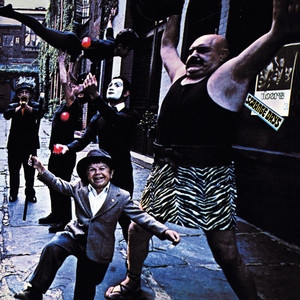
When The Doors released Strange Days in September 1967—just eight months after their debut lit the world on fire—they were chasing sound, poetry, and a little bit of sonic chaos. From Moogs to marimbas, alleyway acrobats to tape loops run backwards, Strange Days was wild, weird, and way ahead of its time. You’ve heard the hits. Now here are five behind-the-curtain facts that prove just how strange—and brilliant—these days really were.
1. That Synth? It’s One of the First in Rock History
Before synths became the pulsing heart of new wave, Jim Morrison and Paul Beaver were rigging up a Moog to filter Morrison’s voice—by playing notes on a keyboard while Morrison sang. Engineer Bruce Botnick called it “an envelope” for Jim’s vocals, and added a tape loop delay for good, trippy measure. The effect? A warbling, echo-drenched vocal performance that sounded like it was beamed in from another dimension. Not bad for 1967. Somewhere, Brian Eno tipped his hat.
2. The Album Cover Was a Manhattan Street Circus—Literally
The iconic Strange Days cover was shot in Sniffen Court, a tucked-away alley in New York. Photographer Joel Brodsky wrangled a wild ensemble of circus performers… and when that wasn’t enough, he got creative. His assistant dressed as a juggler, and a cabbie was paid $5 to pretend he played trumpet. Twin dwarfs were used to create symmetry across the front and back covers. The Doors themselves only appear as a poster in the background. It’s a surreal image—and a subtle nudge that the real spectacle was always the music.
3. “Unhappy Girl” Was Played Entirely Backwards—On Purpose
Ray Manzarek wasn’t just a keyboard wizard—he was a reverse-reading, bottom-up musical puzzle master. For “Unhappy Girl,” he literally read his sheet music backwards and recorded his part that way. Then the band overdubbed in real-time on top of the reverse performance. The result is an unsettling, off-kilter swirl that perfectly matches the song’s haunting theme. It’s not just experimentation for its own sake—it’s expression through inversion.
4. “Horse Latitudes” Was a Windstorm of Avant-Garde Madness
Before the term “spoken-word interlude” became a Spotify skippable, Morrison gave us “Horse Latitudes,” a dramatic, howling poem he wrote as a teenager (or so he claimed). The band conjured a storm of sound: tape hiss, reversed loops, and freeform noise made from twisting knobs and playing instruments the wrong way. Botnick even hand-spun the tape to create artificial wind. It’s theatrical, chaotic, and possibly the only Doors track that could double as performance art at MoMA.
5. The Harpsichord in “Love Me Two Times” Wasn’t a Gimmick—It Was Rock Royalty
Ray Manzarek played the final version of “Love Me Two Times” on a harpsichord, which he called “a most elegant instrument not normally associated with rock and roll.” But elegance was exactly the point. Robby Krieger’s blues riff was about lust, longing, and leaving, and Manzarek’s choice gave it a baroque-meets-blues tension that still feels fresh today. Banned in New Haven for being too controversial, the song was also banned in some minds for being too catchy.
Strange Days may have lived in the shadow of its blockbuster predecessor, but in hindsight, it’s the album where The Doors got braver, weirder, and infinitely more experimental. It’s the sound of four musicians poking holes in reality—and letting strange, wonderful sounds leak through.