


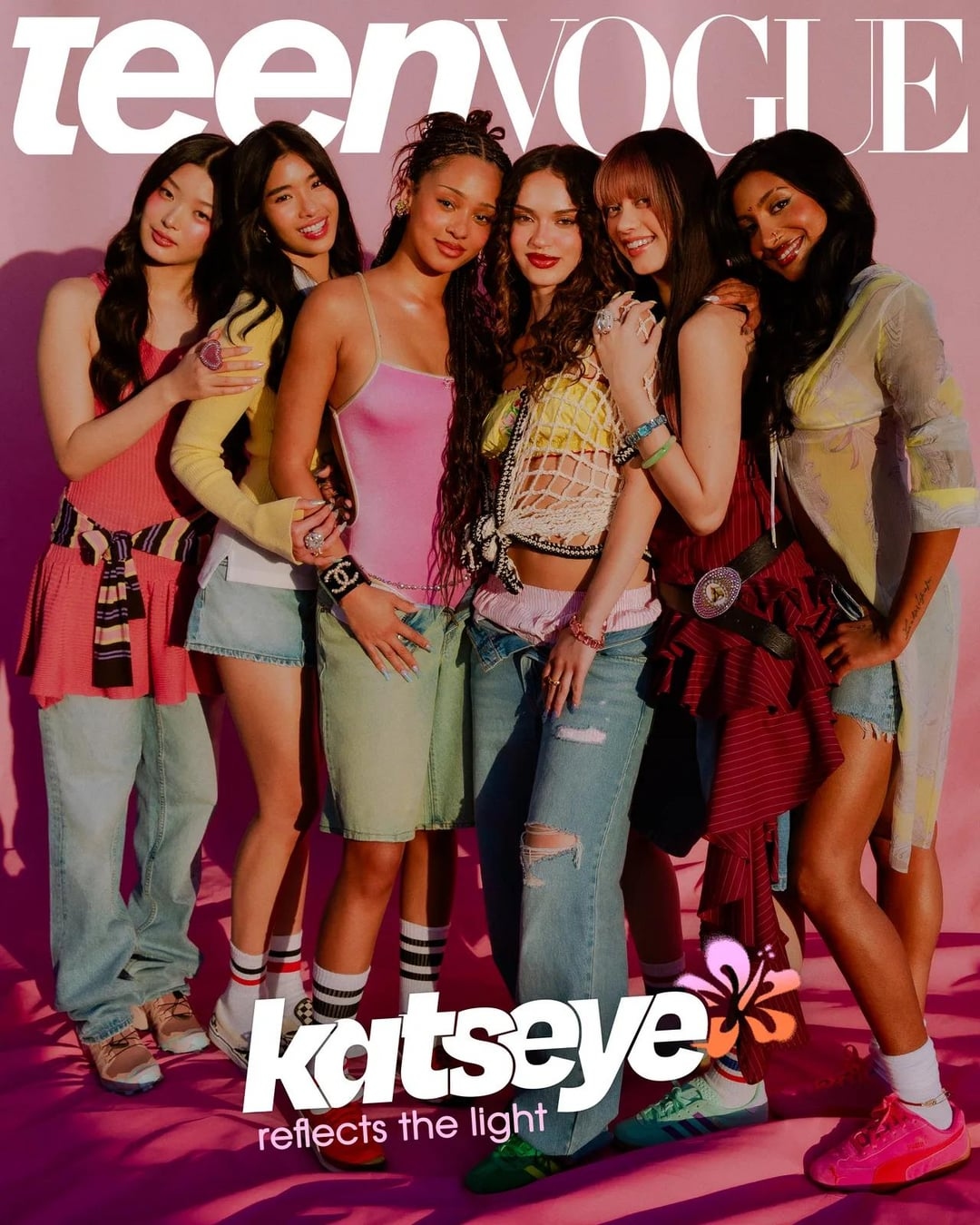
Today, Teen Vogue published their latest cover featuring global music superstars KATSEYE, and announced that the girl group will appear at the annual Teen Vogue Summit taking place on September 20 in Los Angeles.
Tickets to the full-day experience featuring today’s most influential cultural icons and change-makers are on sale now at https://events.teenvogue.com/. Additional details will be announced in the coming months.
Highlights of KATSEYE’s cover story can be found below.
On their polarizing song “Gnarly”:
“It’s sort of good when people so strongly dislike something,” Lara Raj tells Teen Vogue. “Because I think it just shows that it makes people feel something strong, whether that’s dislike or they really like it.” Sophia Laforteza reveals that the group was similarly hesitant when they listened to the demo. “We screamed,” Yoonchae Jeung says, but they knew they would make it their own.
On combating negative feedback and social media haters:
“We learned that’s going to be a part of the position that we’re in,” Sophia says. “We’re always told by our team [that] if you’re a trendsetter or if you have this influence, a lot of the things that you’re going to bring into the world, people aren’t going to understand from the beginning.”
On maintaining their individuality through visual presentation:
“What resonated with the people so much about our visuals is how much we choose to enhance it and stay true to ourselves,” Sophia says. “As much as we love to try new things, every single one of us is true to ourselves, and we always make sure that we’re confident and we feel good. I think that’s what makes whatever you put on make others feel like they’re going to feel the impact and the intention.”
Leader Sophia Laforteza on celebrating her Filipino heritage:
“I want to be somebody who will never hide the fact that I’m Filipino,” she says. “I want to be loud about it … It means a lot when somebody embraces their culture, especially their Philippine culture and their heritage.”
Manon Bannerman on building up her confidence:
“Growing up in Switzerland, I always looked very different,” Manon, who has Ghanaian, Swiss, and Italian heritage, says. “Mostly all my life, I was the only Black girl in class and one of the only Black girls in the school. It was a struggle for me to embrace that [identity], and I got a lot of mean comments, especially in elementary school, about my hair. So I would only wear it in a bun, and I didn’t really know how to take care of it that well.”
“I started to braid my own hair because getting it braided in Switzerland is really expensive, and I couldn’t afford that,” she says, noting that she learned how on YouTube. “I would just braid my hair and try out different things. And in the beginning, I would literally sit in front of the mirror for like 14 hours braiding my hair. It looked really bad back then, but now I can braid my own hair.”
She also loves the interest in another cultural look she sports, her waist beads that she picked up while visiting a flea market at one of her father’s favorite spots in Ghana six years ago. “I was standing there for so long and looking at all of them, and I just fell in love.”
“It makes people curious, and I feel like it’s always a great conversation starter too,” she says, adding that she loves to educate people on the rich history of the country. The beads connect Manon to her roots, but she’s adopted a modern twist, too: “Old-school women in Ghana would not show [their waist beads]; only their husbands could see them,” she says. “But I’m a very modern girl, so it’s more about embracing it, and I think it looks cute. A cute part of my culture that I like to share.”
Daniela Avanzini on leaning into her Latin roots:
“I would speak Spanish all the time [growing up in Atlanta], and I grew up in that culture at home,” she says. As she began to embrace her heritage while campaigning for The Debut: Dream Academy, some commenters would debate over whether she’s truly a Latina since she was born in Georgia, not Latin America. “My mom’s entire side is all Cuban. I’ve been to Cuba many, many, many times, and I’m just so deep into the culture and know so, so much. It’s in my blood, and it is just a big, big part of who I am. I’m not going to let anybody take that away from me because that’s just how I grew up. Without that, I don’t know what I would be.”
Lara Raj on being unapologetic about representing her Indian culture onstage:
“Growing up in America, being brown is really not easy at all,” Raj says, explaining why she now unapologetically represents her Indian culture onstage. “And the jokes, the stereotypes, it was always such a thing. I feel like this has probably been the most important thing to me forever because this was also a big reason why I wanted to be an artist and be a pop star.”
Raj on how her queer identity informs her style:
“I always knew that I like girls, always. But I feel like I’m so straight-looking in a way, and I wanted to look more gay because I wanted girls to know that I like girls,” Lara says, struggling with an age-old femme problem. “It was so hard for me to pull girls because they just wouldn’t know.”
Now, Lara is getting “a little bit more comfortable” expressing some masculinity through her style, and she’s finding joy in the experimentation. “Some days I love to be super feminine and I love to show a bunch of skin and really be super girly,” she says. “And then some days I love to be more masculine, baggy clothes, and really have my tattoos out.”
Megan Skiendiel on growing up in the public eye and going through a phase of experimentation:
“I don’t even really truly know who I am yet,” Megan says. “That’s a big reason why I’m still experimenting with everything, like my style, my hair, my makeup. It’s fun, but at the same time, it is scary just knowing that everyone’s watching. And especially me, I struggle with anxiety, so I’m like, ‘Oh, I wonder if people like this or not.’”
Yoonchae Jeung on what the other members have taught her:
“When I was living in Korea, I didn’t really know about things outside of Korea, outside of my life. After I came here, I started to know about so many cultures and so many thoughts because [the members] also came from different cultures. I’ve been learning English more from living together, and being confident,” she adds. “They always hype me up.”
On their dynamic as a group:
“You can clearly see that each of us has a different vibe going on, a different aesthetic,” Sophia says. “Yet, when you see us all collectively together, it makes sense. There’s that beautiful blend of it, and that’s why it’s so hard to put into words what it is. But when you see all of it together, it’s just like, ‘That’s KATSEYE!’”
On their current era:
Daniela says. “I think that we all have an idea of what we want us to go for, but the point is that it’s always changing and it’s this big mess, and with each era it changes and it develops. Definitely for this era, it’s edgy and it’s colorful and shows our grit and even more masculinity, because SIS was so feminine. So for right now, that’s what our vibe is.”