


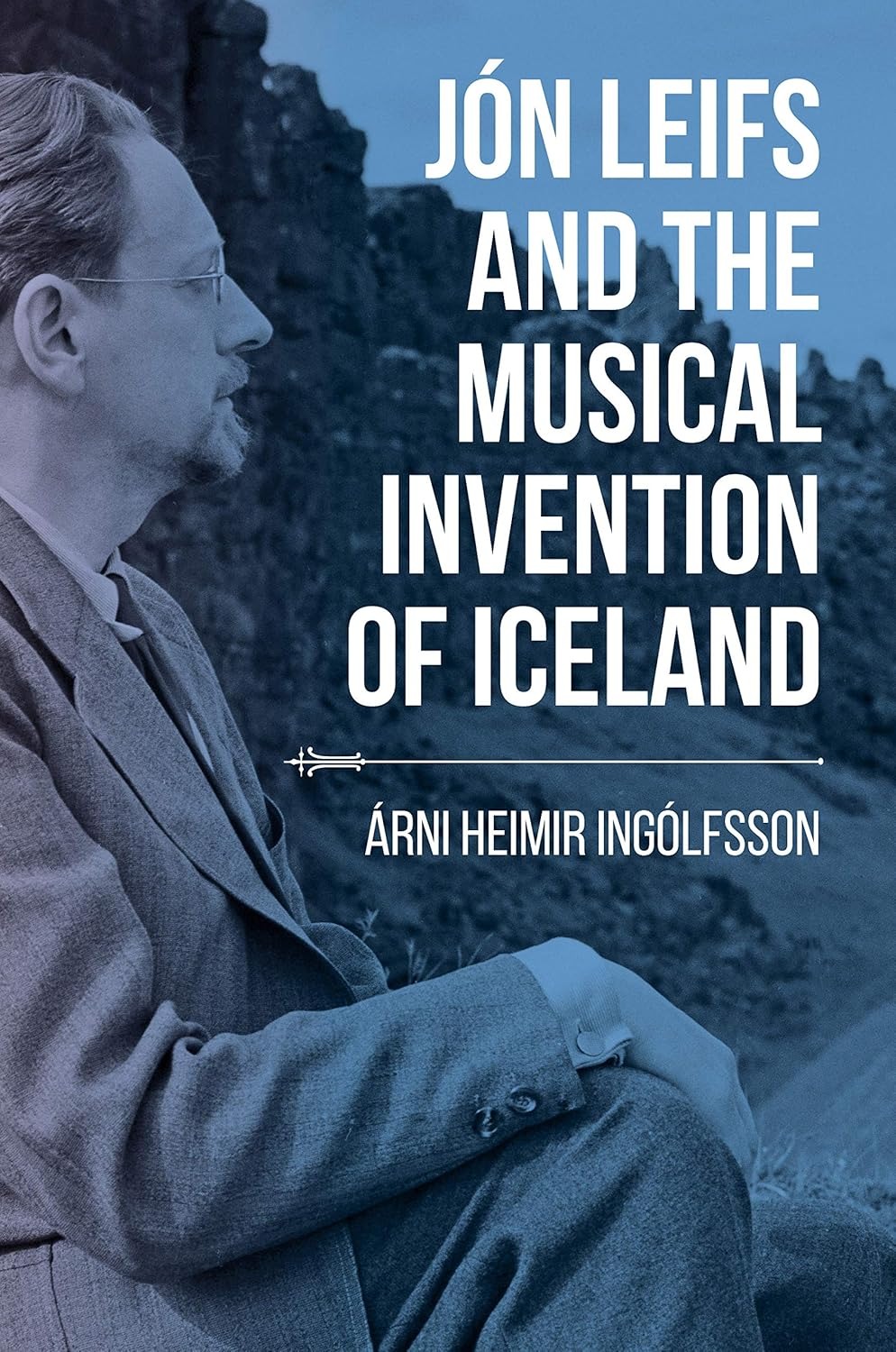
In Jón Leifs and the Musical Invention of Iceland, Árni Heimir Ingólfsson provides a striking account of the dramatic career of Iceland’s iconic composer. Leifs (1899?1968) was the first Icelander to devote himself fully to composition at a time when a local music scene was only beginning to take form. He was a fervent nationalist in his art, fashioning an idiosyncratic and uncompromising ‘Icelandic’ sound from traditions of vernacular music with the aim to legitimize Iceland as an independent, culturally empowered nation.
In addition to exploring Leifs’s career, Ingólfsson provides detailed descriptions of Leifs’s major works and their cultural contexts. Leifs’s music was inspired by the Icelandic landscape and includes auditory depictions of volcanos, geysers, and waterfalls. The raw quality of his orchestral music is frequently enhanced by an expansive percussion section, including anvils, stones, sirens, bells, ships’ chains, shotguns, and cannons.
Largely neglected in his own lifetime, Leifs’s music has been rediscovered in recent years and hailed as a singular and deeply original contribution to twentieth-century music. Jón Leifs and the Musical Invention of Iceland enriches our understanding and appreciation of Leifs and his music by exploring the political, literary and environmental contexts that influenced his work.
Árni Heimir Ingólfsson is an Icelandic musicologist. He holds a PhD in historical musicology from Harvard University, and BM-degrees in music history and piano performance from the Oberlin Conservatory of Music. His primary area of interest is the history of Icelandic music from the Middle Ages to the present, and he is the author of several books on Icelandic music, including “Jón Leifs and the Musical Invention of Iceland” (Indiana University Press, 2019), which was listed as one of that year’s best books on music by Alex Ross of The New Yorker. His most recent book is “Music at World’s End: Three Exiled Musicians from Nazi Germany and Austria and Their Contribution to Music in Iceland” (SUNY Press, 2025). Its Icelandic version was nominated for the Icelandic Book Award in November 2024.