


By Mitch Rice
LANDR and DistroKid aren’t the only distribution services out there, but they’re arguably two of the big players in the distribution market. If you’ve been searching for a new distributor, you’re guaranteed to come across both.
The two companies offer similar base services: unlimited distribution, tiered packages, promotion tools, streaming analytics and mastering services.
But if you look under the hood both companies have dramatically different approaches to how they package their services.
So, if you’ve found yourself scratching your head going through pricing pages and sign-up flows while weighing the benefits and costs involved with each subscription tier, we’re clearing everything up in this article.
Quick take: Which distribution service is right for you?
The answer to that is specific to your needs as an artist and your budget.
To point you in the right direction, here’s a table breaking down all the differences between LANDR and DistroKid.
| LANDR | DistroKid | |
| Base subscription tier & price | Essentials: $23.99/year | Musician: $24.99/year |
| Premium subscription tiers & price | Pro: $44.99/ year, Studio Essentials: $99/year | Musician Plus: $44.99/year, Ultimate $89.99/year |
| Unlimited distribution | Yes | Yes |
| Artist revenue share | 100% | 100% |
| Release stays up after cancelling the subscription | Yes, LANDR takes a 15% cut on revenues | No, unless you pay a $29 “Leave a Legacy” fee per single or $49 per album |
| Release approval time | Essentials: 7 days, Pro: 2 days, Studio Essentials: 5 days | 2-5 days for all plans |
| Support response time | Human support responses. Essentials: 5 days, Pro: 24, hours, Studio Essentials: 3 days | Automated support responses only. |
| Artists included | Distribution Basic and Studio Essentials: One, Distribution Pro: Five | All tiers: One |
| Post lyrics to streaming platforms | Yes through Musixmatch | Yes through Google |
| Claim & verify Spotify profile | Yes | Yes |
| Royalty splits | Yes | Yes |
| Mobile app version | Yes | Yes |
| Reporting & stats | Yes | Yes |
| Release customizability | Pro & Studio Essentials: Label name, release date, country exclusion, metadata | Musician Plus and Ultimate: Label name, release date, iTunes store price |
| File Sharing | Yes, through LANDR Projects | Yes |
| YouTube Content ID, Social Media IDs, Shazam Discovery | Yes, included with Distribution Pro and all Studio plan, LANDR takes 20% commission | Yes, charges extra yearly fees for each type of ID, starting at $4.95/single and $14.95/album |
| Mastering included | LANDR Mastering included with Studio Essentials subscription | No, option to add-on Mixea mastering pass for $99/year |
| Royalty-free sample market place | Access LANDR Samples with Studio Essentials subscription | None |
| Plugins and instrument software | Access LANDR Plugins collection with Studio Essentials subscription | None |
| Release importer | Yes | No |
| Cover song licensing | Yes, $15/track | Yes, $12/track/year |
While both services offer similar products, the differences lie in the added features each service offers and their different price points.
It’s why the best plan for you completely depends on your needs as an artist.
The key differences between LANDR and DistroKid
There are short and long-term benefits of using either service.
Here’s a deeper dive into some of their key differences.
Overall pricing format
DistroKid’s base subscription is slightly more than LANDR’s, but more importantly, DistroKid has a tendency to nickel-and-dime its users for important features like Content ID, Shazam, and mastering, to name a few.
Plus, DistroKid will charge you if you want to keep your music up after cancelling your subscription.
So if you’re looking for something quick and inexpensive, don’t need added features and you don’t intend to keep your music up for the long haul after ending your subscription, DistroKid might be the better option.
Using its base service, you mostly just get your music on streaming platforms right away.
At its base level, LANDR offers slightly slower distribution times, and its price point is slightly lowerthan that of DistroKid’s.
But the great part about LANDR is that the long-term cost of using the service is generally fixed.
LANDR won’t nickel-and-dime you for important services, although releasing cover songs does require a small one-time fee per song.
Yes, you’ll have to go with its Distribution Pro or Studio Essentials subscription tiers to open up access to the better half of its service, but once you subscribe, you won’t hit paywalls for things like Content ID and distribution to TikTok and Instagram.
LANDR also offers its Studio subscription package which includes distribution alongside a big collection of plugins, its AI mastering service and a respectable royalty-free sample library. This makes for a pretty compelling offering, especially for any upstart musician who needs all of these services.
Distribution subscription tiers
At their base tiers, LANDR and DistroKid’s subscription packages are fairly comparable.
The main difference is that LANDR’s comes in at $23.99/year compared to DistroKid’s slightly higher price of $24.99/year. You also won’t need to pay a fee to keep your music up if you cancel your subscription.
But their higher-tier subscription services are where the two services diverge most.
With LANDR Distribution Pro and above, you get release customization options like scheduling, label name and country exclusions. Still, more importantly, you get YouTube Content ID, TikTok and Instagram included with a 20% commission and no extra fees.
DistroKid’s comparable tier in Musician Plus only gives access to customization options, but even then, these customization capabilities are limited to what its heavily automated system allows.
Add-on features, benefits and software packages
Add-on features and their costs are easily the biggest differentiator between LANDR and DistroKid.
With the top tiers of both subscriptions pricing out at $99 and $89 for LANDR and DistroKid, respectively, the add-ons that each subscription includes vary significantly.
DistroKid’s Ultimate subscription adds 1TB of Dropbox-style file sharing and access to playlist curators.
But compared to LANDR, those add-ons look fairly limited.
With LANDR Studio Essentials, you get a similar filesharing service through its LANDR Projects feature. But you also get access to its plugins and samples library, its mastering service and a collection of music production courses.
LANDR is missing the playlist connections that DistroKid claims to offer to its subscribers, but its Studio Essentials subscription offers artists a growing set of tools for music production.
Long-term costs
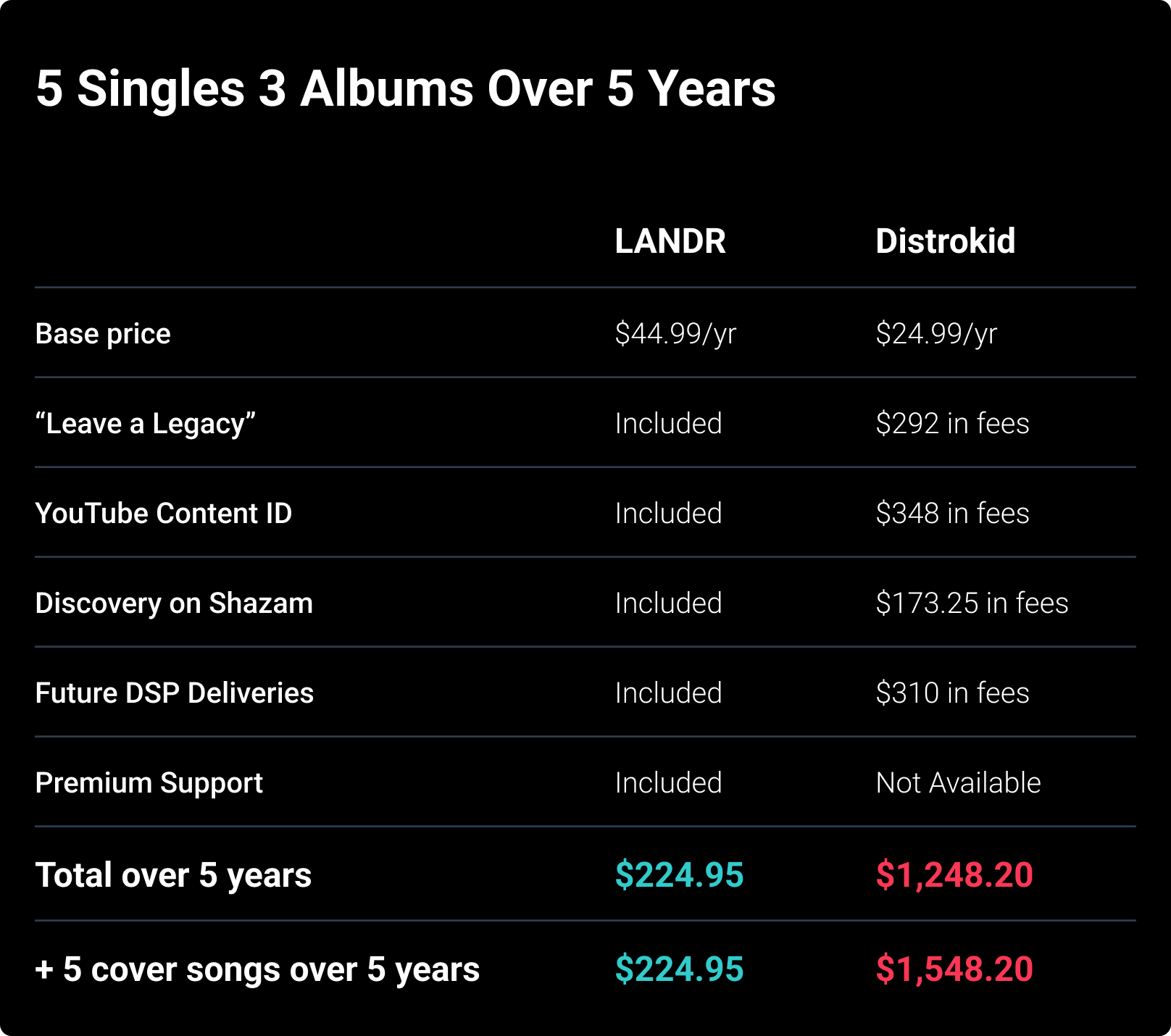
We’ve already pointed out that DistroKid tends to nickel-and-dime its subscribers with added fees for important services like Content ID.
Because these fees are charged yearly, the costs can add up quickly if you want a fully fledged distribution service that pays you for plays on YouTube, TikTok and Instagram.
Compared to LANDR, which charges for everything up front, the long-term cost of DistroKid is significantly more.
Here’s a breakdown of an artist releasing five singles and three albums over five years with DistroKid compared to LANDR.
Customer support
With music streaming platforms changing their policies and artists demanding custom help with representing themselves online, customer support is becoming an increasingly important aspect of music distribution.
The fact that LANDR offers human support and doesn’t restrict its subscribers to an automated system like DistroKid is huge, especially if you’re an artist with specific needs.
Distribution companies are getting very strict about AI, sample and loop usage.
If you incorporate AI or loops in your music production process, having a human to interface with makes things much easier when it comes to validating your music and ensuring your tracks won’t get taken down.
Choose your journey
Ultimately, the choice between LANDR and DistroKid hinges on your specific needs and budget as an artist.
Evaluate the features, pricing structures, and long-term costs carefully to determine which service best aligns with your musical journey.
Data and information are provided for informational purposes only, and are not intended for investment or other purposes.