


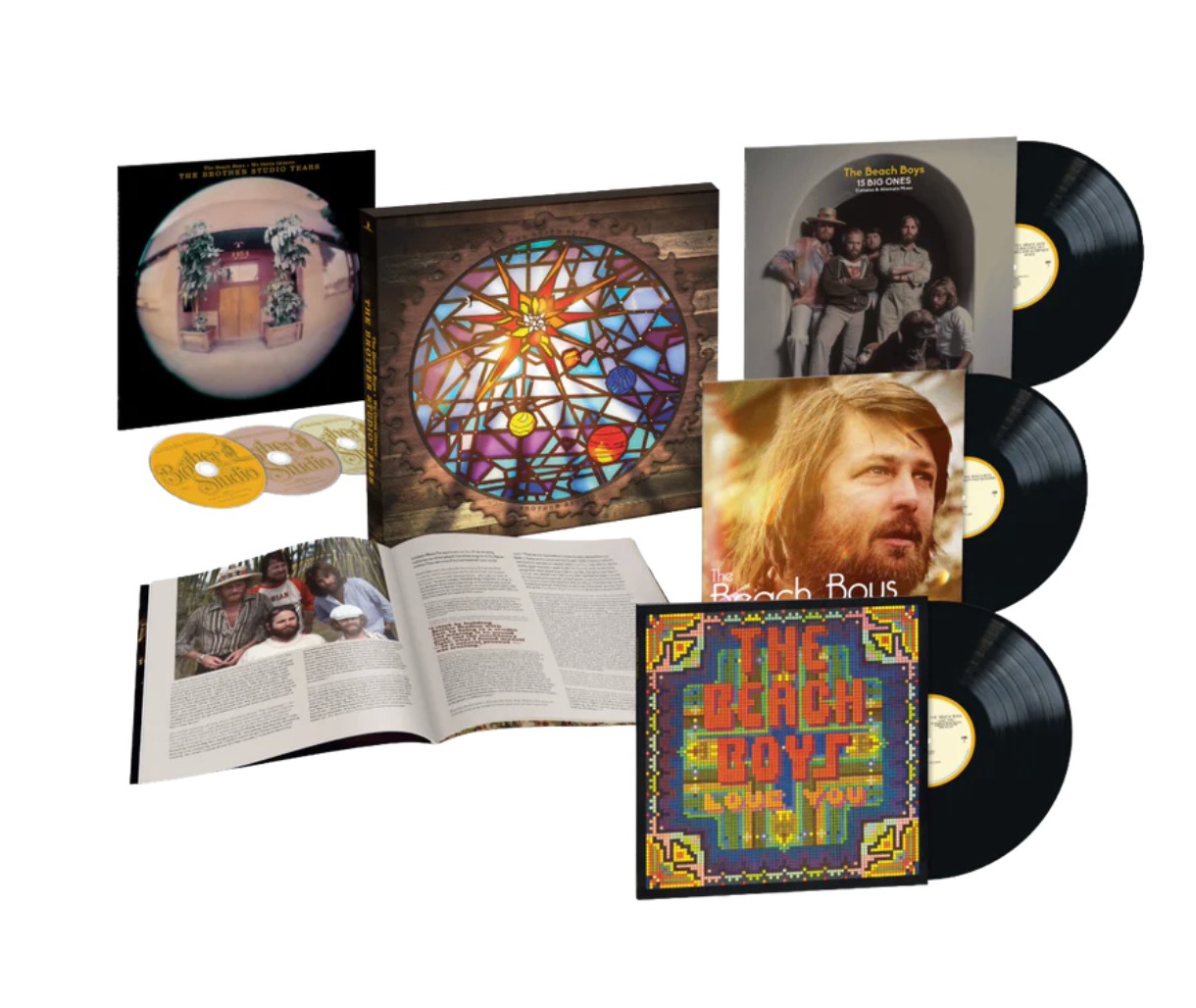
In the mid-1970s, the unexpected success of two back-to-back Top 10 greatest hits albums pushed The Beach Boys toward their early surf-and-cars past, fueling hits-laden nostalgia tours at sold-out stadiums and arenas across the U.S. Amidst this era, America’s Band, led by Brian Wilson’s return to songwriting and producing, quietly made some of the rawest, unexpected, and most emotionally exposed studio recordings of their career at their recording haven, Brother Studio in Santa Monica, Calif. Across a period defined by intense touring, shifting internal dynamics, and the highly publicized “Brian’s Back!” campaign, all five principal members — Brian Wilson, Dennis Wilson, Carl Wilson, Mike Love, and Al Jardine — contributed to a body of work far more complex than the era’s public narrative suggested.
Following the revelatory ’70s-era box sets Feel Flows — centered on the albums Sunflower and Surf’s Up — and Sail On Sailor, which explored the Carl and the Passions – “So Tough” and Holland sessions, We Gotta Groove: The Brother Studio Years turns to the next chapter of the band’s evolution. The expansive new collection, due February 13 via Capitol/UMe, gathers this pivotal period, recorded between 1976-77 at Brother Studio into one place for the first time, anchoring itself around a newly remastered edition of The Beach Boys Love You (1977) and the album sessions, the first-ever official release of the long-shelved Adult/Child sessions, and a wealth of outtakes and alternates from the transitional 15 Big Ones (1976) sessions. These recordings powered the era’s “Brian’s Back!” campaign — launched to rebalance the band’s commercial fortunes — which presented Brian as returning to full creative command even as his participation in the studio remained uneven and, at times, fragile.
The six-disc box set (3CD & 3LP), co-produced by acclaimed producer/mixing engineer James Sáez and longtime Beach Boys historian Howie Edelson, with artist direction from band archivist Alan Boyd, offers an in-depth look at Brian’s late-’70s burst of songwriting and producing while also showcasing the essential contributions of Mike, Al, Carl, and Dennis. The 73-track collection, boasting 35 unreleased and 22 newly mixed tracks, presents the majority of the album sessions across three LPs with additional outtakes, alternate mixes and demos on three CDs, which also include the same tracks as the vinyl. The albums are packaged in a handsome 12.75” x 12.75” slipcase emblazoned with a picture of the stunning stained-glass window that hung in Brother Studio and features a 40-page booklet with extensive, illuminating liner notes by co-producer Edelson that draws on new and archival interviews with all of The Beach Boys and the Brother Studio engineer team of Stephen Moffitt, Earle Mankey and John Hanlon to tell the story of this integral and influential era. The booklet is filled with a slew of rare photos, tape box images and artifacts of the era and a complete sessionography detailing when and where every recording was made.
“We Gotta Groove,” the song that gives the set its name, is available to listen to now. An upbeat outtake of the Love You sessions, written and produced by Brian Wilson, the track, which has been newly mixed by co-producer Sáez, was recorded to 2” 24-track tape between October-November 1976 at Brother Studio and features Mike Love on lead vocal, with backing vocals and electric guitar by Billy Hinsche, and Brian on vocals and all other instrumentation, including Baldwin electric harpsichord, drums, tack upright piano, Hammond B-3 organ, electric bass and tambourine.
In celebration of this historic release, the Grammy Museum in Los Angeles will host a special evening on Thursday, February 12, bringing together the compilation producers Edelson and Sáez in conversation with the original Brother Studio engineers, Stephen Moffitt, Earle Mankey and John Hanlon, who will reunite for the first time since these recordings were made 50 years ago to talk about this pivotal and underappreciated period of The Beach Boys catalog. For more information or to purchase tickets, visit: INSERT LINK
Upon returning home from Holland where they recorded their 1973 album of the same name, The Beach Boys relocated their homebase from Brian’s Bel Air mansion to a former X-rated movie theater at 1454 5th St. in Santa Monica, Calif., that they christened Brother Studio. The studio was designed and headed up by Stephen Moffitt who had previously created Geordie Hormel’s Village Recorders – a West L.A. mainstay for so many top acts over the years. In addition to The Beach Boys, Brother hosted sessions by Elton John, Eric Carmen, The Runaways, Helen Reddy, The Paley Brothers, and The Quick, among others.
The first disc of We Gotta Groove features The Beach Boys Love You which has been newly remastered from the original 1977 mix, alongside 10 period outtakes, providing a fuller picture of the fruitful album sessions that lasted from October 1976 to January 1977. Recorded largely at Brother Studio with Brian at the console and playing most of the instruments, Love You strips the group to blocky analog synthesizers, pounding piano, and close-mic’d vocals. Its distinctive sound world — driven by ARP and Oberheim synths rather than traditional Beach Boys instrumentation — has since become one of the most studied and influential aspects of the album, turning songs about parenthood (“I Wanna Pick You Up”), romance (“Roller Skating Child”), the cosmos (“Solar System”), and talk show hosts (“Johnny Carson”) into something both childlike and unexpectedly modern. Mike and Al’s unmistakable vocal signatures — from Mike’s bass and baritone leads to Al’s crystalline high parts — play a crucial role in grounding Brian’s synthesizer-driven arrangements, while Carl’s controlled, elegant leads and Dennis’s rough-edged emotional intensity add depth and contrast throughout.
While divisive among critics and fans at release, Brian frequently cited Love You as his favorite Beach Boys record, calling it “the best album we ever made.” Over the ensuing nearly five decades since its release, it has become a cult classic and a touchstone for musicians far outside classic rock circles. R.E.M. guitarist Peter Buck has also singled it out as his favorite Beach Boys album, and generations of indie and alternative artists have gravitated toward its cracked vocals, minimal synth-pop textures, and outsider sincerity — hearing in it a proto-new-wave sensibility as much as a late-period Beach Boys LP. As Edelson writes in the liners, “Upon the initial release of The Beach Boys Love You, non-believers picked up on the D.I.Y. punk ethos from the Lower East Side all the way to the hipper enclaves across Europe. Today, Brian Wilson’s left field use of keyboards in the 1970s is considered to be an early influence for 1980’s New Wave, Synth Pop, and New Romantic record makers.”
If Love You is the era’s officially released peculiar masterpiece, Adult/Child is its whispered legend. Recorded in 1977 with arranger Dick Reynolds, whose sophisticated Four Freshmen–style charts Brian had idolized since youth, the shelved album leans into big-band swing, lounge textures, fitness jingles, and some of Brian’s most disarmingly intimate originals, including “Still I Dream of It” and “It’s Over Now.” Brian sidestepped the electronic buzz found on Love You and instead tapped into a simpler era. “I wrote a song for Frank Sinatra once called ‘Still I Dream Of It.’ He didn’t say yes to the song. It was a beautiful song about loneliness and hope. The song ended up on an album named Adult/Child, which was filled with those kinds of songs. It was a Beach Boys album that never came out,” Brian remarked in an interview.
Prepared for release but ultimately vetoed and left in the vault, Adult/Child circulated for decades only through collectors’ tapes and bootlegs, attaining near-mythical status among fans. Its mixture of big-band pastiche, autobiographical confession, and unabashed eccentricity left both the label and parts of the band uncertain how to present it, resulting in its quiet shelving. We Gotta Groove finally assembles the material in a coherent album sequence for the first time, supplemented by new 2025 backing-track mixes and session highlights. The group’s distinctive vocal blend, including prominent contributions from Mike, Al, Carl and Dennis adds warmth and cohesion to Brian’s idiosyncratic material, revealing Adult/Child as more of a Beach Boys project than its mythology has often implied.
We Gotta Groove also offers a new perspective on 15 Big Ones through its wealth of studio material rather than its familiar running order. Combining oldies covers with new Brian-penned compositions, the 1976 album, which marked the group’s first long player to feature a “Produced by Brian Wilson” credit since 1966’s Pet Sounds, divided critics even as it returned The Beach Boys to the U.S. Top 10 and produced a major hit with “Rock and Roll Music.” 15 Big Ones was mostly recorded between March through May 1976 at Brother Studio and released quickly after in July of that year. The new set offers the opportunity to hear a variety of covers that were in contention for the album but ultimately didn’t make the cut, including “Mony Mony,” “Running Bear,” “Shake, Rattle & Roll, “On Broadway,” and “Sea Cruise.” Hearing these outtakes reveals the muscular band interplay and dense vocal arrangements beneath the mid-’70s production gloss — including Mike’s dominant lead on the hit single, Al’s powerful vocal contributions, and Carl’s pivotal production leadership — reconnecting the album to the group’s deep studio-craft traditions.
This period also coincided with The Beach Boys’ transformation into one of America’s most successful touring acts, playing massive summer-circuit shows even as their studio recordings grew stranger, more insular, and more Brian-centric behind the scenes. Across its six discs, We Gotta Groove places these contradictions into context, highlighting parallel creative threads in the Beach Boys universe: Dennis’s haunting “Holy Man,” Carl’s developing compositions that would later evolve on L.A. (Light Album), Mike and Al’s essential vocal and conceptual contributions, and a suite of Brian’s studio-cassette demos that reveal Love You and Adult/Child in their most vulnerable form — just voice and keyboard, unvarnished and immediate.
Pulling together newly mixed tracks like “We Gotta Groove,” “Hey There Mama,” and “Short Skirts,” along with finally finished versions of long-circulating titles, We Gotta Groove: The Brother Studio Years reframes 1976–77 as one of the most revealing and creatively restless chapters of the band’s evolution — a moment when all five Beach Boys were navigating change, rediscovering their creative identities, and shaping a deeply human turning point in the continuing story of The Beach Boys.
WE GOTTA GROOVE: THE BROTHER STUDIO YEARS
Disc 1 — The Beach Boys Love You Album (1977 Mix)
LP1 Side 1
1. Let Us Go On This Way
2. Roller Skating Child
3. Mona
4. Johnny Carson
5. Good Time
6. Honkin’ Down The Highway
7. Ding Dang
LP1 Side 2
8. Solar System
9. The Night Was So Young
10. I’ll Bet He’s Nice
11. Let’s Put Our Hearts Together
12. I Wanna Pick You Up
13. Airplane
14. Love Is A Woman
Love You Outtakes (CD Only)
15. Ruby Baby *
16. Marilyn Rovell *
17. Sherry She Needs Me *
18. Lazy Lizzie *
19. We Gotta Groove (2025 Mix) *
20. Hey There Mama (2025 Mix) *
21. Clangin’ (2025 Mix) *
22. Love Is A Woman (Al Jardine Vocal) *
23. Johnny Carson (Alternate Mix With Intro) *
24. You’ve Lost That Lovin’ Feeling *
Disc 2 — Adult/Child Sessions
LP2 Side 1
1. Life Is For The Living *
2. Deep Purple *
3. It’s Over Now
4. Still I Dream Of It
5. Everybody Wants To Live *
6. Lines *
7. It’s Trying To Say *
LP2 Side 2
8. Shortenin’ Bread *
9. New England Waltz *
10. Life Is For The Living (Backing Track) *
11. Deep Purple (2025 Backing Track Mix) **
12. It’s Over Now (2025 Backing Track Mix) **
13. Still I Dream Of It (2025 Backing Track Mix) **
1974 – 1977 Select Outtakes (CD Only)
14. Holy Man (2025 Mix Carl Wilson Vocal) **
15. Carl’s Song 1 (It Could Be Anything) (2025 Mix) **
16. Carl’s Song 2 (Angel Come Home) (2025 Mix) **
17. String Bass Song (Rainbows) (2025 Mix) **
18. 10,000 Years Ago *
19. Gimme Some Lovin’ (2025 Mix) *
20. Honeycomb (Marilyn Wilson-Rutherford Vocal) *
21. In The Back Of My Mind (1975 Alternate Take 2025 Mix) **
Disc 3 — 15 Big Ones Outtakes and Alternate Mixes
LP3 Side 1
1. Just Once In My Life (2025 Mix) **
2. Mony, Mony (2025 Mix) *
3. Running Bear (2025 Mix) *
4. Shake, Rattle And Roll *
5. On Broadway (2025 Mix) **
6. Sea Cruise (2025 Mix) **
LP3 Side 2
7. Chapel Of Love (2025 Mix) **
8. Short Skirts (2025 Mix) **
9. TM Song (2025 Backing Track Mix) **
10. Rock And Roll Music (2025 Backing Track Mix) **
11. Had To Phone Ya (2025 Deconstructed Mix) **
12. Just Once In My Life (2025 Backing Track Mix) **
Love You Alternate Mixes (CD Only)
13. Let Us Go On This Way (Alternate Mix) *
14. Mona (2025 Deconstructed Mix) **
15. Honkin’ Down The Highway (Billy Hinsche Vocal) *
16. Ding Dang (Session Highlights and Unedited 2025 Mix) **
17. Solar System (2025 Backing Track Mix) **
18. The Night Was So Young (2025 Vocals Only Mix) **
19. Let’s Put Our Hearts Together (2025 Coda Mix) **
Love You Brian Cassette Demos (CD Only)
20. That Special Feeling (Demo) *
21. It’s Over Now (Demo) *
22. They’re Marching Along (Demo) *
23. Love Is A Woman (Demo) *
24. Mona (Demo) *
25. Airplane (Demo) *
26. Let’s Put Our Hearts Together (Demo) *
27. I’ll Bet He’s Nice (Demo) *
28. Still I Dream Of It (Demo) *
* previously unreleased
** newly mixed in 2025