


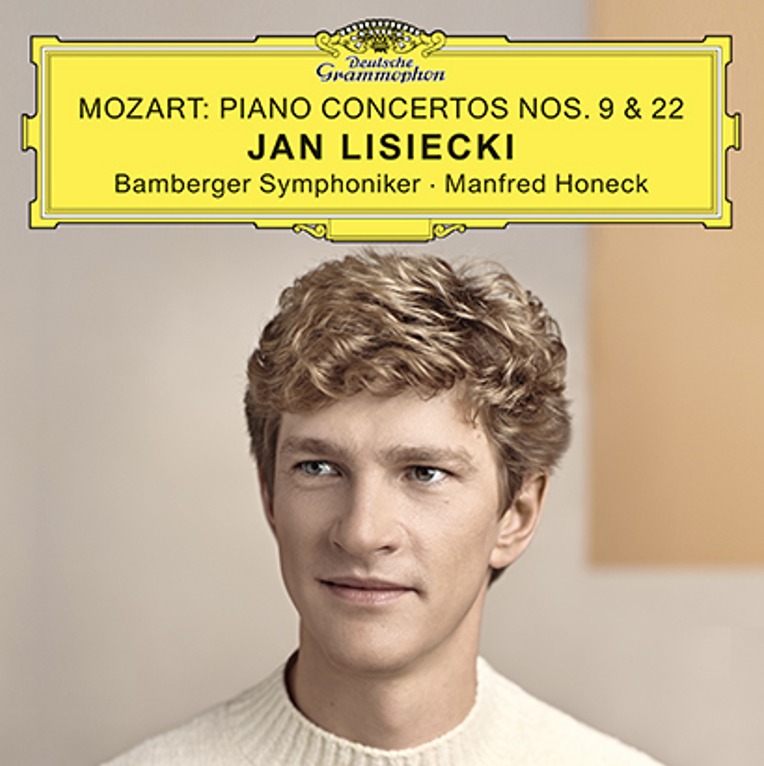
Celebrated pianist Jan Lisiecki returns to the concertos of Wolfgang Amadeus Mozart, a decade after recording Nos. 20 and 21 for his DG debut album (“beautiful Mozart playing, direct, unmannered and fresh” – The New York Times). Set for release as the music world marks the 270th anniversary of Mozart’s birth, Lisiecki’s latest recording presents a contrasting but complementary pair of works in E flat major, Concertos Nos. 9 and 22. Joining the pianist are conductor Manfred Honeck and the players of the Bamberger Symphoniker. “Recording these two works was a dream of mine,” says Lisiecki, “and I’m very glad to have been able to do so with a dream team, too.”
The album, whose booklet includes notes by the pianist himself, will be issued digitally and on CD on 17 April 2026. A limited-edition version of the CD, complete with signed art card, will be available exclusively from the DG Shop. The central Andante from Concerto No. 22 will be released for streaming on 23 January to coincide with Mozart’s birthday four days later.
Ever since he first worked with Maestro Honeck in Chicago in 2019, Jan Lisiecki had been keen to record with him. “I immediately felt that he had such an affinity and respect for Mozart’s music and was able to communicate it with the orchestra – the phrasing, the elegance, the beauty,” he recalls. “So to work with him on a recording of Mozart is an absolute joy and privilege.”
Lisiecki’s praise extends to the musicians of the Bamberger Symphoniker. “They’re dedicated, passionate and also respectful of tradition,” he says. “It’s inspiring to find musicians who have vigour and freshness, but also follow the indications of the composer and the urgings of the conductor – and of the soloist too!”
That collaborative spirit shines through these deft and insightful readings of two works Lisiecki calls “singular masterpieces” – even among Mozart’s many superlative works in the genre. “I think,” he adds, “Mozart had an innate connection with E flat major and was able to write such beautiful works in this key. Sometimes composers feel at home in certain places and certain keys, and one senses that here.”
Written in 1777, Piano Concerto No. 9 is notable for the way in which it instantly sets up a closely entwined dialogue between soloist and orchestra that continues throughout the work. Another fascinating aspect of the score is that the composer’s original cadenzas have survived, allowing Lisiecki and his team “to fully embrace and respect Mozart’s intentions”. He particularly prizes that of the second movement: “it’s absolutely spectacular, and to have this grand, quite dense cadenza in the second movement of a piece is revolutionary”.
Mozart composed Concerto No. 22 in Vienna in 1785, at around the same time as he was writing Le nozze di Figaro. Here too, there is close interplay between the solo and orchestral writing, while a striking role is given to the clarinets, making their first appearance in one of Mozart’s piano concertos. As Lisiecki observes, the composer “ensured that these instruments were utilized to their full potential, employing technically demanding and musically intricate passages throughout the work”.
In a recent review, Bachtrack writes about Jan Lisiecki’s performance of No. 22 with the Seattle Symphony and Peter Oundjian: “In the first movement, [he] played with the care, delicacy and religiosity one hopes for in Mozart: exacting, yet emotional. His technical fluency made his performance seem effortless, but not easy. The melancholy Andante came off as boldly expressive but not overdramatic. The final Allegro sparkled with wit and incisiveness. Lisiecki’s cadenzas throughout went beyond technical expertise to an almost heavenly level.”