


You might have seen a few concerts in your life. Maybe you’ve seen a LOT. No matter how much you love the artist onstage, sometimes concerts are just concerts. Then there are the ones that changed everything. These are the performances that stopped time, shifted culture, and reminded the world why live music exists in the first place. No rankings. Just thirteen moments that mattered.
Jimi Hendrix Sets His Guitar on Fire, Monterey Pop Festival, 1967
Hendrix was virtually unknown to American audiences when he took the Monterey stage. He left as a legend. The performance was volcanic from the first note, but it was the moment he doused his Stratocaster in lighter fluid and set it ablaze that burned itself into history. It was theater, ritual, and rock and roll all at once. Nobody who was there ever forgot it.
The Beatles, Shea Stadium, 1965
Sixty thousand people. Screaming so loud the band couldn’t hear themselves play. The Beatles at Shea Stadium wasn’t just a concert, it was the moment live music became a mass cultural event. It defined what a stadium show could be and set the template for every arena tour that followed. The footage still crackles with an energy that feels almost impossible.
Johnny Cash, Folsom Prison, 1968
Cash walked into a maximum-security prison and delivered one of the most focused, fearless performances ever recorded. He wasn’t performing for critics or radio programmers. He was performing for men who had nothing to lose. The room understood him completely. The resulting live album became one of the best-selling records of his career and cemented his status as something far larger than a country star.
David Bowie Kills Ziggy Stardust, Hammersmith Odeon, 1973
Bowie announced from the stage that this would be the last Ziggy Stardust show ever. The crowd didn’t know it was coming. Neither did most of his band. It was a calculated act of artistic self-destruction, a performer killing his own creation at the peak of its power. The move was audacious, deliberate, and completely Bowie. It set the standard for how an artist controls their own narrative.
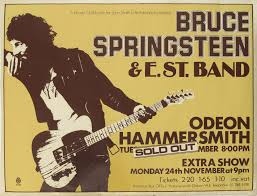
Bruce Springsteen and the E Street Band, Hammersmith Odeon, 1975
Columbia Records flew journalists to London to see Springsteen before ‘Born to Run’ had even broken properly. What they witnessed was a four-hour performance of staggering intensity. Critics ran out of adjectives. The show didn’t just launch a career, it announced that something new and serious had arrived in rock and roll. Springsteen has been living up to that night ever since.
Bob Marley, Smile Jamaica Concert, 1976
Two days after surviving an assassination attempt at his Kingston home, Marley walked onto the stage at the National Heroes Park and played for ninety minutes. He showed the bullet wound. He played anyway. It remains one of the most defiant acts in the history of popular music. The message was clear without a single word of explanation.
Queen, Live Aid, Wembley Stadium, 1985
Every other act at Live Aid was competing with the scale of the event. Queen made the event compete with them. Freddie Mercury’s twenty-one minutes on the Wembley stage that afternoon is widely considered the greatest live rock performance ever delivered. The band was in peak form and Mercury was operating on a frequency most performers never reach. It was the moment Queen became immortal.
Public Enemy, Fear of a Black Planet Tour, 1990
Public Enemy on stage in 1990 was not a concert. It was a confrontation. The production, the energy, the political precision of every moment combined into something that felt genuinely dangerous in the best possible sense. Chuck D commanded that stage like few performers before or since. Hip-hop had arrived as a live force, and Public Enemy proved it beyond any argument.
Nirvana, MTV Unplugged, New York, 1993
Nirvana walked into the MTV Unplugged taping with candles, lilies, and a setlist loaded with covers. It felt like a funeral and a masterwork simultaneously. Kurt Cobain stripped the songs down to their emotional core and delivered a performance of raw, aching honesty. The resulting album outlasted the controversy of the era and stands today as one of the most important live recordings in rock history.
Jay-Z and Linkin Park, MTV Ultimate Mash-Ups Concert, 2004
When ‘Collision Course’ was performed live, it confirmed what the record had suggested: these two worlds fit together with an almost eerie precision. The concert pulled rock fans and hip-hop fans into the same room and gave both everything they came for. It was a genuinely rare moment of genre collision that held up under live pressure.
Beyoncé, Coachella, 2018
The first Black woman to headline Coachella did not show up to simply perform. She showed up to redefine what a headlining set could be. An HBCU marching band, a full theatrical production, a setlist that doubled as a cultural statement. “Beychella” raised the bar for festival performances so dramatically that it has yet to be cleared. It was a declaration, not a concert.
Kendrick Lamar, Super Bowl LIX Halftime Show, 2025
Kendrick Lamar turned the most-watched live television event in American history into a pointed, unflinching cultural reckoning. The performance was precise, layered, and unmistakably intentional. It referenced his ongoing public conflict with Drake without ever losing its compositional discipline. Halftime shows are rarely art. This one was.
Taylor Swift, The Eras Tour, 2023-2024
Over three hours. Forty-four songs. Ten distinct musical eras performed with a logistical and artistic precision that had no real precedent. The Eras Tour became a genuine economic phenomenon, a cultural event, and a masterclass in artist-to-audience connection. It proved that in an age of streaming and algorithms, the live experience still holds more power than anything a platform can deliver.