


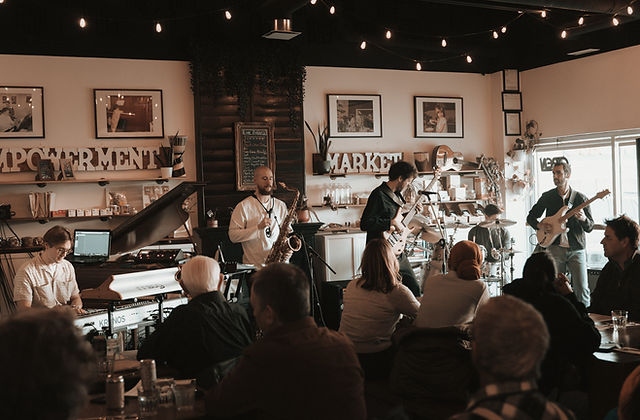
There is a new music venue opening in Ottawa shortly, and its owner is calling it “the neighbourhood’s living room.” That phrase tells you everything you need to know about why this idea is so timely, so right, and so overdue. It is not a concert hall. It is not a bar with a stage crammed in the corner. It is a place built around the idea that music and community belong together in the same room, at human scale, without a ticket price that requires a mortgage pre-approval.
This is not a new concept. But it is having a very significant moment. Here are five reasons why boutique music cafes are one of the most important trends in music culture right now.
1. They trace their roots to one of the most beautiful musical traditions in history.
The direct ancestor of the boutique music cafe is the Japanese kissaten, or kissa, which emerged in Tokyo in the 1920s when jazz arrived in Japan and needed a home. These were cafe-bars with high-end audio systems that played classic American jazz, places where you went to unwind after work, had a coffee or beer, and just sat and listened to the music. They were temples to careful listening at a time when music was something you gave your full attention to, not a backdrop. The best of them had extraordinary sound systems, curated vinyl collections, and an atmosphere of hushed, reverent appreciation. That tradition never really disappeared. It just went underground for a few decades while the rest of us were busy staring at our phones. Now it is back, and it is spreading from Japan to North America with remarkable speed. Washington D.C. alone has seen a recent crop of music-centric spots draw inspiration from Japanese kissa, while others use their eclectic LP collections and regular DJs to set the mood. Ottawa is joining a very good lineage.
2. They are the answer to something streaming cannot give you.
We have never had more access to music than we do right now. Global paid streaming subscriptions reached 752 million in 2024, a 9.5% increase from the previous year. You can listen to virtually anything ever recorded, anywhere, at any time, on a device that fits in your pocket. And yet something is obviously missing. People are hungry for the physical, the communal, and the intentional in a way that no algorithm can satisfy. A new generation is throwing house parties, rooftop DJ sets and intimate shows in unexpected spots like art galleries and cafes, driven by a post-pandemic thirst for third spaces where guests can chill out, nerd out over the music, and reconnect with one another. The boutique music cafe meets that need precisely because it offers what Spotify cannot: a room full of other human beings, a great sound system, and the understanding that you came here to listen. That is not nothing. That is everything.
3. They are the last great defenders of the listening experience.
Here is something that gets lost in conversations about music consumption: most people stopped actually listening to music somewhere around the early 2000s. Music became ambient. It became background. It became what you put on while doing something else. The boutique music cafe pushes back against that with a simple and radical proposition. Come in, sit down, and listen. No Wi-Fi. No laptops. Just the music. The vinyl component matters here too. When music is printed on wax and playing off a needle, the quality has a warmth that downloaded tracks do not have, and the right sound system makes all the difference. These spaces are designed to make you hear things you have been missing. They are, in a very real sense, music education disguised as a good time.
4. They are extraordinary platforms for local artists.
One of the quiet crises in the music industry is that there is a shrinking middle tier of venues where emerging artists can actually develop a live following. Large festivals are great if you can get on one. Your bedroom is great for recording. But the intimate room, the place where an artist plays 40 people and leaves having made 40 actual fans, that has been disappearing for years. Boutique music cafes fill that gap beautifully. Venues are transforming into vibrant cultural hubs, with a growing interest in niche genres and local artists, embracing diverse events that foster community by supporting local talent. For a city like Ottawa, which has a music scene that consistently punches above its weight, having a dedicated space where local artists can perform in a room designed to make them sound extraordinary is genuinely significant. The “neighbourhood’s living room” framing is smart because living rooms are where you actually talk to people. Local artists thrive on that.
5. They serve a deep human need that the music industry forgot it was supposed to serve.
Sociologist Ray Oldenburg coined the term “third place” in 1989 to describe the spaces that exist between home and work, the places where community actually forms. Pubs, barbershops, libraries, coffee houses. The great ones always had music in them. One owner of a music-cafe hybrid in Venice, California described his space this way: “The whole design is based on a living room. We always envisioned it as a third space. We could have just opened our home and it would have the same effect, but doing it here is even better.” That sentiment, almost word for word, is what the Ottawa owner is describing when they call their space the neighbourhood’s living room. It is not a coincidence. It is a recognition that music has always been social, always been communal, and always been at its most powerful when it brings strangers into the same room and makes them feel like they already know each other.
The music business spent twenty years chasing scale. Bigger festivals, bigger streaming numbers, bigger everything. The boutique music cafe is the correction. It is small, intentional, and built around the belief that music deserves your full attention and that a neighbourhood deserves a place to gather around it.
Ottawa is lucky to be getting one. Go support it.