


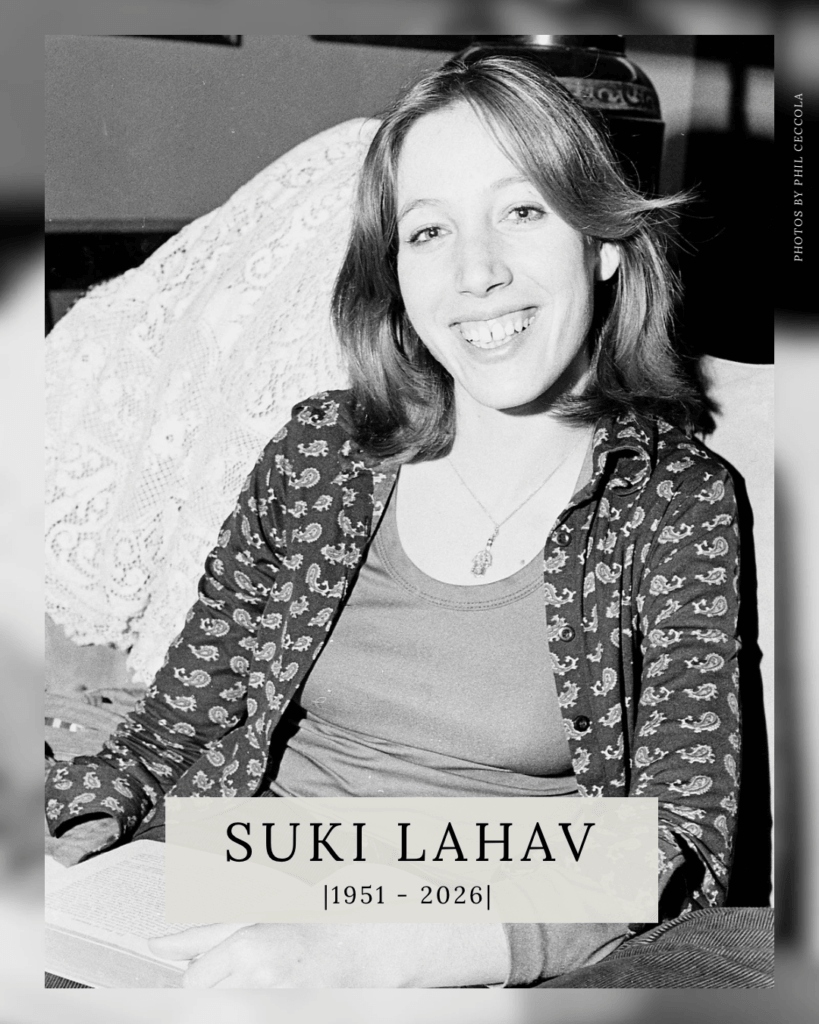
The violin note that opens “Jungleland” has haunted listeners for more than fifty years. The person who played it, Tzruya “Suki” Lahav, died on April 1st following a short battle with cancer. She was 74. Her son, Yonatan Lahav, confirmed the news, writing that his mother was “a special woman, smart, pure in heart and loving life.” The funeral was private.
Lahav came into Bruce Springsteen’s world through her husband, recording engineer Louis Lahav, who recorded Springsteen’s debut album ‘Greetings From Asbury Park’ in 1972. From there, her contribution to the music grew quietly but permanently. Her violin opens “Jungleland,” the closing track from ‘Born to Run’. Her vocals appear, uncredited, on “4th of July, Asbury Park (Sandy)” and “Incident on 57th Street” from ‘The Wild, the Innocent and the E Street Shuffle’, where she stepped in as a one-woman choir after a children’s church choir failed to appear. She also contributed to a fan-favorite cover of Bob Dylan’s “I Want You.”
She toured with Springsteen and the E Street Band from October 1974 through March 1975, a run of 38 shows during which the Boss’s star was rising fast. She was not entirely prepared for the scale of it. Recalling her first glimpse of the roaring crowd, she later said she hid behind Clarence Clemons, who, she noted warmly, was always big enough to hide behind. It is the kind of detail that says everything about who she was: gifted, grounded, and human in the middle of something enormous.
In 1975, following a personal tragedy, Lahav returned to Israel. She never looked back in bitterness. Her time with Springsteen remained a part of her, she said in a 2007 Jerusalem Post interview, something that would never fade, even if it was not the main thing. What came after was a full and decorated life: songwriter, poet, novelist (two award-winning books), and screenwriter. In Israel she was a major cultural figure, a recipient of the ACUM Lifetime Achievement Award and the Erik Einstein Prize.
She remembered the early Springsteen years with clarity and affection. “The music was incredible,” she said. “The lyrics were so rich; some of the most beautiful lyrics didn’t ever make it onto record.” She also recalled that everyone around Springsteen at the time knew he was going to be something extraordinary, even as they were all, in her words, completely poor and completely into it.
That is the thing about Suki Lahav. Her contribution to some of the most beloved rock recordings ever made was brief, often uncredited, and entirely irreplaceable. Every time “Jungleland” begins, she is there.