


Let’s talk about productivity. In the summer of 1977, Jeff Lynne rented a chalet in the Swiss Alps, locked himself away, and wrote one of the best-selling double albums in rock history. Not over months of careful drafting and revision. Not through a long collaborative process with his bandmates. He did it alone, in three and a half weeks, reportedly staring at fog and mountains and whatever else the Alps throw at you in July. Then he took the songs to Munich, spent two months recording them, and Out of the Blue was done.
The album hit number 4 on both sides of the Atlantic, spawned five hit singles across different countries, and became the first double album in British chart history to generate four separate top-twenty hits. It has sold around ten million copies worldwide. Axl Rose, by his own admission a devoted ELO fanatic, called it simply “an awesome record.”
What’s remarkable is how much is packed into those seventy minutes — and how many of the details behind it have been quietly sitting there, waiting to be noticed. Here are five of them.
The Entire Album Was Written in Three and a Half Weeks — and It Almost Didn’t Happen at All
Lynne arrived in Switzerland to write the follow-up to A New World Record and, by his own account, sat in the chalet for the first two weeks producing nothing. The weather was relentless — dark, misty, no view of the Alps whatsoever. Then one morning the clouds cleared, the mountains appeared, and he wrote “Mr. Blue Sky” and thirteen other songs in the two weeks that followed. The whole album, start to finish, emerged from that single break in the weather.
“Mr. Blue Sky” Contains a Secret Instruction — and a Legal Dispute
At the very end of the song, a vocoder sings the phrase “please turn me over” — a literal instruction to the listener to flip the vinyl record to Side Four. It’s a charming piece of album design, but the song also carries a less charming backstory: bassist Kelly Groucutt filed a lawsuit against Lynne in 1983, claiming he had written the song’s middle section without receiving credit. The suit didn’t change the official songwriting credit, but it did add a layer of complexity to what most people assume is just the world’s most cheerful pop song.
“Sweet Talkin’ Woman” Almost Had a Completely Different Name
The track was originally titled “Dead End Street” during recording, and some of that original identity survived into the final version — the opening of the third verse contains the line “I’ve been livin’ on a dead end street,” a leftover from the song’s earlier incarnation. What became one of ELO’s most disco-adjacent moments started life as something considerably darker in tone, which makes that glittering string arrangement feel even more like a reinvention.
The Spaceship on the Cover Is Hiding the Album’s Catalogue Number
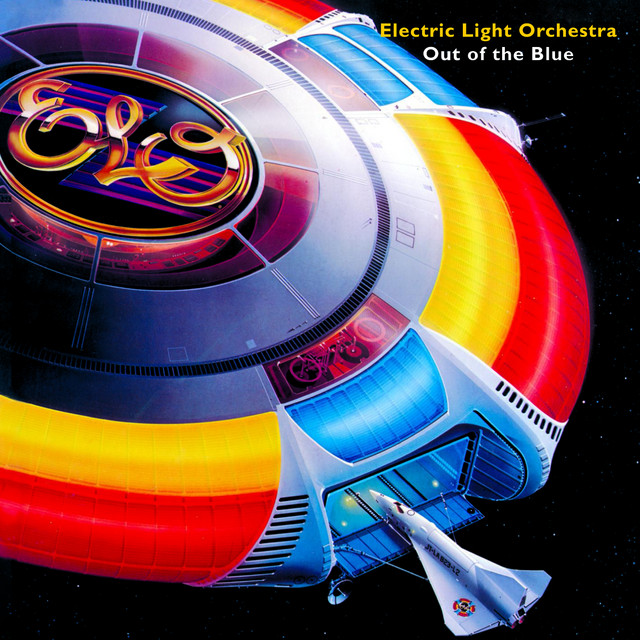
The elaborate spacecraft artwork — designed by Kosh and illustrated by Shusei Nagaoka, modelled on the space station from 2001: A Space Odyssey — contains a small shuttle docking at the station. The number printed on that shuttle, JTLA 823 L2, is not a fictional spacecraft identifier. It’s the album’s original catalogue number. The cover also came with a cardboard cutout of the space station as an insert, and the spaceship concept carried directly onto the live tour, where ELO performed inside a massive glowing flying saucer on stage.
“The Whale” Was ELO’s Environmental Statement — and Part of the Proceeds Went to Greenpeace
The instrumental track on Side Four was written after Lynne watched a television episode about whale hunting. It opens with aquatic sound effects and uses the stereo field to evoke the scale of the ocean, and it wasn’t purely artistic — a portion of the proceeds from Out of the Blue was donated to Greenpeace. For an album otherwise preoccupied with sunshine, disco strings, and Swiss mountain vistas, it’s a quietly serious moment tucked near the end of a very long record.