


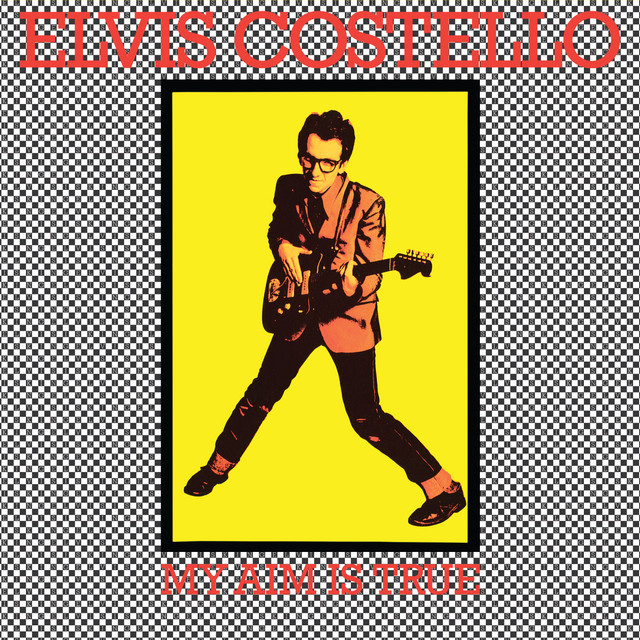
It’s late 1976. A data entry clerk at Elizabeth Arden cosmetics in London is calling in sick, taking the train to a country house in Hampshire to rehearse songs with an American country rock band, then heading back the next day to record them at a tiny eight-track studio in Islington. He’s doing this on a budget of roughly £2,000. He hasn’t told his employer what he’s actually up to. He won’t quit that day job until July the following year.
The clerk is Declan MacManus. The album is My Aim Is True. And the band he’s rehearsing with — Clover, a California country rock act who happened to be living in Britain at the time — won’t even be credited on the finished record, because of contractual complications. Their names won’t appear on the sleeve. Neither will the name of the album’s designer. It is, in almost every respect, a record that came into the world sideways.
What followed was one of the most celebrated debut albums in the history of rock. Pitchfork gave it 9.8 out of 10. Rolling Stone ranked it among the 500 greatest albums of all time. Paste called it the best new wave album ever made. Here are five things about it that might surprise you.
The Backing Band on the Album Is Completely Uncredited — and Includes a Future Rock Star
The musicians who played on My Aim Is True were Clover, an American country rock act who had relocated to Britain and signed to Phonogram. Due to contractual difficulties, none of them are named on the original sleeve — the album simply refers to them vaguely in early marketing as “The Shamrocks.” Among those absent from the credits: Sean Hopper on keyboards and John McFee on guitar — and also present at the time, though he sat these sessions out entirely, was Clover’s harmonica player and occasional vocalist, a man who would later find enormous fame with his own band. His name was Huey Lewis. He later explained simply: “I took a vacation.”
Costello Changed His Name to Elvis — and Elvis Presley Died During the Album’s First Tour
The name change from Declan to Elvis was a marketing suggestion from Stiff Records co-founder Jake Riviera, meant to sharpen Costello’s image for the punk moment. Costello accepted it, acknowledging it would make people “pause just that little bit longer.” When the album came out in July 1977, Costello was already on the road promoting it — and on August 16, Elvis Presley died. British newspapers that had been planning features on Costello pulled them. Stiff ran a new slogan: “The King Is Dead, Long Live the King.” Four days after Presley’s death, My Aim Is True reached number 14 on the UK Albums Chart.
“Less Than Zero” Was Written About a British Fascist — and American Audiences Had No Idea
The opening single was inspired by Costello watching former British Union of Fascists leader Oswald Mosley on television, apparently unrepentant about his actions in the 1930s. The song never mentions Mosley by name, referring only to “Mr. Oswald” — which American audiences assumed was a reference to Lee Harvey Oswald, JFK’s assassin. Costello eventually rewrote the lyrics entirely for US performances, creating what became known as the “Dallas version,” with the song reframed around the assassination. Both versions exist on reissues.
Costello Sabotaged His Own Saturday Night Live Performance — and Got Banned for Over a Decade
Columbia Records pressured Costello to play “Less Than Zero” on his SNL appearance in December 1977, believing it would connect with American audiences. Costello thought the song was too obscure for the moment and had a better idea. He started playing the song, stopped after a few bars, told the audience there was “no reason to do this song here,” and launched into “Radio Radio” — a song he had specifically promised not to play. Inspired by Jimi Hendrix scrapping “Hey Joe” live on the BBC in 1969, it was a deliberate act of defiance. NBC banned him from the show until 1989.
“Alison” Was Written About a Checkout Girl — and Costello Donated the Cover Version Royalties to the ANC
Costello has said the song was inspired by a woman he saw working a supermarket cash register, her expression suggesting that “all the hopes and dreams of her youth were draining away.” He has always been deliberately vague about the deeper meaning, writing only that it concerns “disappointing somebody.” When Linda Ronstadt covered it in 1979 and turned it into a moderate hit, Costello privately admitted he didn’t mind spending the money it earned him. He then donated his royalties from Ronstadt’s version to the African National Congress, after she performed at Sun City in apartheid South Africa.