


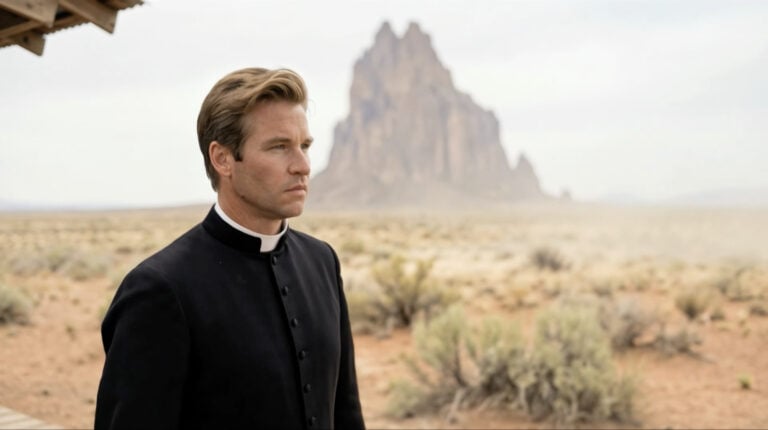
Val Kilmer died in April 2025, but he’s about to spend roughly an hour and seventeen minutes on screen in a western called As Deep As the Grave — as a Catholic priest and Native American spiritualist, no less, a role that by all accounts was written specifically around the man and his heritage. The production had been in motion since 2020, stalled by Covid and the cruel arithmetic of a prolonged cancer battle, and Kilmer never shot a single frame. So UK-based company Sonantic reconstructed his voice from old recordings, his estate and daughter Mercedes signed off on the visual deepfake, and suddenly we have something genuinely new in cinema history: a major authorized AI performance by an actor who agreed to the role while alive but never lived to play it. The trailer aired at CinemaCon this week, and the most striking moment is an AI Kilmer looking into someone’s eyes and saying, quietly, “Don’t fear the dead and don’t fear me.” Whether that line lands as poetry or provocation probably depends on where you stand on all of this.
Here’s the thing, though — this was always coming, and arguing about whether it’s right or wrong mostly misses the point. The more useful question is whether it was done with integrity, and by the standards the industry has so far set, this one actually clears the bar: the family was involved, SAG-AFTRA guidelines were followed, the estate was compensated, and the role was designed around who Kilmer actually was as a person. Compare that to the nightmare scenarios — estates being exploited, likenesses licensed without meaningful consent, studios using AI to quietly replace living actors on the cheap — and As Deep As the Grave starts to look less like a warning and more like a template. It won’t be the last film to do this. Bruce Willis licensed his digital twin before his dementia diagnosis, the estates of Laurence Olivier and James Dean have signed deals with ElevenLabs, and the commercial logic of keeping beloved performers “available” indefinitely is not going to get weaker.
What’s worth watching now is how audiences actually respond when they’re sitting in the dark watching it — because the technology argument and the ethics argument are ultimately secondary to the emotional one. Kilmer’s voice was a singular instrument: soft and authoritative at once, always with that faint current of controlled unpredictability running underneath it. Early reports suggest the AI approximation is close but not quite there, which is almost the most interesting outcome possible. Cinema has always been about the suspension of disbelief, and we’ve accepted plenty of illusions far cruder than this. If audiences find themselves genuinely moved by a man who died a year ago delivering a performance he never got to give, the conversation about AI in Hollywood will shift permanently — from “should we allow this” to “how do we do it right.” That’s the conversation we should be having anyway.