Walk through Belfast and you’ll notice something. The walls talk, and so does the air. On one street, a gable-end mural the size of a house tells you exactly who lived here, what they believed, and what they lost. Around the corner, a pub spills traditional fiddle into the evening, or a plaque marks the spot where a punk band changed everything. These two things, the paint and the sound, aren’t separate stories. They’re the same story told in two languages. And this August, with Fleadh Cheoil na hÉireann coming home to Belfast from August 2 to 9, 2026, the world’s biggest celebration of Irish music lands in a city that has always processed its history out loud, whether with a brush or a guitar. There’s no better moment to look at how Belfast’s art and its sound have always moved together.
To understand Belfast’s murals, you have to understand the walls themselves. The first peace walls went up in 1969 to divide Catholic and Protestant communities, and today they stretch over 21 miles across the city. What began as raw division slowly became a canvas. Amid the turmoil of the Troubles, the walls of Belfast became surfaces for political expression, memorialisation, and cultural identity, evolving from crude slogans and territorial markings into elaborate murals.
The result is one of the most striking open-air galleries on earth. Belfast and Derry have the most political murals in all of Europe, with Belfast displaying around 300 quality murals throughout the city. Crucially, the two communities painted in different visual dialects. On the nationalist side, murals depict important moments in Irish history and pay tribute to victims of the Troubles, while on the loyalist side the imagery tends to be more militaristic, equally loaded with political meaning. Read them side by side and you’re reading the city’s divided memory in real time.
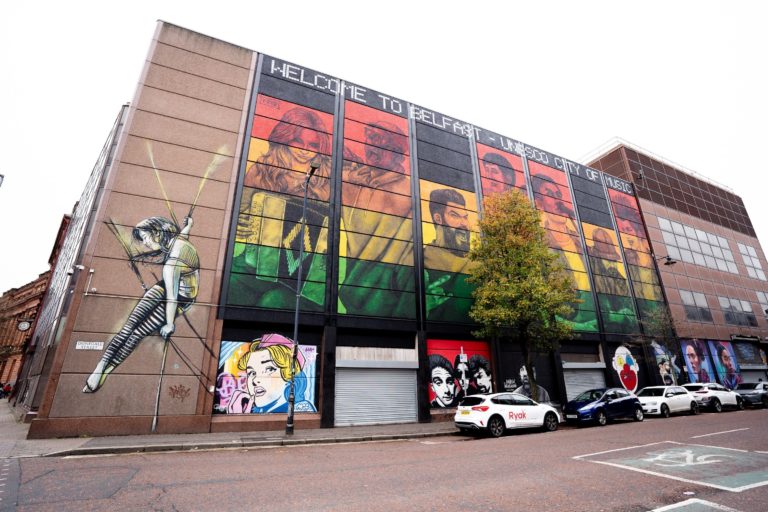
Here’s where the story turns hopeful. A newer generation of artists, raised in peacetime, began painting a different Belfast. Adam Turkington organised a street art festival called Hit The North, which transformed the mural scene in Belfast’s Cathedral Quarter, where a new generation of artists born in peacetime are more concerned with making art than political statements. The Cathedral Quarter today feels like a living, breathing canvas. The art there changes constantly, with new pieces replacing old ones and walls repainted, functioning as a living gallery rather than a fixed exhibition. And fittingly for a UNESCO City of Music, the walls have begun to celebrate sound itself. A new mural celebrating the value of music was unveiled at the Telegraph Building on Donegall Street.
Now layer the music on top, and the parallels jump out. Belfast’s musical legacy was forged in exactly the same pressure that produced the murals. Belfast was a major epicentre for the garage rock revolution of the 1960s with the formation of Them, the home of Van Morrison, as well as Thin Lizzy founders Eric Bell and Gary Moore, and punk bands Stiff Little Fingers, Rudi and The Outcasts.
Van Morrison did with songs what the muralists did with paint: he turned ordinary Belfast streets into permanent landmarks. He turned the streets of Belfast into something magical, with Cyprus Avenue just as mythical a place as The Eagles’ Hotel California or Sinatra’s New York, New York. When a songwriter immortalises your streets like that, you’ve earned a place in music history that no mural could rival, and yet the impulse is identical, taking the everyday geography of a divided city and making it mean something.
The punk scene drew the connection even more explicitly. Where muralists painted the conflict onto the walls, the punks shouted it back at those same walls. Stiff Little Fingers wrote “Alternative Ulster” as a direct challenge to the militarised streets they were living on, and the punk scene put Belfast music on the world stage in the seventies and eighties in a way no marketing campaign could have manufactured. That defiance had a home base. Good Vibrations, founded in 1976 by Terri Hooley, served as a voice of defiance and an escape from violence, a place where people didn’t care about sectarian labels, and released “Teenage Kicks” by The Undertones, a track John Peel loved so much he played it twice in a row. A record shop that ignored the dividing lines, in a city defined by them. That’s the same reconciliation the newer murals reach for, just pressed to vinyl.
What ties the paint and the sound together is that both refused to look away. The murals memorialise and the songs protest, but both take Belfast’s hardest realities and transform them into something the wider world will stop and look at, or listen to. And both have made the same journey, from instruments of division toward expressions of identity, pride, and increasingly, peace. For hundreds of years Belfast has channelled its passion into music and song, and the city is more than just a place where music is played; it’s a way of life. You could say precisely the same thing about its walls.
This is why the best way to experience Belfast is to treat the murals and the music as a single tour. The grand finale of the city’s music walking tour brings you to the Oh Yeah Music Centre in the Cathedral Quarter, a music hub whose exhibition showcases memorabilia from Snow Patrol, Van Morrison, and Stiff Little Fingers. Stand in the Cathedral Quarter and you can take in a street artist’s mural and a punk landmark within the same block. Art on the wall, sound in the air, both telling you who Belfast was, and who it’s becoming.
Fleadh Cheoil na hÉireann (fleadhcheoil.ie) takes place in Belfast, August 2–9, 2026. For more information visit fleadhcheoil.ie, visitbelfast.com, and discovernorthernireland.com.