


All aboard for a legendary ride through Canadian music history! In 1970, Festival Express brought a trainload of musicians, unforgettable performances, and cross-country camaraderie to Canada. It’s been 55 years since the rails rang with jam sessions, laughter, and landmark concerts—and the legacy continues to inspire.
Festival Express: 55 Fun Facts to Celebrate 55 Years
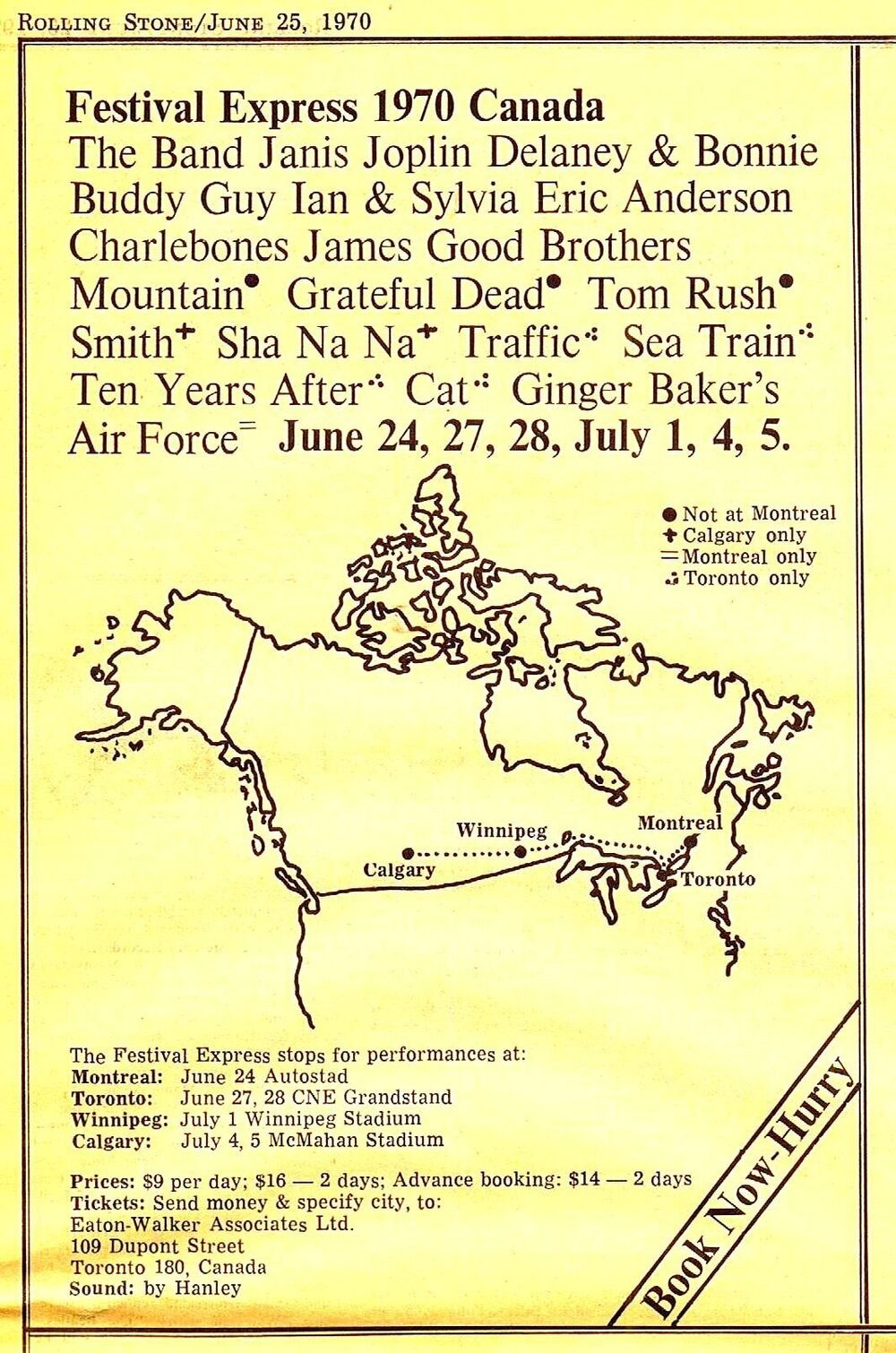
- Festival Express was originally billed as the Transcontinental Pop Festival.
- It took place across three cities: Toronto, Winnipeg, and Calgary.
- The tour was originally planned to include Montreal and Vancouver.
- Musicians traveled by train instead of flying—14 cars in total.
- The train included lounge cars, sleeper cars, a dining car, and even a staff car.
- The first stop was Toronto’s CNE Stadium on June 27–28, 1970.
- The second stop was Winnipeg Stadium on July 1.
- The final stop was Calgary’s McMahon Stadium on July 4–5.
- Montreal’s concert was canceled due to overlap with St. Jean-Baptiste Day.
- Vancouver’s show was canceled due to artificial turf installation at PNE Stadium.
- The tour was conceptualized by Ken Walker of Eaton-Walker Associates.
- Canadian National Railways operated the train used by the musicians.
- The jam sessions on the train became legendary among those onboard.
- In Toronto, 2,500 protesters objected to ticket prices, sparking a spontaneous free concert.
- Jerry Garcia helped organize the free show at Coronation Park to ease tensions.
- Around 12,000 people eventually attended the free Coronation Park show.
- The May 4th Movement helped organize Toronto’s protest.
- In Chapleau, Ontario, the train bought out the entire local liquor store.
- Winnipeg’s show had about 4,600 attendees, modest but peaceful.
- Calgary’s show moved from an open field to McMahon Stadium at the city’s request.
- Calgary’s mayor, Rod Sykes, asked the promoter to let people in for free—but was met with a strong refusal.
- Promoter Ken Walker claimed to have punched the mayor after being called “Eastern scum.”
- The tour’s original budget was $900,000, with $500,000 allocated to musical talent.
- Despite its ambition, the tour lost between $350,000 and $500,000.
- Janis Joplin performed some of her final concerts during this tour.
- The Grateful Dead debuted songs from their soon-to-be-released Workingman’s Dead.
- The Band performed at the peak of their musical powers.
- The train’s musical jam sessions included members of the Grateful Dead, Janis Joplin, and Rick Danko.
- One famous onboard jam featured “Ain’t No More Cane” with Danko, Garcia, Weir, and Joplin.
- The 2003 film Festival Express brought the story back to life after decades.
- Film reels were rediscovered in producer Willem Poolman’s garage, where they were used as hockey goalposts.
- Music was mixed at Toronto’s MetalWorks Studios by Eddie Kramer.
- Kramer also worked with Jimi Hendrix and Led Zeppelin.
- The film features stunning footage by Oscar-winner Peter Biziou.
- Bob Smeaton, director of The Beatles Anthology, helmed the film.
- The world premiere of Festival Express was at the Toronto International Film Festival in 2003.
- The film grossed $1.2 million in U.S. box office sales.
- The DVD release went straight to #1 on Amazon’s music DVD charts.
- “Cry Baby” by Janis Joplin and “Friend of the Devil” by the Dead were key film highlights.
- “Rock & Roll Is Here to Stay” was performed by Sha Na Na.
- The New Riders of the Purple Sage featured Jerry Garcia on pedal steel guitar.
- Traffic and Ten Years After performed in Toronto but didn’t appear in the film.
- Bonnie Bramlett is seen on the train; Delaney Bramlett joined a jam in “C.C. Rider.”
- Calgary performances of “Long Black Veil” and “Rockin’ Chair” appear in A Musical History by The Band.
- Many local Toronto bands played at the free Coronation Park concert.
- The People’s Revolutionary Concert Band and Si Potma were among the local acts.
- Promoters honored Montreal tickets in Toronto and ran buses between the cities.
- Capilano Stadium in Vancouver was denied as an alternate venue.
- Security concerns and a lack of facilities prevented Vancouver from hosting the event.
- The concert in Winnipeg coincided with a visit from Prime Minister Pierre Trudeau.
- The train stopped at Chapleau, Ontario, purely to restock alcohol.
- Sha Na Na added nostalgic ‘50s flair to the lineup.
- James and the Good Brothers performed both at the stadium and in Coronation Park.
- The film includes rare footage of Mashmakhan’s “Comin’ Home Baby.”
- Today, Festival Express is remembered not only as a traveling music festival—but as a moving symbol of freedom, friendship, and the unifying power of music.
Fifty-five years later, Festival Express still captures the imagination of music lovers and storytellers. From railcar jam sessions to spontaneous park concerts, it brought together some of the greatest talents of its era in a uniquely communal way. As we look back, we celebrate not just the performances, but the spirit of togetherness that made this journey legendary.