


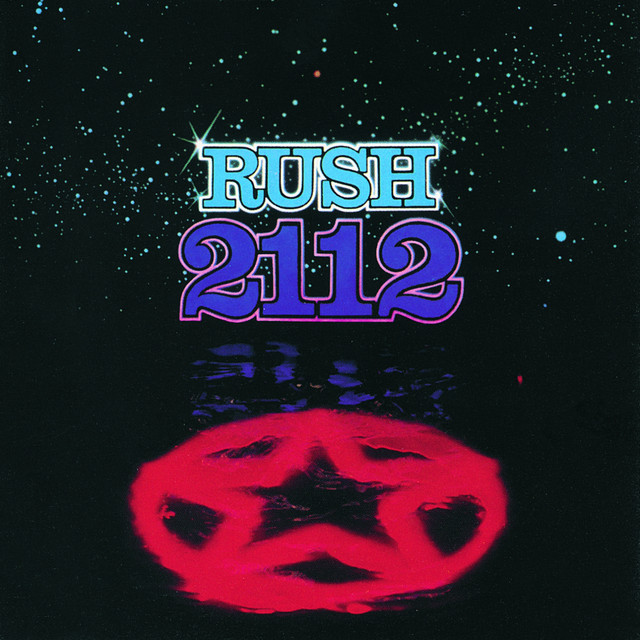
Here’s something worth sitting with for a moment. It’s 1976. Three guys from Toronto — a bassist who sounds like he’s singing from another planet, a guitarist who grew up on Cream and Led Zeppelin, and a drummer who reads Ayn Rand on tour buses — are about to get dropped by their record label. Their manager has just flown to Chicago to personally beg Mercury Records for one more shot. The label says yes, but with a condition: give us something commercial. Something that fits on radio. Something a normal person might actually buy.
What Rush did next was either the most audacious act of creative defiance in Canadian rock history, or the most gloriously reckless — depending on how you look at it. They went into Toronto Sound Studios in January 1976 and recorded a 20-minute science-fiction concept suite that takes up the entire first side of a vinyl record. The label hadn’t heard a single note of it until it was finished.
The album was called 2112. It went on to sell more than three million copies in the United States alone. It became the defining document of a band that had, against all odds and all advice, bet everything on being exactly who they were. But behind that story — one of rock’s great survival tales — are some details that even longtime Rush fans might not know. Let’s get into them.
The Album Was Written in Dressing Rooms, Hotel Rooms, and a Tour Van
There was no fancy pre-production studio time. Rush were still out on the road supporting Caress of Steel through the second half of 1975 — the same tour they’d later nickname the “Down the Tubes Tour” — when they started building what would become 2112. Neil Peart was already drafting lyrics while Geddy Lee and Alex Lifeson developed song ideas on acoustic guitars backstage and in hotel rooms, working out arrangements that complemented whatever mood Peart was writing toward.
Lifeson specifically recalled working out “The Temples of Syrinx” backstage at a show in Sault Ste. Marie, Ontario — in front of their opening act, Mendelson Joe. And here’s the kicker: the grand “Overture” that opens the entire epic suite? It was the very last piece written for the album.
Peart Added the Ayn Rand Credit Specifically to Avoid a Lawsuit
The storyline of “2112” — a future totalitarian society where a lone individual discovers a suppressed art form and brings it before an indifferent authority — bears a striking resemblance to Ayn Rand’s 1938 novella Anthem. The band had read it. As the song came together, Peart recognized the parallels were becoming hard to ignore, and he made a deliberate decision: he credited Rand’s work in the liner notes specifically to head off any potential legal action.
That credit stirred up its own trouble. A writer at Britain’s NME accused the band of being fascists based on the connection. This cut particularly deep for Geddy Lee, whose parents were Holocaust survivors. Lee pushed back firmly, describing the story as explicitly anti-totalitarian and anti-fascist — the exact opposite of what the critic had suggested.
The Closing Words of the Album Accidentally Spell Out “2112” — And Lifeson Says It Wasn’t Intentional
At the very end of “Grand Finale,” a voice speaks two lines: “Attention, all planets of the Solar Federation” — seven words, spoken three times (21 words total) — followed by “We have assumed control” — four words, spoken three times (12 words total). Put them together: 21 and 12. The album title, hidden in its own closing statement.
It sounds like a masterstroke of conceptual design. Alex Lifeson has said it was completely unintentional. Whether you believe him is entirely up to you.
“The Twilight Zone” Was Written and Recorded in a Single Day
Rush needed one more track to fill out Side Two. The band were big fans of the television series and its creator Rod Serling, and decided to write something in tribute. According to Peart, the whole thing — lyrics, music, and recording — was done in one day. The finished song draws on two specific episodes: “Will the Real Martian Please Stand Up?” for the first verse, and “Stopover in a Quiet Town” for the second.
It also became the first single released from the album, in June 1976, and Rush dedicated it to Serling’s memory. Forty years later, Steven Wilson recorded a cover for the anniversary reissue — not a bad legacy for a track born in a single session.
The Iconic “Starman” Logo Made Its First Appearance on This Album — and Later Ended Up on a Canadian Postage Stamp
The naked figure reaching toward a red star, now one of the most recognizable logos in rock, was created by artist Hugh Syme for the 2112 gatefold sleeve. Syme explained the nudity in classical terms — a tradition representing purity, the human form without material trappings. To Neil Peart, the Red Star symbolized any collectivist ideology, while the man represented “the abstract man against the masses.” Peart used the Starman on his bass drum heads from 1977 to 1983, then brought it back in 2004 and again in 2015.
In July 2013, Canada Post featured the Starman on a commemorative stamp honouring Rush — a fittingly official recognition for a logo born out of an album the band’s own label didn’t want them to make.