


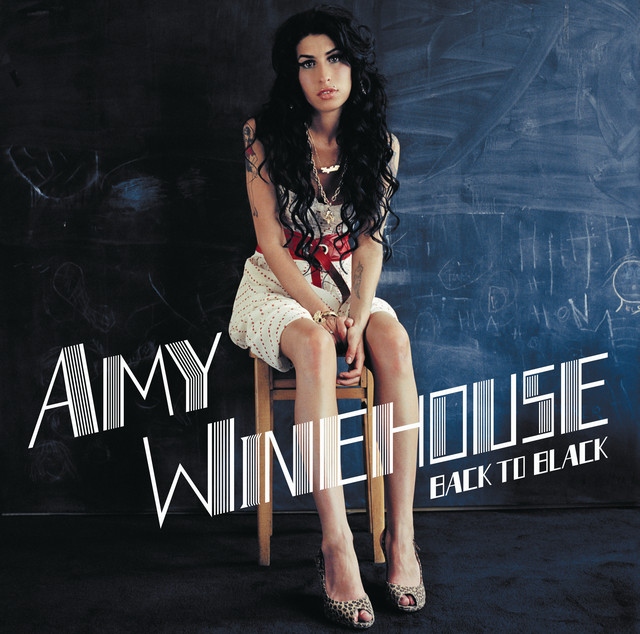
There’s a particular kind of magic that happens when a modern artist doesn’t just reference the past but actually inhabits it so completely that you genuinely have to check the release date. It’s not nostalgia exactly, and it’s not pastiche. It’s something closer to channeling: the production choices, the vocal phrasing, the arrangement, all of it locking into a frequency from another era so precisely that the present moment just falls away. Here are twelve songs that did exactly that.
Amy Winehouse, “Back to Black” (2006)
Winehouse didn’t borrow from the early 1960s girl-group sound so much as she moved into it and changed the locks. Mark Ronson’s production stacked the Dap-Kings’ raw, dry instrumentation against lyrics of such devastating self-awareness that the vintage frame made the heartbreak feel timeless rather than retro. The walking bassline, the muted trumpet, the barely-there reverb: it sounded like something pulled from a jukebox in 1961, except no one in 1961 was writing quite this honestly about being complicit in their own destruction.
Bruno Mars, “Treasure” (2012)
Bruno is going to show up a lot here. From the opening four-on-the-floor kick drum and the stabbing brass hits, “Treasure” commits so completely to the early 1980s funk-pop template that you half expect to see a Prince credit somewhere. Mars understood that the era’s genius wasn’t just the sound but the economy of it: tight arrangements, nothing wasted, every element locked to the groove. The falsetto vocal sits right in that Minneapolis pocket, and the production by The Smeezingtons keeps it warm and analog-feeling in a way that most digital-era pop simply doesn’t bother with anymore.
Duffy, “Mercy” (2008)
Duffy arrived fully formed as a kind of missing link between Dusty Springfield and mid-period Aretha, and “Mercy” was the moment that made the case most forcefully. The production leans hard into that late-1960s Atlantic Records soul blueprint: the call-and-response brass, the punchy rhythm section, the vocal delivery that sits right on the beat and then suddenly floats above it. What kept it from feeling like a costume was Duffy’s voice itself, which carried enough genuine ache that the period trappings felt earned rather than borrowed.
Meghan Trainor, “All About That Bass” (2014)
Strip away the cultural conversation that surrounded this song and what you have is a genuinely impressive piece of doo-wop and early 1960s pop reconstruction. The finger-snapping rhythm, the barbershop-adjacent backing vocals, the breezy walking bass and the bright, almost tinny production all point squarely at the girl-group era. Producer Kevin Kadish kept the arrangement deliberately sparse and light, and Trainor’s delivery has that quality of sounding like it was cut live in a room with four other people rather than built track by track in Pro Tools.
Mark Ronson ft. Bruno Mars, “Uptown Funk” (2014)
This song is basically a master class in mid-1980s Minneapolis funk, and the fact that it became one of the biggest singles of the century says something interesting about how deeply that era is embedded in popular music’s DNA. The horn charts, the call-and-response vocal dynamics, the locked groove between bass and kick drum: Ronson and Mars studied their James Brown and their early Prince records and then built something that didn’t feel like homework. The production is deliberately dry and punchy, with almost no reverb, which is exactly what gives it that period-correct intimacy.
Lana Del Rey, “Summertime Sadness” (2012)
Del Rey built her entire early career on a very specific hallucination of early 1960s California, and “Summertime Sadness” is where that vision crystallized most completely. The production by Emile Haynie wraps her voice in a warm, slightly woozy orchestral haze that recalls Phil Spector’s Wall of Sound without being a direct copy of it. The lyrical imagery, the highways and the heaven references and the glamour-adjacent melancholy, belongs to a very particular strain of mid-century American romanticism that Del Rey didn’t revive so much as reinvent entirely on her own terms.
Adele, “Someone Like You” (2011)
The production here is almost aggressively minimal: piano, vocal, a light string arrangement that enters late and sits underneath rather than in front. That simplicity is what anchors it so firmly in the early 1970s singer-songwriter tradition, the James Taylor and Carole King school of just putting a voice and a feeling in a room together and trusting both of them. Adele’s phrasing has that quality of sounding entirely unmediated, like the emotion is arriving in real time, which is exactly the aesthetic that Tapestry and Sweet Baby James were built on.
Cee Lo Green, “Forget You” (2010)
The Motown influence here is worn completely openly and without apology: the bright, punchy horns, the bright piano triplets, the ascending chord structure, the sheer good-naturedness of the groove. Producer Salaam Remi built the track around the energy of mid-1960s soul at its most exuberant, the kind of music that was designed to make people move regardless of what the lyrics were actually saying. The gap between the cheerful, radio-friendly sound and the actual content of those lyrics is itself a very Motown trick, stretching back to songs like “My Girl” and “Ain’t Too Proud to Beg.”
Janelle Monáe, “Tightrope” (2010)
“Tightrope” sounds like James Brown produced a record for someone who had just read every word of the Black Power movement and decided to set it to the most purely joyful funk groove imaginable. Big Boi’s co-production locks into a mid-1970s Southern funk template with a precision that feels almost scholarly, but the song never sounds like an exercise. Monáe’s vocal delivery, all controlled urgency and sudden explosive release, draws a direct line back to the hardest working man in show business while carving out something that was entirely and unmistakably her own.
Michael Bublé, “Haven’t Met You Yet” (2009)
Bublé has built an entire career on inhabiting the great American songbook tradition, but “Haven’t Met You Yet” is interesting because it’s an original song that genuinely sounds like a lost standard from the late 1950s big band era. The swinging brass arrangement, the lightly swinging rhythm section, the melodic construction that feels designed to be played in a supper club: all of it points back to a era of music-making that most artists Bublé’s age wouldn’t have known firsthand. What makes it work is that he doesn’t play it as irony. He means every note of it.
Leon Bridges, “Coming Home” (2015)
The debt to Sam Cooke is audible in every single element of this record: the warm, slightly dusty production, the gospel-adjacent chord changes, the restrained vocal delivery that communicates enormous feeling through understatement rather than runs. Producer Austin Jenkins kept the sonic palette deliberately narrow and analog, recording to tape in a way that gives the album a physical warmth that digital recording simply doesn’t replicate. Bridges wasn’t doing an impression of early 1960s soul. He was extending it, picking up a thread that had been left hanging and following it somewhere new.
Silk Sonic, “Leave the Door Open” (2021)
Bruno Mars and Anderson .Paak didn’t just borrow from late 1970s soul. They essentially became it for the duration of this album. “Leave the Door Open” has the lush, unhurried quality of early Earth, Wind and Fire or the Commodores at their most romantic: the warm electric piano, the slow-burning groove, the layered background harmonies that sound like they were tracked live in a room full of people who all loved each other. The production by Mars and D’Mile keeps the low end round and full in a way that feels almost nostalgic for vinyl, and the vocal interplay between the two leads captures something genuinely communal about how that music was made