


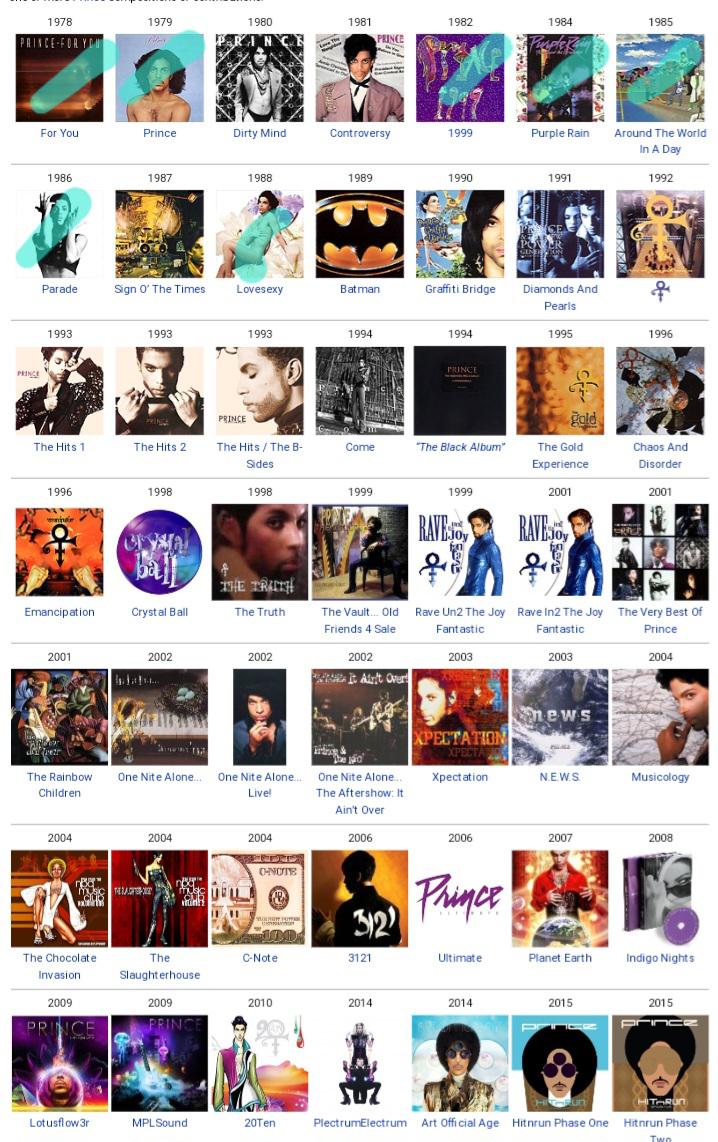
Prince Rogers Nelson died ten years ago today at Paisley Park in Chanhassen, Minnesota. He was 57. The cause was an accidental fentanyl overdose. He was found alone in an elevator.
No announcement prepared the world for it. No farewell tour, no public illness, no long goodbye. He was simply here, and then he was not. And the silence that followed was so enormous that it took days for people to fully understand what had actually left with him.
A decade on, that silence has filled back up. His catalog streams in the hundreds of millions. A 100-foot mural of his face watches over downtown Minneapolis. Minneapolis Mayor Jacob Frey recently announced a free community sing-along near that mural, declaring “In Minneapolis, we don’t just remember Prince, we feel him in the streets, in the music, in who we are.” Paisley Park is planning a five-day “Celebration of Life” featuring concerts, screenings, panel discussions, and exclusive access to unreleased music and rare concert footage, according to Consequence. The estate has not gone quiet. Neither has the conversation about what he meant and what he still means.
The real question worth asking today is not whether Prince was great. That was settled before most of us were born. The question is what kind of greatness it was, and why it keeps reverberating through music that sounds nothing like him.
The man who refused to be one thing
To understand Prince’s ongoing influence, you have to understand what made him genuinely strange in the context of his era. He arrived in the late 1970s at a moment when genre loyalty was close to mandatory. Rock audiences and R&B audiences did not share much real estate. Soul purists and hip-hop pioneers occupied separate worlds. Radio formats enforced those divisions with a kind of institutional stubbornness.
Prince simply ignored all of it. On a single album he could deliver hard rock guitar, Minneapolis funk, lush orchestral pop, spare electronic minimalism, and devotional gospel. He wrote his own songs, produced his own records, played most of the instruments himself, designed his own costumes, directed his own videos, and controlled his own masters at a time when almost no one did. He was not a genre artist. He was a weather system.
That breadth is precisely why his influence is so hard to pin down and so wide in its reach. As Far Out Magazine has noted, the extent of his ingenuity between 1980 and 1987 alone is such that most of the singers who cite his influence only reflect one aspect of his artistry. You might approximate his ballads, his limb-wrenching funk, his squalling rock, or his electronic compositions, but nobody has done it all.
The artists who carry him forward
The list of musicians who openly cite Prince as a defining influence reads like a dispatch from the current top of music.
The Weeknd has built an entire aesthetic universe from Prince’s DNA: the nocturnal sexuality, the falsetto that drops without warning into something rawer and more desperate, the way a pop song can feel simultaneously like a seduction and a confession. Justin Timberlake was direct about it after Prince’s death, saying that Prince was “somewhere within every song I’ve ever written,” as reported by Rolling Stone. D’Angelo was perhaps the most faithful inheritor of the Prince lineage, translating that virtuoso-as-sensitive-loverman sensibility for the hip-hop generation with Brown Sugar and then reaching something close to the master’s own standard with Voodoo in 2000. Janelle Monae built a career on the same refusal to be categorized that Prince embodied, and has spoken at length about the specific debt she owes him.
Writing on his Tumblr after Prince’s death, Frank Ocean said that Prince made him feel more comfortable with how he identified sexually, describing how Prince moved him to be more daring and intuitive with his own work through his irreverence for archaic ideas like gender conformity. “He was a straight black man who played his first televised set in bikini bottoms and knee high heeled boots, epic,” Ocean wrote. That piece of the legacy is perhaps the most underappreciated. Prince did not simply influence how people made music. He influenced how artists understood what was permissible, what was possible, what you were allowed to be on a stage in front of a stadium full of people.
As Dazed noted at the time of his death, Kendrick Lamar’s flow on To Pimp a Butterfly drew, via Madlib, from the Prince of “If I Was Your Girlfriend” and “Shockadelica.” You would not immediately hear Prince in Kendrick’s work, but the philosophical DNA is there: the refusal to stay in one lane, the insistence that Black artistry encompasses everything rather than being confined by any single expectation.
Speaking to Entertainment Weekly, Miguel has been clear about the debt: “There’s no way Prince could not be a musical influence of mine. I grew up not only looking up to him as a musician but as an icon, someone who was pushing the boundaries in his art.”
Alicia Keys, who helped induct Prince into the Rock and Roll Hall of Fame in 2004, put it simply during the ceremony: “Because of him, I never wanted to be anyone else but myself. Because of his music, my music has wings to be different. He’s the inspiration that generations will return to until the end of time.”
The thing that made him unrepeatable
Every generation gets one or two artists who seem to exist outside the normal rules of what popular music is supposed to be. Artists who are not just good at the craft but who seem to have a different relationship to it than everyone else, as though the music is coming through them rather than from them.
Prince was one of those artists. He reportedly accumulated thousands of unreleased songs at Paisley Park. He would finish a record, decide it was not what he wanted to put into the world, put it in the vault, and start again. The vault is still being opened carefully, with posthumous releases trickling out over the past decade, each one a reminder that the catalog we already know represents only a fraction of what he made.
What made him unrepeatable was not any single skill. It was the combination of total musical mastery, absolute creative control, genuine weirdness, and an almost theological relationship to the act of making music. He worked constantly. He played live constantly. He believed, with a conviction that never seemed to waver, that music was a sacred thing and that doing it halfway was not really doing it at all.
Dave Grohl once called it his proudest musical achievement when Prince covered Foo Fighters’ “Best of You” during his legendary Super Bowl halftime performance in 2007. Think about that for a moment. One of rock music’s most acclaimed performers, describing as his proudest achievement the moment that Prince chose to play his song.
Minneapolis, ten years on
Elliott Powell, associate professor of American Studies at the University of Minnesota, told the Minnesota Daily that the mourning over Prince’s passing has since turned into a long-term culture of remembrance, with anniversary events and continued visits to Paisley Park becoming part of how fans honor his legacy. A new generation is discovering him constantly, through the classroom, through streaming, through the artists they already love who point back to him.
He is showing up in conversations about artist ownership of masters, a fight he waged publicly and at great personal cost long before Taylor Swift made it a mainstream debate. He is showing up in conversations about genre, about gender, about the relationship between Black artists and the commercial music industry.
He is showing up, most of all, in the music. In the way certain records take a left turn that should not work but does. In the way a guitar solo arrives in a pop song and reframes everything that came before it. In the way an artist decides, against all commercial logic, to be more than one thing and to refuse the box anyone is trying to put them in.
Ten years is a long time. It is also nothing. Some musicians make work that belongs to its moment. Prince made work that seems to belong to every moment that follows it. Put on “Sign O’ The Times” today. Put on “When Doves Cry.” Put on “Purple Rain.”
Tell me it sounds old.