


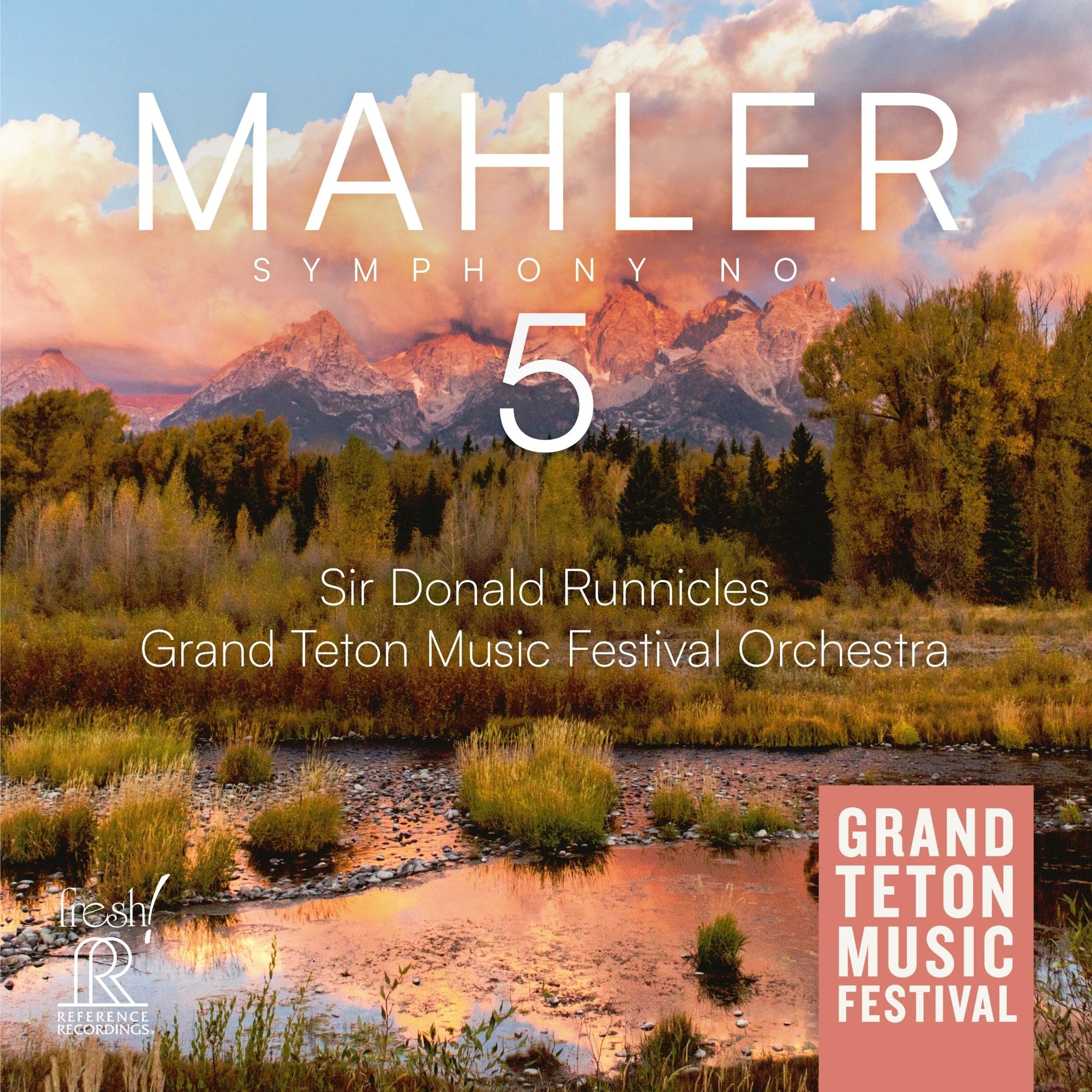
Few symphonies in the orchestral canon carry the weight of Mahler’s Fifth, and fewer conductors carry the credibility to do it full justice. Sir Donald Runnicles, widely regarded as one of today’s pre-eminent Mahler interpreters, leads the Grand Teton Music Festival Orchestra through a landmark performance of the symphony, released today via Reference Recordings. It’s the Festival Orchestra’s second album for the label, following its acclaimed recording of Beethoven Piano Concertos with Garrick Ohlsson, and it arrives as one of the more significant classical recordings of 2026. Listen here.
Recorded live in July 2024 during the Festival’s summer residency at Walk Festival Hall in Teton Village, Wyoming, the performance captures an ensemble of more than 250 elite musicians drawn from 84 orchestras and 72 institutions across North America and Europe. These aren’t studio musicians assembled for a session. They’re principal players and section leaders who gather annually under Runnicles’ artistic leadership, and the recorded result reflects that collective intensity. Celebrated hornist and brass pedagogue Gail Williams and preeminent trumpet player Thomas Hooten lead the Festival Orchestra brass throughout.
The performance itself traces Mahler’s epic journey from darkness into light with unflinching intensity. From the stark severity of the opening Trauermarsch through the radiant confidence of the final Rondo-Finale, Runnicles brings decades of deep structural insight to a symphony that can defeat conductors who don’t fully understand its architecture. Here, the journey unfolds with luminous orchestral color and emotional weight that justifies every one of its nearly 73 minutes.
Runnicles reflects on what this recording represents. “Over the many years where it has been my privilege to be Music Director, the Grand Teton Music Festival has quietly yet assuredly established itself as one of the great American orchestras, nestled in the rarified beauty of the Teton Mountains. May the release of the epic Fifth Symphony of Gustav Mahler burst upon the scene with the same joy and excitement that we experienced in performing this masterful work.”
GTMF Executive Director Emma Kail adds, “This release continues an exciting artistic arc for the Grand Teton Music Festival, reaffirming our long-term commitment to live recording at the highest level. Mahler’s Fifth, led by Sir Donald Runnicles, captures the spirit of our Festival Orchestra at its summer peak, and allows us to share that experience far beyond Jackson Hole.”
The technical presentation matches the ambition of the performance. The natural acoustics of Walk Festival Hall, combined with Reference Recordings’ meticulous production values, result in a vivid, expansive soundstage available on Hybrid SACD (5.1 surround and stereo), as well as standard, high-resolution and Dolby Atmos digital formats. For listeners with the playback systems to experience it fully, this is the kind of recording that reminds you what the format can do.
Runnicles has served as Music Director of the Grand Teton Music Festival since 2005 and Music Director of the Deutsche Oper Berlin since 2009. His previous roles include the San Francisco Opera, BBC Scottish Symphony Orchestra, and Orchestra of St. Luke’s. In February 2024, he was appointed Chief Conductor of the Dresden Philharmonic. Knighted in 2020, his discography spans Wagner, Mozart, Britten, and beyond, including a 2013 Gramophone Award for Best Vocal Recording and a Grammy nomination for his recording of Janáček’s Jenůfa. The Grand Teton Music Festival itself has been recognized by The New York Times as one of the top 10 music festivals in the U.S. and named Festival Choice by BBC Music Magazine.
‘Mahler: Symphony No. 5’ is out now on Reference Recordings.
Tracklist:
I. Trauermarsch. In gemessenem Schritt. Streng. Wie ein Kondukt — 13:38
II. Stürmisch bewegt. Mit grösster Vehemenz — 15:45
III. Scherzo. Kräftig, nicht zu schnell — 17:51
IV. Adagietto. Sehr langsam — 10:05
V. Rondo-Finale. Allegro — 15:35