


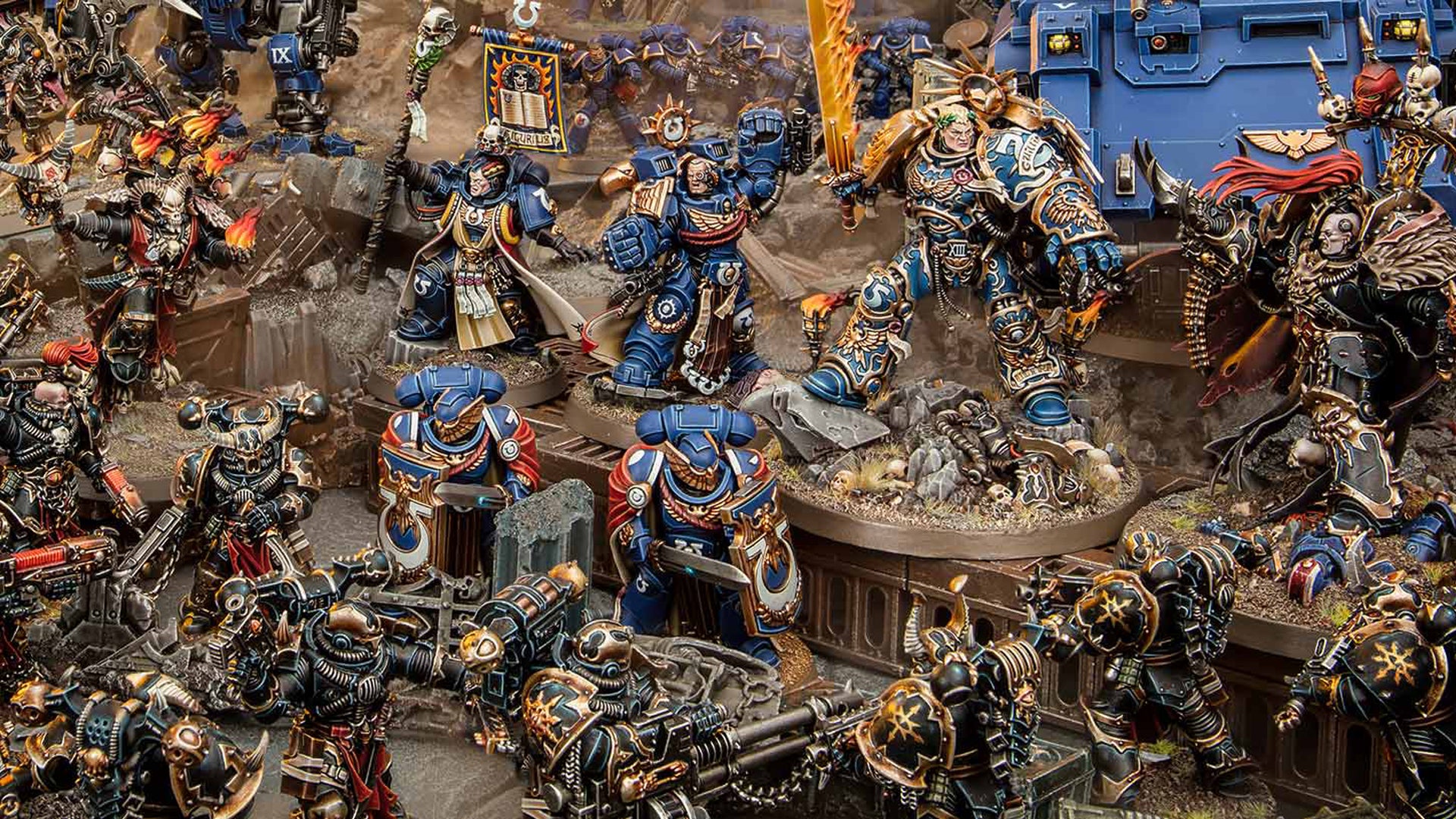
John Blanche, the British illustrator and miniature painter whose dark, gothic imagination shaped the visual identity of Warhammer and Warhammer 40,000 for decades, has died in 2026 at the age of 78. As the longtime art director of Games Workshop, he was one of the defining creative forces behind some of the most recognisable worlds in fantasy and science fiction gaming.
Born in 1948 into a working-class family in post-war England, Blanche grew up on a council estate during the 1950s, a period he remembered as “grey and flat” and starved of visual richness. He found his own colour where he could, drawing inspiration from cinema, collecting toy soldiers, and sketching historic warriors on the backs of old rolls of wallpaper. That instinct for the heroic and the fantastical would never leave him, even as the world around him tried to talk him out of it.
It tried more than once. At art college, where he earned a place on the strength of his paintings of battle scenes and prehistoric conflicts, Blanche was told he “had a romantic spirit, but it would never earn me a living.” He was warned he would never get a job painting angels, dragons, goblins, and trolls. He drifted into graphics, discovered illustration, hippydom, and The Lord of the Rings, and quietly set about proving that advice wrong. After college he worked as an assistant to a taxidermist in a Georgian manor house, building models and painting fantastic scenes in his spare time.
His break came after he relocated to London and approached the artist and publisher Roger Dean, who offered him freelance illustration work. Through the late 1970s and early 1980s Blanche produced book covers and interior art, including five illustrations for David Day’s A Tolkien Bestiary. In 1977 he began his long association with Games Workshop, supplying cover art for the fourth issue of White Dwarf and producing the cover for the first British edition of Dungeons & Dragons. He went on to paint the box art for the first edition of Warhammer Fantasy Battle in 1983.
After Games Workshop moved to Nottingham in 1986, Blanche was made the company’s art director, a role in which his influence became immeasurable. He directed the in-house art department, commissioned outside illustrators, and shaped designs for Citadel Miniatures, overseeing the art and painting columns in White Dwarf for years. Working alongside artists such as Ian Miller and Adrian Smith, he gave the company’s core products their distinctive look, a dark, gothic, occasionally bizarre, punkish quality that became inseparable from the Warhammer worlds themselves. His standing as a craftsman was recognised in 1987 when he won the Master Painter award at Games Day for his own Chaos Minotaur miniature, complete with a Mona Lisa banner conversion.
Blanche’s reach extended beyond the gaming table. He provided cover art for Nottingham thrash metal band Sabbat’s 1988 album History of a Time to Come, and illustrated fantasy gamebooks including the Fighting Fantasy series and Steve Jackson’s Sorcery! quartet. Several books were devoted to his work, among them Ratspike, created with Ian Miller, and The Prince and the Woodcutter.
His technique was as distinctive as his vision. He drew on turn-of-the-century illustrators like Arthur Rackham and Kay Nielsen, alongside Rembrandt, Bosch, Dürer, and the Pre-Raphaelites, and described his art as tapping an archetypal core of inherited imagery, the same hunting scenes, war paint, and trophies that he saw echoed in punk haircuts and films like Blade Runner and Aliens. He worked small, most of his jewel-like paintings smaller than A4, building each element separately before layering inks, acrylics, and glazes to create an inner glow. He often folded famous images into his own work, the Mona Lisa among them, calling it not plagiarism but a deliberate policy to place the world’s best-known image into a new reality. Occasionally he used his art to comment directly, as with Amazonia Gothique, painted out of frustration with the exploitative fantasy art he saw creeping onto magazine covers; it was later voted best cover of the year.
Following a period of poor health, Blanche turned in later years to sketchbooks exploring the Warhammer universes, describing himself contentedly as “living in the worlds he has helped to create.” He officially retired from Games Workshop on 31 May 2023, but his creative drive continued. He licensed his name to a range of paints inspired by his style and launched Kickstarter campaigns for a line of models called Mörderin and a game, John Blanche’s En Guarde.
To generations of hobbyists, painters, and players, Blanche was the man who taught the grim darkness of the far future how to look. He took the angels, dragons, goblins, and trolls he was once told would never pay and built from them entire universes, leaving behind a body of work that will continue to shape the imaginations of artists and gamers for years to come.