


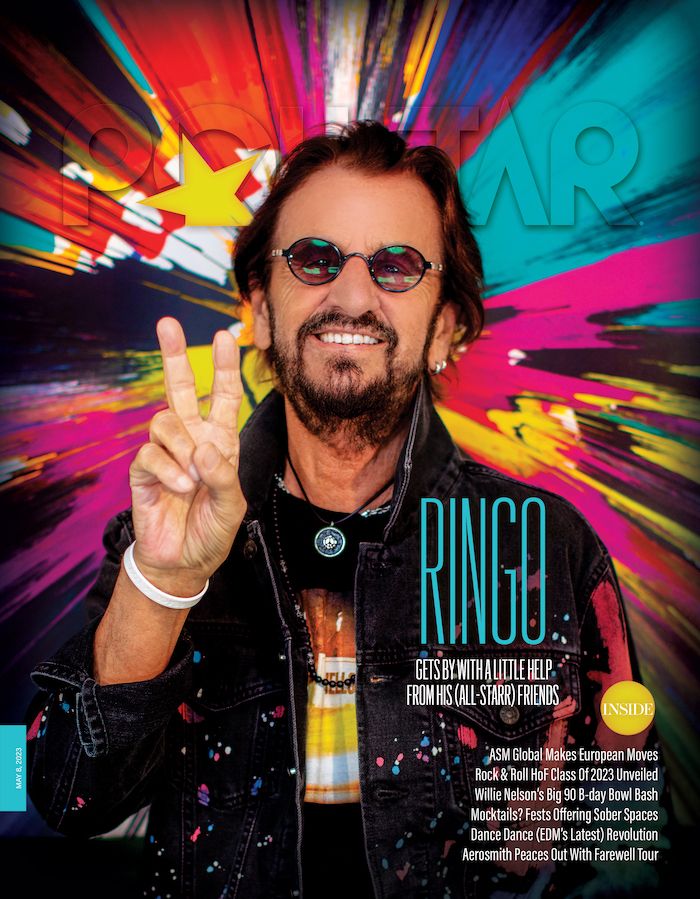
History gives us a map for almost everything, except this. Ringo Starr turns 86 in July and he’s onstage, anchoring a generation of rockers who’ve walked the calendar somewhere no popular musicians have walked before.
Look back and the precedent thins out fast. Jazz and blues handed us the early models. B.B. King kept his road life running into his late 80s, playing hundreds of nights a year as the self-described Ambassador of the Blues, a man who started touring in 1955 and barely stopped. Tony Bennett sang into his 90s, took a Number 1 album at 88, and headlined jazz festivals when most of his peers were long gone. They proved a voice could carry across seven decades.
What’s happening in 2026 stretches even those examples. King and Bennett were singular figures, exceptions standing nearly alone. This summer hands us a whole roster. Mike Love of the Beach Boys is 85. Bob Dylan turns 85. Paul Simon is 84. Randy Bachman of The Guess Who is 82. Jon Anderson and Eric Clapton are 81, joined by Micky Dolenz and Rod Stewart. John Fogerty turns 80.
There’s a familiar scene that plays out every few years. A legendary performer, well past the age when most people have retired, announces a “farewell tour.” Tickets sell out. The shows are emotional. And then, eighteen months later, a new run of dates appears. The farewell, it turns out, was not goodbye.
We tend to explain this cynically — they need the money, or their handlers won’t let them quit. Sometimes that’s true. But the more interesting answer is psychological. For many artists who have spent 50 or 60 years on stage, stopping isn’t a logistical decision. It’s an existential one. Here’s a look at what’s actually going on beneath the rescheduled farewell.
For most people, identity is distributed across many roles: parent, friend, professional, neighbor. For a performer who became famous young, an enormous share of their sense of self can be fused to a single activity. Psychologists call this identity foreclosure — when a person commits hard to one identity early in life and never develops alternatives. A teenager who becomes a touring musician at nineteen may never have built the scaffolding for a self that exists off-stage.
This makes retirement feel less like ending a job and more like erasing a person. The question “Who am I if I’m not performing?” isn’t rhetorical for these artists. They genuinely may not have an answer, because the experiment of being someone else was never run. Touring isn’t what they do. It’s the load-bearing wall of who they are.
There is no ordinary experience that replicates what happens when twenty thousand people sing your words back to you. The combination of mass attention, rhythmic crowd response, and the physiological rush of live performance produces a neurochemical cocktail — dopamine, adrenaline, oxytocin from social bonding — that the brain learns to expect and crave.
This isn’t addiction in the clinical sense, but it shares a structure with it. The feedback loop is immediate, intense, and reliable in a way that almost nothing in private life can match. A retired performer doesn’t just lose a paycheck or a routine. They lose access to one of the most powerful reward experiences a human nervous system can have. Daily life afterward can feel muted, gray, under-stimulated by comparison. Many describe the off-season or the gap between tours as a low-grade depression. The stage isn’t a habit they can’t break. It’s a high they can’t find anywhere else.
For older artists specifically, touring takes on a second layer of meaning. To keep moving is, in a quiet way, to refuse to be finished. Continuing to perform becomes evidence — to the audience but mostly to oneself — that one is still vital, still relevant, still here.
There’s a concept in psychology called terror management: the idea that humans construct meaning systems partly to buffer the anxiety of knowing we will die. For an artist, the work itself is that buffer. A song outlives its singer; a performance is a small act of defiance against time. Stopping can feel uncomfortably like an admission — that the body is failing, that the relevance is fading, that the end is near. As long as the next tour is booked, the story isn’t over. The calendar full of future dates is, in a sense, a promise to the self that there is still a future.
Performers are often, paradoxically, people who are most comfortable in front of crowds and least comfortable alone. The stage offers a kind of intimacy that is intense but bounded — connection without the vulnerability of a one-on-one relationship. It’s love at scale, with a clear exit at the end of the night.
Retirement removes the structure and replaces it with the thing many performers spent their whole lives avoiding: stillness, solitude, and the unmediated company of their own thoughts. The roar of the crowd is also, for some, a way of not having to sit in a quiet room with themselves. Touring keeps the silence at bay.
It would be too simple to frame all of this as ego or avoidance. There’s a healthier strand running through it too. Work that feels meaningful is one of the strongest predictors of wellbeing in later life, and being needed is a powerful antidote to the irrelevance that often accompanies aging.
For an artist, a tour is a reason to stay disciplined — to keep the voice in shape, the body moving, the mind sharp. It provides structure, social connection with a touring family, and the sense that one still has something to give. Some older performers keep going not because they’re running from death but because the work is genuinely the best part of being alive for them. We don’t tell a beloved teacher or surgeon they should have quit years ago simply because they reached a certain age. The instinct to keep contributing is, in many cases, the sign of a life well-aligned with its purpose.
The cynical read — they can’t let go, they’re chasing a fading high, they’re afraid of dying — is real for some artists. But so is the generous read: that they’ve found something that gives their life shape and meaning, and they intend to do it until they physically cannot.
Maybe the most honest answer is that both are usually true at once. The same tour can be an avoidance of mortality and a celebration of being alive. The crowd can be both a fix and a genuine source of joy. Human motivation is rarely clean.
What’s clear is that “why don’t they just stop?” is the wrong question. For a person whose identity, nervous system, and sense of meaning have all been organized around the stage for half a century, the better question is: stop and become what? Until there’s an answer to that, the farewell tour will keep saying hello.