Home Blog Page 111

Minus the Bear Extend the ‘Menos El Oso’ Anniversary Celebration This Fall

0

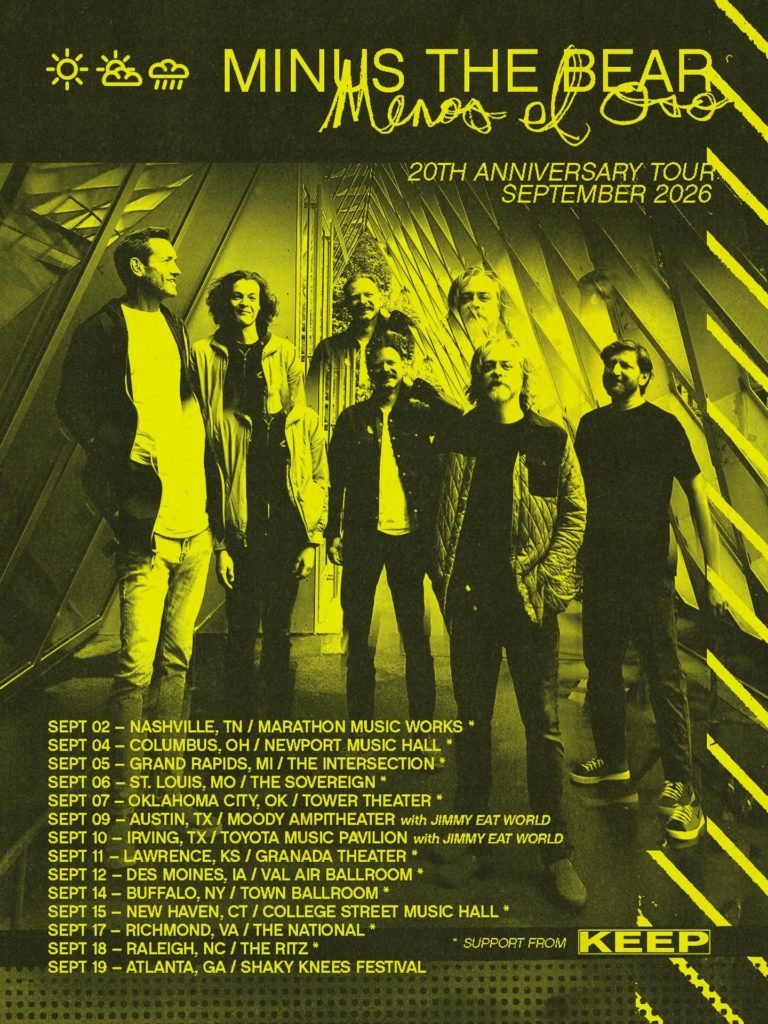
Minus the Bear are hitting the road again. The Seattle indie rock outfit have announced a fall run across the South, East Coast, and Midwest, continuing the ‘Menos El Oso’ 20th anniversary tour that launched last year. The beloved album received a deluxe reissue on Suicide Squeeze last August, and the response to the fall run clearly warranted more dates.

Guitarist David Knudson sums it up directly: “We had way too much fun playing Menos el Oso on the fall run last year so we’re gonna do it again. This time we’re hitting some of our favorite towns that we couldn’t squeeze into the last itinerary.” The new routing covers Nashville, Columbus, Grand Rapids, Saint Louis, Oklahoma City, Lawrence, Des Moines, Buffalo, New Haven, Richmond, and Raleigh, filling in the gaps from the first leg.

Two dates stand apart from the headline run. September 9 in Austin and September 10 in Irving see Minus the Bear joining Jimmy Eat World on their Bleed American tour, a pairing that feels exactly right. Knudson called it a chance they simply could not pass up. The run closes September 19 at Shaky Knees Festival in Atlanta, with Keep supporting on all headline dates.

‘Menos El Oso’ remains one of the defining albums of its era, a record that balanced melodic sophistication with experimental edge in a way few bands have managed before or since. Hearing it played in full, night after night, is exactly the kind of live experience that reminds you why it mattered so much in the first place.

September cannot come soon enough.

‘Menos El Oso’ Tour Dates:

September 2 — Nashville, TN — Marathon Music Works (with Keep)

September 4 — Columbus, OH — Newport Music Hall (with Keep)

September 5 — Grand Rapids, MI — The Intersection (with Keep)

September 6 — Saint Louis, MO — The Sovereign (with Keep)

September 7 — Oklahoma City, OK — Tower Theater (with Keep)

September 9 — Austin, TX — Moody Amphitheater (with Jimmy Eat World)

September 10 — Irving, TX — Toyota Music Pavilion (with Jimmy Eat World)

September 11 — Lawrence, KS — Granada Theater (with Keep)

September 12 — Des Moines, IA — Val Air Ballroom (with Keep)

September 14 — Buffalo, NY — Town Ballroom (with Keep)

September 15 — New Haven, CT — College Street Music Hall (with Keep)

September 17 — Richmond, VA — The National (with Keep)

September 18 — Raleigh, NC — The Ritz (with Keep)

September 19 — Atlanta, GA — Shaky Knees Festival (with Keep)

Kip Moore Announces ‘Reason To Believe’ and a World Tour to Match

0

Kip Moore has announced his new album ‘Reason To Believe,’ arriving May 29. His second full-length in two years, the record is out via his global partnership with Virgin Music Group and arrives alongside lead single “Levee,” a guitar-driven anthem co-produced with Andrew DeRoberts and featuring guest vocals from Hillary Lindsey. The track is out now and already drawing strong praise from Billboard, Music Row, and Whiskey Riff, who called it “a winner all-around.”

“Levee” sets the tone for an album that runs deeper than its rockers suggest. Moore describes ‘Reason To Believe’ as a record about his daily inner life, grief, faith, and the weight of time, shaped in part by the loss of his mentor, first producer, and champion Brett James during recording. The album is named after a song James loved that Moore co-wrote years ago with Dan Couch and Scott Stepakoff. That context gives the record a gravity that is hard to manufacture.

The production approach was a deliberate shift. Working with DeRoberts for the first time, Moore embraced a philosophy of space over volume, letting the songs breathe rather than pushing for impact through force. The result moves between anthemic crowd rockers, quiet meditations on hardship, and songs built to function as lifelines. “Levee” lands with the urgency and melodic confidence of an artist fully in command of his craft.

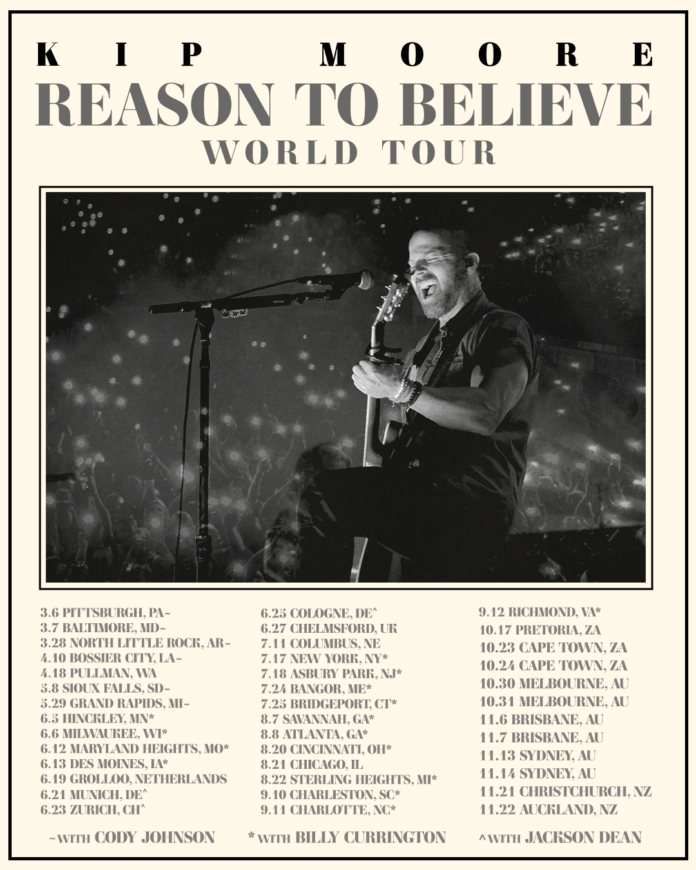
The Reason To Believe World Tour is a significant undertaking. Moore headlines stadiums and arenas across the US, Europe, Australia, New Zealand, and South Africa, where he has previously performed for crowds exceeding 40,000. The run includes dates with Cody Johnson, a co-headline run with Billy Currington, and European stops with Jackson Dean.

Thirteen tracks. A world tour. A record built from real loss and real conviction. May 29.

‘Reason To Believe’ Tracklisting:

  1. Levee (Kip Moore, Luke Preston, Hank Born)
  2. Get What Ya Give (Kip Moore, Luke Preston)
  3. The Darkness (Kip Moore, Andrew DeRoberts, Luke Preston)
  4. Heartbreaker (Kip Moore, Jaren Johnston, Casey Beathard)
  5. Headlights (Kip Moore, Andrew DeRoberts)
  6. You & Me (Kip Moore, Andrew DeRoberts, Hillary Lindsey)
  7. Faith In The Wind (Kip Moore, Andrew DeRoberts, Luke Preston)
  8. Reason To Believe (Kip Moore, Dan Couch, Scott Stepakoff)
  9. Lonely Tonight (Kip Moore, Casey Beathard)
  10. Long Time Coming (Kip Moore, Andrew DeRoberts, Luke Preston)
  11. Wild Things Like You (Kip Moore, Dan Couch)
  12. Sober (Kip Moore, Manny Medina, Dave Nassie, Erich Wigdahl, Hank Born, Will Lynde)
  13. Josephine (Kip Moore, Manny Medina, Dave Nassie, Erich Wigdahl, Hank Born, Will Lynde)

Reason To Believe World Tour Dates:

March 28 — North Little Rock, AR — Simmons Bank Arena (with Cody Johnson)

April 10 — Bossier City, LA — Brookshire Grocery Arena (with Cody Johnson)

April 18 — Pullman, WA — Beasley Coliseum

April 30 — Louisville, KY — Fourth Street Live!

May 8 — Sioux Falls, SD — Denny Sanford Premier Center (with Cody Johnson)

May 29 — Grand Rapids, MI — Van Andel Arena (with Cody Johnson)

June 5 — Hinckley, MN — Hinckley Amphitheater (Billy Currington & Kip Moore: Live In Concert)

June 6 — Milwaukee, WI — Landmark Credit Union Live (Billy Currington & Kip Moore: Live In Concert)

June 12 — Maryland Heights, MO — Saint Louis Music Park (Billy Currington & Kip Moore: Live In Concert)

June 13 — Des Moines, IA — Lauridsen Amphitheater (Billy Currington & Kip Moore: Live In Concert)

June 19 — Grolloo, NL — Holland International Blues Festival

June 21 — Munich, DE — TonHalle (with Jackson Dean)

June 23 — Zurich, CH — X-TRA (with Jackson Dean)

June 25 — Cologne, DE — Carlswerk (with Jackson Dean)

June 27 — Chelmsford, UK — State Fayre

July 17 — New York, NY — The Rooftop at Pier 17 (Billy Currington & Kip Moore: Live In Concert)

July 18 — Asbury Park, NJ — Stone Pony Summer Stage (Billy Currington & Kip Moore: Live In Concert)

July 24 — Bangor, ME — Maine Savings Amphitheater (Billy Currington & Kip Moore: Live In Concert)

July 25 — Bridgeport, CT — Hartford HealthCare Amphitheater (Billy Currington & Kip Moore: Live In Concert)

August 7 — Port Wentworth, GA — Port Wentworth Amphitheater (Billy Currington & Kip Moore: Live In Concert)

August 8 — Atlanta, GA — Coca-Cola Roxy (Billy Currington & Kip Moore: Live In Concert)

August 20 — Cincinnati, OH — The Andrew J Brady Music Center (Billy Currington & Kip Moore: Live In Concert)

August 21 — Chicago, IL — The Salt Shed (Billy Currington & Kip Moore: Live In Concert)

August 22 — Sterling Heights, MI — Michigan Lottery Amphitheatre at Freedom Hill (Billy Currington & Kip Moore: Live In Concert)

September 10 — Charleston, SC — Firefly Distillery (Billy Currington & Kip Moore: Live In Concert)

September 11 — Charlotte, NC — Skyla Credit Union Amphitheatre (Billy Currington & Kip Moore: Live In Concert)

September 12 — Richmond, VA — Allianz Amphitheater at Riverfront (Billy Currington & Kip Moore: Live In Concert)

October 17 — Pretoria, ZA — SuperSport Park Stadium

October 23 — Cape Town, ZA — GrandWest Arena

October 24 — Cape Town, ZA — GrandWest Arena

October 30 — Melbourne, AU — The Forum

October 31 — Melbourne, AU — The Forum

November 6 — Brisbane, AU — The Fortitude Music Hall

November 7 — Brisbane, AU — The Fortitude Music Hall

November 13 — Sydney, AU — The Enmore Theatre

November 14 — Sydney, AU — The Enmore Theatre

November 21 — Christchurch, NZ — Christchurch Town Hall

November 22 — Auckland, NZ — Auckland Town Hall

Indie Favorites Myriad Drop Swooning New EP ‘Notes She Never Read’ This Friday

0

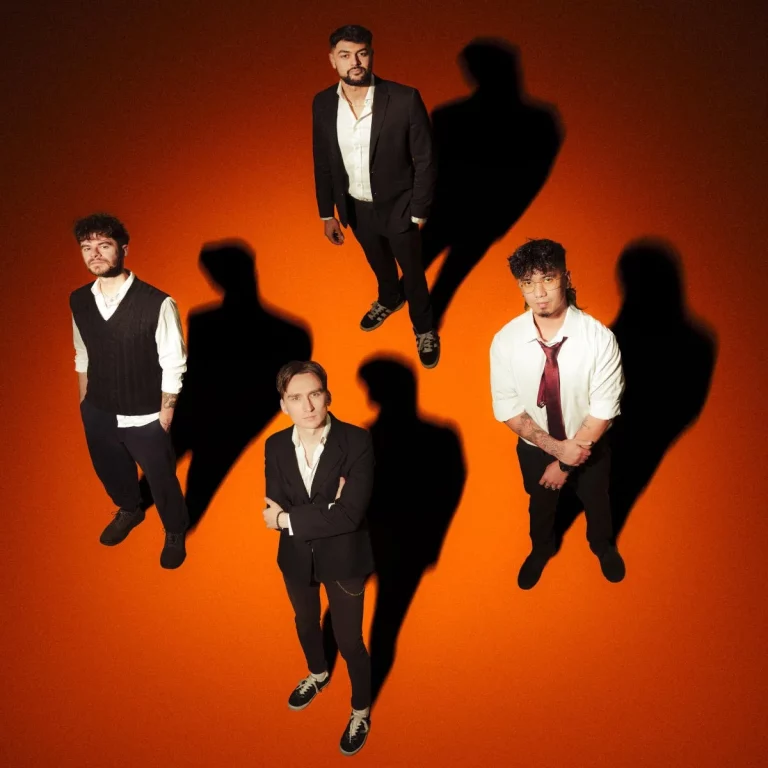
Myriad are back with their most ambitious release yet. The Southampton indie four-piece drop their new EP ‘Notes She Never Read’ this Friday, March 20, a five-track collection built around the full emotional arc of falling in love for the first time. From the first electric spark to the quiet wreckage of betrayal, the EP covers serious ground with soaring guitars and lyricism that earns every feeling it chases.

The band frame it simply: “the charge, the heartbreak, the beauty, the butterflies, the fall.” Five tracks, each with its own distinct emotional temperature. Opener “The Energy” captures the magnetic pull of an undeniable connection, while “Better Off Without You” turns heartbreak into defiance. “Cowboys” brings vulnerability and young love into sharp focus, “LBD” follows a bold chance encounter that becomes something real, and closer “10:23” sits in the quiet, nostalgic aftermath of a relationship’s end.

Myriad arrive at this release with real momentum behind them. Late 2025 saw them supporting The Hunna and The Summer Set, and their festival appearance at Isle of Wight Festival broadened their reach considerably. The new EP is a deliberate step up, bigger and more confident than anything they have put out before.

To celebrate the release, the band are throwing an EP release party at Suburbia in Southampton on Saturday, March 21. Tickets are affordable by design, the band committed to keeping live music accessible, and the show is already 75% sold. Move fast.

‘Notes She Never Read’ is five tracks of indie songwriting that knows exactly what it wants to say.

‘Notes She Never Read’ Tracklisting:

  1. The Energy
  2. Better Off Without You
  3. Cowboys
  4. LBD
  5. 10:23

EP Release Party:

Saturday, March 21 — Southampton — Suburbia

Grateful Dead Legends Phil Lesh and Owsley Stanley’s Lost 1974 Recording Finally Surfaces

0

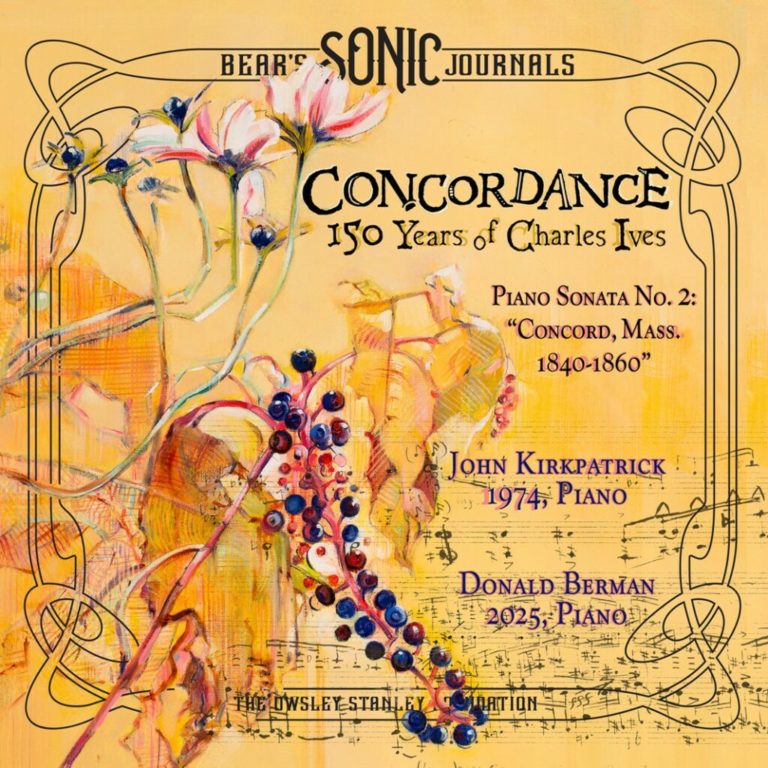
One of the most unusual recordings in the Grateful Dead universe has finally surfaced. Bear’s Sonic Journals: Concordance, 150 Years of Charles Ives is out now via the Owsley Stanley Foundation, and it delivers something Phil Lesh specifically requested when the archiving of Owsley Stanley’s estimated 1,400 reels of live recordings began: find the Ives.

What they found is extraordinary. The centerpiece is a live performance of Charles Ives’ Piano Sonata No. 2, “Concord, Mass., 1840-1860,” recorded at the Marin Veterans Memorial Auditorium on March 7, 1974, captured by Stanley and Lesh featuring pianist John Kirkpatrick, whose interpretation of the Concord Sonata stands as one of the definitive performances of the work. The recording was made to celebrate the centennial of Ives’ birth and documents a remarkable intersection between American experimental composition and the sonic explorers of the Dead’s world.

The two-disc set pairs that 1974 performance with a modern interpretation by pianist Donald Berman, Kirkpatrick’s final student, recorded live in Concord, Massachusetts in February 2025, in the very town that inspired Ives’ transcendentalist masterwork. The set also includes Other Transcendentalists, a collection of new commissioned works inspired by figures from the transcendentalist movement, featuring compositions by Eve Beglarian, David Sanford, Marti Epstein, and Elena Ruehr.

The release is as much a historical document as it is a musical one. A 112-page booklet accompanies the set, featuring reflections on Lesh’s deep connection to Ives, a new interview with Berman, and contributions from Dead keyboardist Tom Constanten, bassist Dave Schools, and Grahame Lesh. For Phil Lesh, Ives’ music was foundational, something he described as “welded into my DNA.”

Fifty years in the archive. Worth every year of the wait.

10 Songs With Hooks You’ll Never Forget

You hear it once and it stays with you forever. That is the power of a hook. Not production, not marketing, not even timing. A hook cuts through everything and plants itself in your brain. These are the moments that define songs, careers, and entire eras.

“I Want to Hold Your Hand” – The Beatles
The second the “Yeah, yeah, yeah” hits, it feels like a switch flips. This is pop music announcing itself with urgency, excitement, and a chorus that refuses to sit quietly.

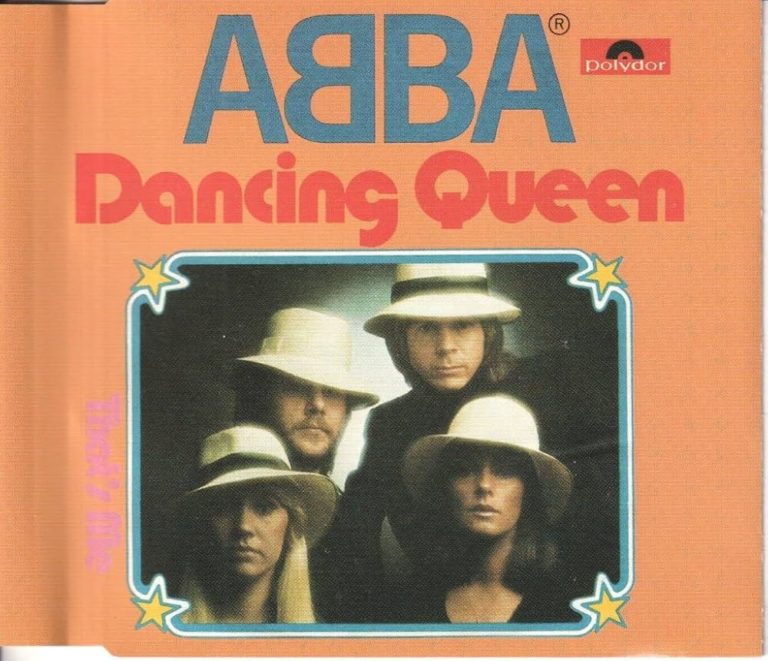
“Dancing Queen” – ABBA
That piano opens the door and the chorus walks right in like it owns the place. “You can dance, you can jive” lands with pure joy you’ll recognize anywhere.

“Stayin’ Alive” – Bee Gees
Four notes and a falsetto and you are in the middle of the disco era. The hook is rhythm, attitude, and identity all at once, locked in a groove that never lets go.

“I Will Survive” – Gloria Gaynor
The chorus arrives like a declaration. Strength, clarity, and melody collide in a way that turns a song into an anthem people carry with them.

“Don’t Stop Believin'” – Journey
It builds and builds and then releases everything at once. That chorus is communal, universal, and designed for a room full of voices singing every word.

“Livin’ on a Prayer” – Bon Jovi
“Woah, we’re halfway there” is less a lyric and more a rallying cry. It pulls everyone in instantly, no explanation needed, just hands in the air and voices turned up.

“Baby One More Time” – Britney Spears
Three piano notes and you already know what is coming. The hook defines an entire era of pop with precision, simplicity, and total recall.

“Hey Ya!” – Outkast
The beat hits, the claps start, and the chant takes over. It is kinetic, unpredictable, and impossible to ignore, a hook for days.

“Bad Romance” – Lady Gaga
The opening syllables arrive like a coded message that everyone understands. It is theatrical, bold, and built to echo long after the song ends.

“Call Me Maybe” – Carly Rae Jepsen
The chorus lands with perfect timing and zero wasted space. Every note pulls you in, every word sticks, and suddenly you’re singing along whether you planned to or not.

Dune Part Three Trailer Signals a High-Stakes Thriller for Paul Atreides

0

Denis Villeneuve is back in Arrakis with the first trailer for ‘Dune Part Three,’ and this time the story moves with intensity and urgency. Set years after the last chapter, Paul Atreides now rules with immense power, facing the consequences that come with it. Villeneuve describes the film as a thriller, and the footage leans into that energy with tension, scale, and a sense of pressure building around every decision.

Zendaya returns as Chani, anchoring the emotional core of the story as her connection with Paul continues to shape the narrative. Robert Pattinson joins the cast as Scytale, bringing a mysterious presence that adds intrigue to the unfolding conflict. Javier Bardem and Anya Taylor-Joy also appear, rounding out a cast that blends familiar faces with new energy.

The trailer highlights a world shifting under Paul’s rule. Political forces gather, resistance grows, and the balance of power feels increasingly fragile. Villeneuve shot the film on both traditional film and digital IMAX, giving Arrakis a striking visual texture that reflects the scale of the story and the intensity of its setting.

With its focus on power, consequence, and survival, ‘Dune Part Three’ builds toward a gripping continuation of the saga. The trailer sets the stage for a film that places Paul at the center of a world closing in around him, with every choice carrying weight across the galaxy.

Spider-Man Brand New Day Trailer Brings Back Familiar Faces and Teases a Powerful New Chapter

0

The first full trailer for ‘Spider-Man Brand New Day’ has arrived, and it’s packed with everything fans hoped to see. Tom Holland is back as Peter Parker, still navigating a world that no longer remembers who he is, while Zendaya’s MJ and Jacob Batalon’s Ned return to remind us what’s at stake emotionally. There’s even a quiet but powerful image of Aunt May’s gravestone, grounding the story in the weight of everything Peter has lost.

At the same time, the trailer expands the universe in a big way. Mark Ruffalo’s Bruce Banner appears in what looks like a mentor role, Jon Bernthal’s Punisher brings intensity, and Michael Mando’s Scorpion finally returns to the big screen. It’s a mix of familiar faces and deeper Marvel connections that signal this isn’t just another sequel, it’s a continuation with higher stakes.

Then there’s the biggest mystery: Sadie Sink. Her character is barely revealed, shown only in fragments, but the hints are enough to spark major speculation. Mind control, danger, and the possibility of a much larger role in the MCU moving forward have fans wondering if this could be the introduction of something even bigger, possibly tied to the X-Men.

What stands out most is the sense of transformation. Peter Parker isn’t the same kid anymore. He’s alone, evolving, and possibly facing changes within himself that go beyond the suit. If this trailer is any indication, ‘Spider-Man Brand New Day’ isn’t just a new chapter, it’s a turning point for one of Marvel’s most beloved heroes.

What Really Happens When A Publicist Hits Send

You see the email. Subject line tight, artist name up front, maybe a hook if you’re lucky. You open it or you don’t. You think it’s quick. It’s not. Before that email lands in your inbox, there’s a whole machine running behind it, and most people never see it.

A publicist spends hours shaping that pitch. Listening to the record. Finding the angle. Reading your outlet. Studying what you’ve covered, what you’ve skipped, what actually gets your attention. This is not spray and pray. This is targeted. Every name on that list is there for a reason. If you’re getting the email, it’s because someone believes you’re the right person to tell that story.

Then comes timing. Release schedules, embargoes, tour announcements, competing news cycles. You are not the only one getting pitched that day, and the publicist knows it. They’re choosing when to send, how to follow up, and when to step back. There’s strategy in the silence as much as there is in the outreach.

And then comes the waiting. Refreshing inboxes. Tracking opens. Wondering if it landed or got buried. Following up without being annoying. Staying persistent without pushing too far. Because relationships matter more than one placement. Always have. Always will.

So when you open that email, remember this: it’s not just a pitch, it’s a conversation starter. It’s someone saying, I know what you care about, and I think this fits. Sometimes it does. Sometimes it doesn’t. But when it clicks, that’s when stories get told, artists get heard, and the whole system works exactly the way it’s supposed to.

Adrian Quesada Signs Global Deal With Concord Music Publishing

0

Adrian Quesada has signed a global publishing deal with Concord Music Publishing, covering upcoming projects and his full catalog. The agreement includes his work as co-founder, guitarist, and producer of seven-time Grammy-nominated psychedelic soul band Black Pumas, as well as his extensive output as a solo artist, producer, and collaborator across funk, soul, Latin music, and beyond.

Quesada’s catalog is genuinely wide. His solo albums ‘Boleros Psicodélicos’ and ‘Jaguar Sound’ arrived in 2022, and last year he released ‘Boleros Psicodélicos II,’ a deeply communal record featuring Cuco, Hermanos Gutiérrez, Monsieur Periné, iLe, Dayme Arocena, and more. Billboard called him “a sonic alchemist of unsurpassed vision,” and the record earned him an NPR Tiny Desk slot. In 2023 he won a Latin Grammy for Best Rock Song for his work with Diamante Eléctrico.

His film work is equally sharp. Quesada co-wrote and produced “Like a Bird” with singer-songwriter Abraham Alexander for the A24 film Sing Sing, earning him a 2025 Academy Award nomination for Best Original Song. His collaborators over the years include Prince, Los Lobos, and Wu-Tang Clan’s GZA, and he has been a member of Grammy-winning Grupo Fantasma, Brownout, and Ocote Soul Sounds.

Quesada is direct about why the deal made sense: “Concord has an unmatched ability to cast a big enough net to reach all the worlds I like to incorporate into my music, from soul to Latin to hip-hop, and beyond.” SVP A&R Jeremy Yohai and VP A&R Pablo Ahogado echoed that enthusiasm, calling Quesada exactly the type of writer they aspire to work with.

For an artist who runs his own studio, Electric Deluxe Recorders in Austin, and continues to push across genres with every project, this is a publishing home built to keep up.

Custom Software vs Off-the-Shelf: Which Is Right for Your Business in 2026?

0

By Mitch Rice

If your team is forcing Salesforce, SAP, or another generic SaaS platform to do work it was never designed for, you are not really buying software anymore. You are funding workarounds.

That is usually the point where the build-vs-buy question becomes urgent.

Off-the-shelf software wins on speed. It is already built, already tested, and usually easier to deploy at the start. But that speed comes with trade-offs: recurring license costs, roadmap dependency, limited flexibility, and integration friction once your workflows stop looking like the market average. Salesforce, for example, prices CRM plans per user per month, and SAP positions many business products around modular packages and quote-based pricing rather than a single flat cost. That model works for many companies, but it can become expensive and operationally awkward as requirements become more specific.

Custom software is the opposite bet. You invest more upfront to get software aligned to your processes, data, users, and growth model. Aionys describes custom software in exactly those terms: software tailored to unique business processes, built to integrate with existing systems, and structured to support efficiency and scale.

For most businesses in 2026, this is not a philosophical decision. It is a capital allocation decision. The right question is not “Which option is better?” It is “Which option creates the best operational and financial outcome for our business over the next three to five years?”

What Is Custom Software Application Development?

Custom software application development is the process of designing and building software around a company’s specific workflows, roles, data structures, and operating constraints instead of adapting the business to fit a prebuilt product.

That can mean:

  • an internal operations platform
  • a custom ERP or CRM layer
  • a customer portal
  • a workflow automation system
  • a reporting and analytics dashboard
  • a field-service app
  • middleware that connects disconnected systems

The defining feature is fit. The system is built for your business model rather than the average requirements of thousands of customers.

Aionys positions its custom software offering around that exact value proposition: tailored functionality, system integration, compliance support, and flexibility for growing operations. Its site also frames custom development as a fit for companies dealing with outdated tools and disconnected systems that want to consolidate sales, CRM, inventory, and reporting into one operating environment.

That matters because many companies do not have a “software problem.” They have a process problem caused by software mismatch.

What Is Off-the-Shelf Software?

Off-the-shelf software is a ready-made product built for a broad market. It usually comes with standard workflows, standard feature sets, and a vendor-managed roadmap.

Examples include:

  • CRM platforms
  • ERP suites
  • accounting tools
  • project management tools
  • HR systems
  • help desk software
  • industry-specific SaaS platforms

The main benefit is obvious: speed. You can buy licenses, configure the basics, and go live much faster than you can with a full custom build.

That is why off-the-shelf software remains the right choice for many common business functions. Salesforce and SAP both structure their offerings as scalable product suites with modular add-ons and tiered pricing. That model gives buyers a quicker path to implementation, especially when the underlying need is common and the process does not create competitive differentiation.

The problem starts when the software becomes the boss. Teams end up changing internal processes to fit platform limits, buying extra add-ons to fill functional gaps, or exporting data into spreadsheets because the native workflow does not match reality.

Head-to-Head Comparison

Cost

Off-the-shelf software usually looks cheaper in year one. That is why many buyers default to it. You pay a subscription, onboard users, and avoid a larger upfront development budget.

But the visible subscription is rarely the full cost. Over time, businesses also pay for:

  • additional user seats
  • premium modules
  • API limits
  • implementation support
  • third-party integrations
  • training
  • admin overhead
  • reconfiguration when the vendor changes the product

Salesforce’s pricing structure shows how this expands as requirements mature: there are different plan tiers, user-based pricing, and additional paid products and add-ons beyond the base CRM. SAP similarly uses package-based pricing and quote-driven enterprise structures, which often reflects a more complex total spend than a headline “monthly plan” suggests.

Custom software is different. The upfront cost is higher because you are paying for discovery, architecture, design, development, QA, deployment, and support. But you are funding a business asset built around your exact requirements rather than renting access to generic functionality.

Scalability

Off-the-shelf software scales well when your growth follows the product’s intended use case. If you are adding more users to a standard process, SaaS can work extremely well.

Custom software scales better when your business model is evolving. That includes new workflows, unusual approval logic, nonstandard customer journeys, complex data relationships, or operational rules that generic tools cannot handle cleanly.

Aionys explicitly positions custom development and platform work around scalability, future modifications, and integrations. Its web development and platform pages also emphasize infrastructure, cloud deployment, and extendable architecture rather than fixed template constraints.

Ownership and control

With off-the-shelf software, the vendor owns the platform, the roadmap, and the pace of change. You license access. You do not control the product direction.

With custom software, ownership terms depend on the contract, but the business can often secure source-code access, architecture control, and a clearer say in future development priorities. That matters when software supports a core operating advantage.

This is one of the most overlooked differences in buyer research. If the software is central to how you deliver value, vendor dependency becomes a strategic issue, not just a technical one.

Integration

Integration is where many “cheaper” software decisions become expensive.

Most businesses do not run a single system. They run a stack: CRM, ERP, finance, support, email, BI, warehouse tools, e-commerce systems, and internal spreadsheets that refuse to die.

Off-the-shelf tools can integrate well when your stack is mainstream and your workflows are simple. But when systems, data models, or approval rules are more complex, integration can turn into a permanent patchwork.

Aionys repeatedly highlights integration as a core custom-development benefit, including custom software, IoT, ERP, and platform development pages. That aligns with a common real-world use case for custom software: not replacing everything, but creating the layer that makes the stack work as one system.

Timeline

Off-the-shelf software is faster to launch. That is its strongest commercial advantage.

If you need a solution in weeks, not months, buying usually wins.

Custom software takes longer because proper delivery includes:

  • discovery
  • requirements mapping
  • architecture decisions
  • UX design
  • development
  • QA
  • deployment
  • post-launch refinement

That longer timeline is justified when the software solves a meaningful operational constraint, supports a differentiating process, or replaces a growing pile of tools and manual work.

When You Should Choose Custom Software Development Services

Custom software development services make sense when the software needs to reflect the business rather than standardize it.

Choose custom when:

1. Your current tools force manual workarounds

If staff are copying data between systems, relying on spreadsheets to close process gaps, or building unofficial workflows around platform limitations, you have outgrown generic software.

2. Your process is a competitive advantage

If faster quoting, cleaner logistics, smarter approval logic, better reporting, or a better customer experience affects revenue or margin, that process should not be trapped inside software designed for the average buyer.

3. You need deep integration across multiple systems

Custom development solutions are often justified not because one tool is broken, but because the overall stack is fragmented.

4. Compliance or security requirements are specific

Aionys positions custom development around support for requirements such as GDPR, HIPAA, and industry-specific controls. That does not mean every company needs a custom build for compliance, but it does mean standard software is not always enough when policies, audit trails, permissions, or data-handling rules are unusually specific.

5. You want to own the roadmap

If software is central to operations, customer delivery, or future productization, controlling the roadmap can be more valuable than fast deployment.

How Much Does Custom Software Development Cost in 2026?

There is no single market price for custom software development because scope drives cost.

The total cost of custom software development usually depends on:

  • product complexity
  • number of user roles
  • integrations
  • security and compliance requirements
  • reporting and analytics depth
  • mobile requirements
  • infrastructure setup
  • QA complexity
  • support and maintenance model

For planning purposes, these are reasonable working ranges for 2026 buyer research:

Small internal tool or workflow app

Typical range: $25,000 to $60,000

Mid-size business platform or operational system

Typical range: $60,000 to $150,000

Complex multi-role platform with integrations, advanced permissions, analytics, and scale requirements

Typical range: $150,000 to $500,000+

These are directional planning bands, not fixed quotes. They assume a professional delivery process, not a freelance patchwork. The real number depends on scope quality, architecture choices, and how much business complexity the product has to absorb.

The more useful question is not “How much does custom software cost?” It is “What is the cost of staying on software that keeps creating friction?” If your team is paying ongoing license fees, admin overhead, integration costs, duplicate data cleanup, and process inefficiency, the comparison should be total cost of ownership, not just starting price. Vendor pricing structures from Salesforce and SAP illustrate why that matters: as usage expands, spend often grows through user-based pricing, package upgrades, and add-on products.

Why Companies Choose Aionys for Custom Application Software Development

Based on Aionys’s public positioning, the company presents itself as a European boutique IT firm focused on custom software development, custom platforms, web development, ERP-related solutions, and integration-led delivery. Its site emphasizes custom functionality, business-process fit, scalability, and system connectivity rather than template-driven implementation.

That is generally attractive to buyers who want more than coding capacity. They want a partner that can help turn operational friction into a scoped delivery plan.