Craft Recordings is proud to announce Miles ’55: The Prestige Recordings, a 16-track retrospective spotlighting a series of landmark 1955 sessions recorded at Rudy Van Gelder’s storied Hackensack, NJ studio for Prestige Records. Featuring selections from Miles: The New Miles Davis Quintet, Miles Davis and Milt Jackson Quintet/Sextet, and The Musings of Miles, among others, Miles ’55 showcases one of jazz’s most important ensembles: the “First Great Quintet” comprised of then-relatively unknown players, including tenor saxophonist John Coltrane, pianist Red Garland, bassist Paul Chambers, and drummer Philly Joe Jones, plus the likes of Milt Jackson, Ray Bryant, and Oscar Pettiford. That year marked a pivotal turning point for Davis, as he began to find his voice as a trumpet player and confidence as a bandleader, with his live performances hinting at the mythical figure he would soon become. These foundational recordings not only set the stage for the trumpeter’s future classics but also showcased the burgeoning genius of his soon-to-be legendary bandmates.
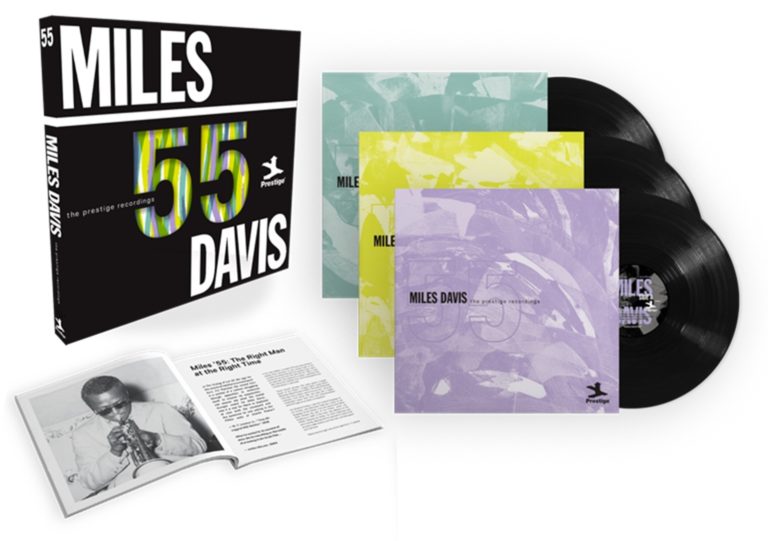
Arriving August 22, Miles ’55 will be available as a 2-CD set, 3-LP set pressed on 180-gram vinyl, and in both standard and hi-res digital audio. All audio has been remastered from the original analog tapes by GRAMMY-winning engineer Paul Blakemore, with lacquers cut for the vinyl version by Kevin Gray at Cohearent Audio while physical editions of the collection offer a new essay by GRAMMY-winning music historian Ashley Kahn (author of Kind of Blue: The Making of the Miles Davis Masterpiece), as well as insightful session notes by GRAMMY-winning writer, Dan Morgenstern. The complete collection is available to pre-order/pre-save, while the track “There Is No Greater Love” can be streamed today.
The collection builds on Craft’s Miles ’54 box set, which was released to broad acclaim last fall. Tape Op called Miles ’54 “A beautiful box set…The pressings in this release are excellent and sound incredible.” UNCUT added, “If you’re curious about this period in [Davis’] career, the newly mastered and lovingly packaged Miles ’54 is a fantastic place to start.” Tracking Angle noted that the remaster sounded “crisp and dynamic,” with “the bass thumpingly clear and precise, the trumpet golden, the other horns billowing brass and air, and the piano… percussive and blooming—in many ways, fuller-sounding,” while also praising the pressing as being on par with far more expensive editions. Nate Chinen at WRTI, Record Collector praised its “dynamic remastering,” declaring the tracks to sound “breathtakingly fresh.”
“There was a particular sound that had defined the ’50s,” writes Ashley Kahn in the Miles ’55 liner notes. “It was an approach that balanced a modern, post-bop feel with echoes of a simpler time. And it belonged to one trumpet player in particular.” That musician was none other than Miles Davis (1926 – 1991). By the middle of the decade, Davis was confidently finding himself as a musician, composer, and bandleader. He had certainly paid his dues. After cutting his chops with such luminaries as Charlie Parker, Dizzy Gillespie, and Coleman Hawkins, Davis broke out on his own, first forming a nonet (early recordings of which were eventually released as The Birth of Cool), and scoring a recording contract with Prestige Records. Despite his struggles with substance abuse in the first half of the decade, Davis was clean, focused, and ready to get back to work by 1954.
That year, Davis headlined major New York venues, including Birdland, and recorded five landmark sessions for Prestige, resulting in albums like Miles Davis with Sonny Rollins, Miles Davis Quintet, and Miles Davis All Star Sextet. Yet, while 1954 found Davis maturing as an artist, it was the following year that solidified his path as a bandleader and genre-defining musician. Kahn notes, “On Miles’s 1954 recordings, one can hear a pronounced musical consistency coming together. In 1955, one can begin to identify it. His trumpet sound had locked onto an emotionally rich identity, intense and now constant.”
Perhaps Davis’ most defining moment of 1955, however, was the formation of a talent-packed yet virtually unknown ensemble of musicians, now known as the “First Great Quintet.” Featuring Sonny Rollins on tenor saxophone (soon to be replaced by another up-and-comer, John Coltrane), Red Garland on piano, Paul Chambers on bass, and Philly Joe Jones on drums, the group made their debut at Birdland in April. In another milestone, three months later, Davis delivered a momentous performance at the second Newport Jazz Festival. His much-talked-about appearance marked “The real beginning of the Miles Davis legend,” according to jazz critic Joe Goldberg in his 1965 book, Jazz Masters of the Fifties.
In between these key moments, Davis was also spending time in the studio, recording marathon sessions that would yield some of his best albums of the decade. Miles ’55 comprises three of these dates (all captured by the great Rudy Van Gelder) beginning with June 7th. Davis was still in the early days of solidifying his new band, and this date (a quartet setting) features two musicians that would become permanent members: Philly Joe Jones and Red Garland, with the addition of bassist Oscar Pettiford. First released as The Musings of Miles in September 1955, the session was comprised of two Davis originals (“I Didn’t” and “Green Haze”), Dizzy Gillespie’s “A Night in Tunisia,” plus the standards “A Gal in Calico,” “I See Your Face Before Me,” and “Will You Still Be Mine?”
In his track notes, which originally appeared on 1988’s Chronicle: The Complete Prestige Recordings, 1951–1956, Dan Morgenstern writes that this session “Represented the germination of The Quintet,” adding that Davis’ approach to balladry here highlights the “muted…playing that was to make The Quintet and its leader so very popular.” Kahn mirrors this in his commentary, noting that “Miles made the most of that feel in particular. It worked exceedingly well on slower blues and ballads, especially after pushing a Harmon mute into the bell of his horn. He came to use it regularly, and it helped him reveal himself through melody and mood.”
The second session, taking place on August 5th, featured the great vibraphonist Milt Jackson, pianist Ray Bryant, bassist Percy Heath, and Art Taylor, then an up-and-coming drummer. Tenor saxophonist Jackie McLean also joins for two of his own compositions: the bluesy “Dr. Jackle” and the up-tempo “Minor March.” Released in 1956 as Miles Davis and Milt Jackson Quintet/Sextet, the set also features Thad Jones’ “Bitty Ditty” and the reflective “Changes,” penned by Bryant.
Davis’ final session of 1955—captured on November 16th—is the most notable, as it resulted in the bandleader’s debut album with his solidified quintet (Coltrane, Garland, Chambers, and Jones). Released in 1956 as Miles: The New Miles Davis Quintet, the LP was comprised of four standards, an unusually snappy rendition of “How Am I to Know?,” plus “Just Squeeze Me,” “S’posin’,” and “There Is No Greater Love” (the only track not featuring Coltrane), as well as the debut of Benny Golson’s “Stablemates,” and the Davis original, “The Theme,” which would become his classic sign-off.
Simply featuring the bandleader’s first name emblazoned across the cover, the album, Morgenstern writes, “Exemplifies the group’s repertoire, pacing, and presentation.” While the quintet was still gelling, their raw talents were palpable. Morgenstern elaborates: “John Coltrane still seems to be seeking his true identity, he is certainly a new and distinctive voice and a commanding presence, the perfect foil for a fully matured and supremely confident Miles. And that rhythm section, while it was to refine its unity and suppleness even further, is already something to marvel at.”
Although Miles was not initially embraced by critics, the album would later be regarded as a defining moment in the trumpet player’s career. Kahn writes, “In 1965, [jazz critic] Joe Goldberg wrote that ‘It has been called the most important and influential group of its time. But when…Miles was released, few thought so.’ He argued that, in fact, all of Davis’ music since that album—save for his work with Gil Evans, and modal experiments like Kind of Blue—‘has been an extension and further exploration of ideas set down in…Miles.’”
As Davis skyrocketed to international fame, the quintet became the dominant small jazz group of the late ’50s and a defining voice in the hard-bop scene. In the ensuing years, Davis continued to push the limits of jazz music—shaping the sounds of post-bop and fusion, while experimenting with electronic elements, funk, rock, pop, and African rhythms well into the late ’80s. Today, Davis holds a mighty legacy as one of the most important figures of 20th century music, with an influence that expands far behind the realm of jazz.
Click here to pre-order/pre-save Miles ’55: The Prestige Recordings
Tracklist (3-LP):
Side A
1. I Didn’t
2. Will You Still Be Mine?
3. Green Haze
Side B
1. I See Your Face Before Me
2. A Night In Tunisia
3. A Gal In Calico
Side C
1. Dr. Jackle
2. Bitty Ditty
Side D
1. Minor March
2. Changes
Side E
1. Stablemates
2. How Am I To Know?
3. Just Squeeze Me
Side F
1. There Is No Greater Love
2. The Theme
3. S’posin’
Tracklist (2-CD/Digital):
Disc 1
1. I Didn’t
2. Will You Still Be Mine?
3. Green Haze
4. I See Your Face Before Me
5. A Night In Tunisia
6. A Gal In Calico
7. Dr. Jackle
8. Bitty Ditty
Disc 2
1. Minor March
2. Changes
3. Stablemates
4. How Am I To Know?
5. Just Squeeze Me
6. There Is No Greater Love
7. The Theme
8. S’posin’



 Release Date: Friday, July 25, 2025