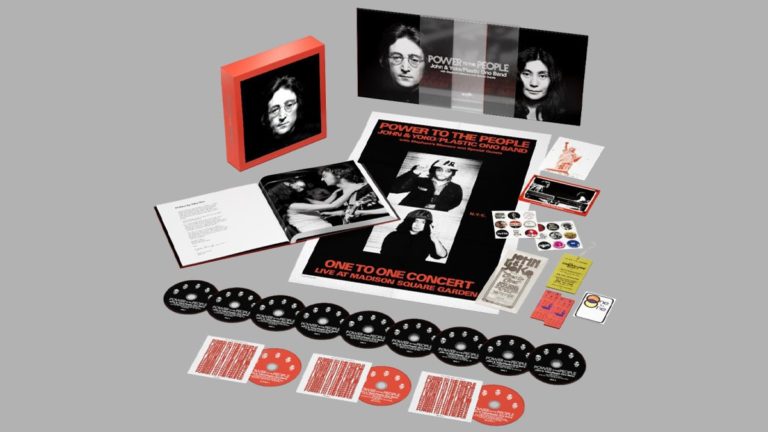
ohn Lennon and Yoko Ono’s non-violent political activism, influential peace and protest anthems, and the couple’s early years in New York City, following their migration from the British countryside to the cultural hotbed of Greenwich Village, which reinvigorated them as artists and galvanized them as activists, will be explored and celebrated in a massive new 12-disc boxed set and digital collection entitled Power To The People (Super Deluxe Edition), out now.
Produced by Sean Ono Lennon and his five-time Grammy Award-winning team, who together took home the 2025 Grammy Award for Best Boxed Set Or Special Limited Edition Package for the innovative and elaborate, bar-raising boxed set, John Lennon’s Mind Games – The Ultimate Collection (Super Deluxe Edition), Power To The People (Super Deluxe Edition) is an exhaustive, lovingly compiled 123-track collection, including 90 never-before-heard and previously unreleased tracks, that chronicles John and Yoko’s most political era. The set spans from Plastic Ono Band’s 1969 Bed-In anti-war anthem “Give Peace A Chance,” to a new version of their pivotal and polarizing 1972 album, Sometime In New York City, and that year’s historic One To One Concerts at Madison Square Garden in NYC – John’s only full-length concerts after leaving The Beatles and also the last concerts John & Yoko ever performed together. It also boasts a wealth of unreleased demos, home recordings, jam sessions, live cuts, unique mixes, and much more.
Power To The People (Super Deluxe Edition) comprises 9 CDs and 3 Blu-ray Audio discs packaged in a bespoke 10-inch slipcase with silver foil titling and a lenticular cover of John and Yoko’s faces that, when layered on top of each other, presents a dynamic 3D effect.
It is accompanied by an illuminating 204-page, deeply researched hardback book designed and edited by Simon Hilton featuring an oral history about all the included music through the words of John & Yoko and those involved, sourced from archival and new interviews. The book is illustrated with unseen photos, lyrics, drawings, tape boxes, and memorabilia. Additionally, the set includes a newspaper print poster, sticker sheets and a VIP envelope containing replica concert tickets, backstage and aftershow passes that have all been uniquely reproduced with textured, archival materials.
The centerpiece of Power To The People is the One To One Concerts, which presents the matinee and evening performances together for the first time. The concerts raised more than $1.5 million (2025 equivalent of $11.5 million) to support children with intellectual and developmental disabilities. All tracks have been completely remixed and re-engineered from the original analog tapes by Paul Hicks and Sam Gannon, using new HD multitrack transfers by Rob Stevens, with the mixes mastered by Alex Wharton at Abbey Road Studios.
The concerts are available separately as both “Afternoon” and “Evening” shows and also as a single “Hybrid” show, which brings together the best performances from both shows. The concerts are available in stereo on the CDs and in HD Stereo and immersive 5.1 HD Surround Sound and Dolby Atmos mixes on the Blu-ray audio discs. Previously, only old mixes of select performances were available on the long-out-of-print 1986 posthumous live album, Live In New York City.
Excerpts from the concerts were featured as part of the new critically acclaimed documentary, One To One: John & Yoko, directed by Kevin Macdonald and Sam Rice-Edwards and Executive Produced by Sean Ono Lennon. One To One, which was in theaters earlier this year, will be streaming on HBO Max this fall.
The films of the remixed, restored, and re-edited concerts are due for release next year as Power To The People, directed by Simon Hilton and edited by Ben Wainwright-Pierce.
The One To One Concert will be available outside of the boxed set in a variety of configurations including the Afternoon and Evening shows as an Audiophile 4 LP Deluxe Collector’s Edition containing four 180-gram black vinyl records with rice paper inner sleeves and an eight-page booklet housed in a 12-inch rigid lift-off-lid box, with the same silver foil titling and lenticular cover as the boxed set as well as the same replica VIP envelope with concert tickets and passes and poster.
A 2 CD Deluxe Edition with a triple gatefold digisleeve featuring a lenticular cover of John and Yoko’s faces includes a 20-page booklet. The hybrid concert will also be available on its own, including on 2 LP 180-gram audiophile black vinyl, limited edition transparent green vinyl and on CD. The vinyl versions contain an eight-page, 12-inch booklet with a six-panel newsprint poster that provides visual and historical context, alongside two full-color postcards.
Power To The People is being previewed with a video for the previously unreleased and newly remixed performance of “Come Together” from the One To One Concert evening show, the second of the two performances that day. John & Yoko are backed by the band Elephant’s Memory and drummer Jim Keltner as they play a blistering version of The Beatles’ Abbey Road classic.
Alongside the concerts, Power To The People (Super Deluxe Edition) offers an aural time capsule of John and Yoko’s first NYC era, when they traded Tittenhurst Park, their estate in Ascot, England, for a small apartment located at 105 Bank St. in Greenwich Village in Manhattan, and includes the music they were inspired to make during a time of great civil unrest and the deeply unpopular Vietnam War. Paramount to their recorded musical endeavors at this time was their 1972 political blockbuster album, Sometime In New York City, recorded by John & Yoko with Keltner and New York’s finest rock ‘n’ roll protest street band, Elephant’s Memory. For this special collection, songs from the album have been completely remixed from scratch, stripped of the overly heavy production sound that constrained such inspired and inspiring songs as “Attica State,” “Angela,” “New York City,” and “Born In A Prison.” The tracks have been reordered, rejuvenated and completely reimagined as a new set of Ultimate Mixes, entitled New York City, which also includes extended versions of “John Sinclair” and “Sunday Bloody Sunday.”
Each track is explored with an Evolution Documentary, a unique track-by-track audio montage by Sam Gannon that details the evolution of each song from demo to master recording via demos, rehearsals, outtakes, multitrack exploration, and studio conversations. A series of four Elements Mixes isolates the orchestral arrangements, opening them up and presenting them on a wider and brighter sound stage, to reveal deeper levels of detail and clarity, especially in 5.1 Surround Sound and Dolby Atmos. The hope is that after hearing the exquisite orchestral arrangements on their own new details previously hidden in the songs will be heard in a completely new way.
Power To The People is rounded out with several discs of never-before-released home recordings and studio jam sessions aptly titled Studio Jam, Live Jam 1, Live Jam 2 and Home Jam. Studio Jam features John & Yoko with Keltner and Elephant’s Memory at Record Plant Studios during the Sometime In New York City sessions, where in between recording album takes, they spontaneously jammed 16 classic rock n’ roll cover versions. Studio Jam gives a tantalizing glimpse into the fun the musicians had as the tape kept rolling between takes and hints at what was in store for John’s classic 1975 album, Rock ‘N’ Roll.
Live Jam comprises two discs of further completely remixed live performances, expanding on the original 1972 Live Jam LP release that accompanied Sometime In New York City, which included performances of “Cold Turkey” and “Don’t Worry Kyoko” from the 1969 Peace and Love for Christmas UNICEF Benefit at The Lyceum Ballroom (with George Harrison, Eric Clapton, Klaus Voormann and a star-studded cast of thousands) and the 1971 Fillmore East show where John & Yoko jammed with Frank Zappa and The Mothers of Invention on four songs.
The Live Jam second disc includes John & Yoko/Plastic Ono Band with musician David Peel and The Lower East Side performing a handful of stripped down songs that would be released the following year on Sometime in New York City, including the first live performance of “Attica State,” along with “The Luck Of The Irish,” “Sisters, O Sisters,” and “John Sinclair,” on December 10, 1971, at the John Sinclair Freedom Rally at Crisler Arena in Ann Arbor, Mich., held in support of the release of political activist John Sinclair who was imprisoned for a 10 year sentence for possession of marijuana.
John and Yoko’s acoustic performance on December 17, 1971 at the Apollo Theatre in Harlem, NYC, at a benefit for the families of victims of the riot at the Attica State Correction Facility includes “Attica State,” the song John & Yoko wrote on John’s birthday (October 10, 1971) a few weeks after the tragedy (September 9-13, 1971), “Sisters, O Sisters” and a poignant performance of “Imagine” on acoustic guitar. Also included are John and Yoko’s TV performances on “The David Frost Show” (with Plastic Ono Band) and at the “Jerry Lewis Muscular Telethon” (with Elephant’s Memory).
The thrilling collection concludes with Home Jam, 33 raw, intimate acoustic demos, covers and home recordings from 1971 from John’s private quarter-inch tape and cassette collections, recorded at the St. Regis Hotel in NYC and the Campus Inn in Ann Arbor, Michigan; the latter includes four tracks with protest singer Phil Ochs.
John’s impromptu covers span songs written or popularized by Buddy Holly, Carl Perkins, Chuck Berry, Duane Eddy, The Dave Clark Five, Elvis Presley, The Everly Brothers, Little Richard, and others. Aside from one, all of tracks have never been released before.
When John Lennon and Yoko Ono arrived in the United States in 1971, they weren’t just escaping the ghosts of the Beatles or the British press; they were seeking a fresh start in a country teetering on the edge of political and cultural transformation. But what awaited them was not just the artistic freedom they craved, but years of surveillance, government harassment, and personal anguish that would shape their early American experience.
They settled at 105 Bank St. in New York City’s Greenwich Village, drawn to the city’s raw energy and progressive undercurrent. Almost immediately, John & Yoko immersed themselves in radical politics and avant-garde art. They aligned with activists, performed at protests, and used their platform to amplify causes like feminism, anti-war resistance, and prison reform.
The couple’s outspoken views and growing ties to the counterculture quickly caught the attention of the Nixon administration. Alarmed by John’s potential influence on young voters, particularly with the 1972 election looming, President Richard Nixon and FBI Director J. Edgar Hoover made John a target. The FBI began extensive surveillance, tapping phones, tailing the couple, and compiling hundreds of pages of intelligence files. The government also launched a campaign to deport John, citing a minor 1968 marijuana conviction in the UK as a pretext.
At the same time, Yoko was fighting her personal battle: to locate and regain custody of her daughter, Kyoko, who had been abducted by her ex-husband, Anthony Cox and disappeared. Unbeknownst to Yoko, he had hidden himself and their child behind the walls of a religious cult in Idaho. Her grief over Kyoko’s absence haunted both her art and private life.
Amid all this turmoil, John & Yoko continued to perform and create. Their 1972 album Sometime in New York City reflected their politics and passions, addressing everything from racial injustice, the Attica Prison riots, civil rights activists like Angela Davis, to women’s liberation, using blunt lyrics and sharp wit to confront inequality and oppression. John & Yoko share lead vocals throughout, with Yoko contributing a number of her own politically charged tracks such as “We’re All Water” and “Sisters, O Sisters.” Designed to resemble a newspaper, the record’s cover mimics the New York Times, complete with headlines, columns, and photos that reflect the themes addressed in the songs, underscoring its mission to inform, provoke, and spark dialogue. The album was recorded primarily at New York’s Record Plant Studios with backing by Elephant’s Memory, a hard-edged local band known for their activism and gritty sound. The group, consisting of Adam Ippolito (keyboards), Gary Van Scyoc (bass), Richard Frank Jr. (drums), Wayne “Tex” Gabriel (guitar), Stan Bronstein (saxophone), plus drummer Jim Keltner, provided a muscular, streetwise foundation for the record’s mix of rock, soul, and protest music. Phil Spector co-produced the album alongside John and Yoko, continuing a collaboration that began with Imagine.
On August 30, 1972, John Lennon and Yoko Ono/Plastic Ono Band, backed by Elephant’s Memory, and joined by special guests, headlined two historic One to One Benefit Concerts at Madison Square Garden in New York City. These performances included an afternoon matinee and an evening performance, held to a combined audience of 40,000 people, raising more than $1.5 million (today’s equivalent of $11.5 million) to support children with with intellectual and developmental disabilities, including children from the Willowbrook State School in Staten Island, N.Y. John & Yoko became aware of Willowbrook, a state-supported institution for physically and mentally handicapped children, after seeing an investigative report from Geraldo Rivera that exposed the horrible conditions and questionable medical practices the children endured. The electrifying concert featured songs from across John and Yoko’s solo albums, songs from their just-released album, Sometime In New York City, a Beatles cut and and peace anthems like “Imagine” and “Give Peace A Chance.” It also included an appearance from Stevie Wonder. These were John Lennon’s only full-length concerts after leaving The Beatles.
The pressure mounted in late 1972 as legal battles over John’s immigration status dragged on. For several years, the threat of deportation loomed large. With the help of attorney Leon Wildes, John challenged the government’s case, and by 1975, just as the Watergate scandal brought down Nixon, the tide turned. John was finally granted permanent U.S. residency in 1976.
The early 1970s were a defining period for John & Yoko – a time of political activism, intense scrutiny, legal struggle, and profound personal pain. But through it all, they remained united in their mission to challenge the system, express themselves freely, and, above all, imagine a better world. Power To The People stunningly documents this vital era in John and Yoko’s musical and personal lives.