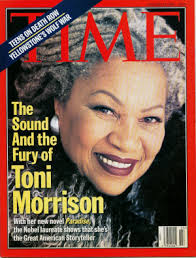
Toni Morrison, the brilliant American novelist, editor, teacher, and Professor Emeritus at Princeton University. In 1993, Morrison was awarded the Nobel Prize in Literature, becoming the first black woman of any nationality to win the prize. Her speech is still one of the powerful moments at the events I’ve ever heard.
Listen to an Audio Recording of Toni Morrison’s Nobel Lecture here.
“Once upon a time there was an old woman. Blind but wise.” Or was it an old man? A guru, perhaps. Or a griot soothing restless children. I have heard this story, or one exactly like it, in the lore of several cultures.
“Once upon a time there was an old woman. Blind. Wise.”
In the version I know the woman is the daughter of slaves, black, American, and lives alone in a small house outside of town. Her reputation for wisdom is without peer and without question. Among her people she is both the law and its transgression. The honor she is paid and the awe in which she is held reach beyond her neighborhood to places far away; to the city where the intelligence of rural prophets is the source of much amusement.
One day the woman is visited by some young people who seem to be bent on disproving her clairvoyance and showing her up for the fraud they believe she is. Their plan is simple: they enter her house and ask the one question the answer to which rides solely on her difference from them, a difference they regard as a profound disability: her blindness. They stand before her, and one of them says, “Old woman, I hold in my hand a bird. Tell me whether it is living or dead.”
She does not answer, and the question is repeated. “Is the bird I am holding living or dead?”
Still she doesn’t answer. She is blind and cannot see her visitors, let alone what is in their hands. She does not know their color, gender or homeland. She only knows their motive.
The old woman’s silence is so long, the young people have trouble holding their laughter.
Finally she speaks and her voice is soft but stern. “I don’t know”, she says. “I don’t know whether the bird you are holding is dead or alive, but what I do know is that it is in your hands. It is in your hands.”
Her answer can be taken to mean: if it is dead, you have either found it that way or you have killed it. If it is alive, you can still kill it. Whether it is to stay alive, it is your decision. Whatever the case, it is your responsibility.
For parading their power and her helplessness, the young visitors are reprimanded, told they are responsible not only for the act of mockery but also for the small bundle of life sacrificed to achieve its aims. The blind woman shifts attention away from assertions of power to the instrument through which that power is exercised.
Speculation on what (other than its own frail body) that bird-in-the-hand might signify has always been attractive to me, but especially so now thinking, as I have been, about the work I do that has brought me to this company. So I choose to read the bird as language and the woman as a practiced writer. She is worried about how the language she dreams in, given to her at birth, is handled, put into service, even withheld from her for certain nefarious purposes. Being a writer she thinks of language partly as a system, partly as a living thing over which one has control, but mostly as agency – as an act with consequences. So the question the children put to her: “Is it living or dead?” is not unreal because she thinks of language as susceptible to death, erasure; certainly imperiled and salvageable only by an effort of the will. She believes that if the bird in the hands of her visitors is dead the custodians are responsible for the corpse. For her a dead language is not only one no longer spoken or written, it is unyielding language content to admire its own paralysis. Like statist language, censored and censoring. Ruthless in its policing duties, it has no desire or purpose other than maintaining the free range of its own narcotic narcissism, its own exclusivity and dominance. However moribund, it is not without effect for it actively thwarts the intellect, stalls conscience, suppresses human potential. Unreceptive to interrogation, it cannot form or tolerate new ideas, shape other thoughts, tell another story, fill baffling silences. Official language smitheryed to sanction ignorance and preserve privilege is a suit of armor polished to shocking glitter, a husk from which the knight departed long ago. Yet there it is: dumb, predatory, sentimental. Exciting reverence in schoolchildren, providing shelter for despots, summoning false memories of stability, harmony among the public.
She is convinced that when language dies, out of carelessness, disuse, indifference and absence of esteem, or killed by fiat, not only she herself, but all users and makers are accountable for its demise. In her country children have bitten their tongues off and use bullets instead to iterate the voice of speechlessness, of disabled and disabling language, of language adults have abandoned altogether as a device for grappling with meaning, providing guidance, or expressing love. But she knows tongue-suicide is not only the choice of children. It is common among the infantile heads of state and power merchants whose evacuated language leaves them with no access to what is left of their human instincts for they speak only to those who obey, or in order to force obedience.
The systematic looting of language can be recognized by the tendency of its users to forgo its nuanced, complex, mid-wifery properties for menace and subjugation. Oppressive language does more than represent violence; it is violence; does more than represent the limits of knowledge; it limits knowledge. Whether it is obscuring state language or the faux-language of mindless media; whether it is the proud but calcified language of the academy or the commodity driven language of science; whether it is the malign language of law-without-ethics, or language designed for the estrangement of minorities, hiding its racist plunder in its literary cheek – it must be rejected, altered and exposed. It is the language that drinks blood, laps vulnerabilities, tucks its fascist boots under crinolines of respectability and patriotism as it moves relentlessly toward the bottom line and the bottomed-out mind. Sexist language, racist language, theistic language – all are typical of the policing languages of mastery, and cannot, do not permit new knowledge or encourage the mutual exchange of ideas.
The old woman is keenly aware that no intellectual mercenary, nor insatiable dictator, no paid-for politician or demagogue; no counterfeit journalist would be persuaded by her thoughts. There is and will be rousing language to keep citizens armed and arming; slaughtered and slaughtering in the malls, courthouses, post offices, playgrounds, bedrooms and boulevards; stirring, memorializing language to mask the pity and waste of needless death. There will be more diplomatic language to countenance rape, torture, assassination. There is and will be more seductive, mutant language designed to throttle women, to pack their throats like paté-producing geese with their own unsayable, transgressive words; there will be more of the language of surveillance disguised as research; of politics and history calculated to render the suffering of millions mute; language glamorized to thrill the dissatisfied and bereft into assaulting their neighbors; arrogant pseudo-empirical language crafted to lock creative people into cages of inferiority and hopelessness.
Underneath the eloquence, the glamor, the scholarly associations, however stirring or seductive, the heart of such language is languishing, or perhaps not beating at all – if the bird is already dead.
She has thought about what could have been the intellectual history of any discipline if it had not insisted upon, or been forced into, the waste of time and life that rationalizations for and representations of dominance required – lethal discourses of exclusion blocking access to cognition for both the excluder and the excluded.
The conventional wisdom of the Tower of Babel story is that the collapse was a misfortune. That it was the distraction, or the weight of many languages that precipitated the tower’s failed architecture. That one monolithic language would have expedited the building and heaven would have been reached. Whose heaven, she wonders? And what kind? Perhaps the achievement of Paradise was premature, a little hasty if no one could take the time to understand other languages, other views, other narratives period. Had they, the heaven they imagined might have been found at their feet. Complicated, demanding, yes, but a view of heaven as life; not heaven as post-life.
She would not want to leave her young visitors with the impression that language should be forced to stay alive merely to be. The vitality of language lies in its ability to limn the actual, imagined and possible lives of its speakers, readers, writers. Although its poise is sometimes in displacing experience it is not a substitute for it. It arcs toward the place where meaning may lie. When a President of the United States thought about the graveyard his country had become, and said, “The world will little note nor long remember what we say here. But it will never forget what they did here,” his simple words are exhilarating in their life-sustaining properties because they refused to encapsulate the reality of 600, 000 dead men in a cataclysmic race war. Refusing to monumentalize, disdaining the “final word”, the precise “summing up”, acknowledging their “poor power to add or detract”, his words signal deference to the uncapturability of the life it mourns. It is the deference that moves her, that recognition that language can never live up to life once and for all. Nor should it. Language can never “pin down” slavery, genocide, war. Nor should it yearn for the arrogance to be able to do so. Its force, its felicity is in its reach toward the ineffable.
Be it grand or slender, burrowing, blasting, or refusing to sanctify; whether it laughs out loud or is a cry without an alphabet, the choice word, the chosen silence, unmolested language surges toward knowledge, not its destruction. But who does not know of literature banned because it is interrogative; discredited because it is critical; erased because alternate? And how many are outraged by the thought of a self-ravaged tongue?
Word-work is sublime, she thinks, because it is generative; it makes meaning that secures our difference, our human difference – the way in which we are like no other life.
We die. That may be the meaning of life. But we do language. That may be the measure of our lives.
“Once upon a time, …” visitors ask an old woman a question. Who are they, these children? What did they make of that encounter? What did they hear in those final words: “The bird is in your hands”? A sentence that gestures towards possibility or one that drops a latch? Perhaps what the children heard was “It’s not my problem. I am old, female, black, blind. What wisdom I have now is in knowing I cannot help you. The future of language is yours.”
They stand there. Suppose nothing was in their hands? Suppose the visit was only a ruse, a trick to get to be spoken to, taken seriously as they have not been before? A chance to interrupt, to violate the adult world, its miasma of discourse about them, for them, but never to them? Urgent questions are at stake, including the one they have asked: “Is the bird we hold living or dead?” Perhaps the question meant: “Could someone tell us what is life? What is death?” No trick at all; no silliness. A straightforward question worthy of the attention of a wise one. An old one. And if the old and wise who have lived life and faced death cannot describe either, who can?
But she does not; she keeps her secret; her good opinion of herself; her gnomic pronouncements; her art without commitment. She keeps her distance, enforces it and retreats into the singularity of isolation, in sophisticated, privileged space.
Nothing, no word follows her declaration of transfer. That silence is deep, deeper than the meaning available in the words she has spoken. It shivers, this silence, and the children, annoyed, fill it with language invented on the spot.
“Is there no speech,” they ask her, “no words you can give us that helps us break through your dossier of failures? Through the education you have just given us that is no education at all because we are paying close attention to what you have done as well as to what you have said? To the barrier you have erected between generosity and wisdom?
“We have no bird in our hands, living or dead. We have only you and our important question. Is the nothing in our hands something you could not bear to contemplate, to even guess? Don’t you remember being young when language was magic without meaning? When what you could say, could not mean? When the invisible was what imagination strove to see? When questions and demands for answers burned so brightly you trembled with fury at not knowing?
“Do we have to begin consciousness with a battle heroines and heroes like you have already fought and lost leaving us with nothing in our hands except what you have imagined is there? Your answer is artful, but its artfulness embarrasses us and ought to embarrass you. Your answer is indecent in its self-congratulation. A made-for-television script that makes no sense if there is nothing in our hands.
“Why didn’t you reach out, touch us with your soft fingers, delay the sound bite, the lesson, until you knew who we were? Did you so despise our trick, our modus operandi you could not see that we were baffled about how to get your attention? We are young. Unripe. We have heard all our short lives that we have to be responsible. What could that possibly mean in the catastrophe this world has become; where, as a poet said, “nothing needs to be exposed since it is already barefaced.” Our inheritance is an affront. You want us to have your old, blank eyes and see only cruelty and mediocrity. Do you think we are stupid enough to perjure ourselves again and again with the fiction of nationhood? How dare you talk to us of duty when we stand waist deep in the toxin of your past?
“You trivialize us and trivialize the bird that is not in our hands. Is there no context for our lives? No song, no literature, no poem full of vitamins, no history connected to experience that you can pass along to help us start strong? You are an adult. The old one, the wise one. Stop thinking about saving your face. Think of our lives and tell us your particularized world. Make up a story. Narrative is radical, creating us at the very moment it is being created. We will not blame you if your reach exceeds your grasp; if love so ignites your words they go down in flames and nothing is left but their scald. Or if, with the reticence of a surgeon’s hands, your words suture only the places where blood might flow. We know you can never do it properly – once and for all. Passion is never enough; neither is skill. But try. For our sake and yours forget your name in the street; tell us what the world has been to you in the dark places and in the light. Don’t tell us what to believe, what to fear. Show us belief s wide skirt and the stitch that unravels fear’s caul. You, old woman, blessed with blindness, can speak the language that tells us what only language can: how to see without pictures. Language alone protects us from the scariness of things with no names. Language alone is meditation.
“Tell us what it is to be a woman so that we may know what it is to be a man. What moves at the margin. What it is to have no home in this place. To be set adrift from the one you knew. What it is to live at the edge of towns that cannot bear your company.
“Tell us about ships turned away from shorelines at Easter, placenta in a field. Tell us about a wagonload of slaves, how they sang so softly their breath was indistinguishable from the falling snow. How they knew from the hunch of the nearest shoulder that the next stop would be their last. How, with hands prayered in their sex, they thought of heat, then sun. Lifting their faces as though it was there for the taking. Turning as though there for the taking. They stop at an inn. The driver and his mate go in with the lamp leaving them humming in the dark. The horse’s void steams into the snow beneath its hooves and its hiss and melt are the envy of the freezing slaves.
“The inn door opens: a girl and a boy step away from its light. They climb into the wagon bed. The boy will have a gun in three years, but now he carries a lamp and a jug of warm cider. They pass it from mouth to mouth. The girl offers bread, pieces of meat and something more: a glance into the eyes of the one she serves. One helping for each man, two for each woman. And a look. They look back. The next stop will be their last. But not this one. This one is warmed.”
It’s quiet again when the children finish speaking, until the woman breaks into the silence.
“Finally”, she says, “I trust you now. I trust you with the bird that is not in your hands because you have truly caught it. Look. How lovely it is, this thing we have done – together.”