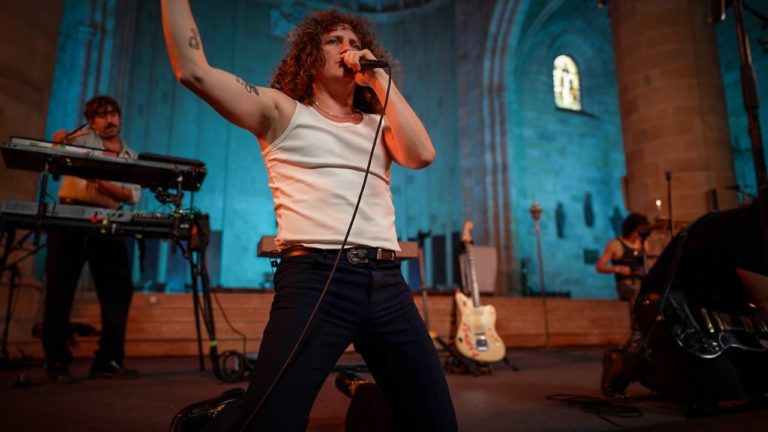
Few bands command a festival headline slot the way Arctic Monkeys do, and their 2023 NOS Alive performance on the Portuguese coast is proof of exactly that, opening with the cinematic atmosphere of “Sculptures of Anything Goes” from ‘The Car’ before detonating into “Brianstorm” and never really letting the crowd breathe again. Alex Turner moved through the set with the kind of cool, unhurried confidence that only comes from two decades of owning stages, weaving together the raw Sheffield punk energy of “The View From the Afternoon” and “Fluorescent Adolescent” with the desert-rock swagger of “Why’d You Only Call Me When You’re High?” and “Do I Wanna Know?”, and closing the encore with John Cooper Clarke’s “I Wanna Be Yours” before finishing on the one-two gut punch of “I Bet You Look Good on the Dancefloor” and “R U Mine?”.
Video: Linkin Park’s Emotional Return to the Stage Introduced a New Era With Emily Armstrong at Warner Bros. Studios
On September 5, 2024, Linkin Park made one of the most emotionally charged returns in rock history, performing a globally livestreamed set at Warner Bros. Studios in Burbank for a small audience of fan club members that served as both a world introduction to their new lineup and the official announcement of eighth studio album ‘From Zero’. New co-lead vocalist Emily Armstrong, known for her work with Dead Sara, stepped into the role alongside Mike Shinoda, with Colin Brittain joining on drums, and the band opened with the live debut of “The Emptiness Machine” before moving through a set of new material and beloved classics that honored Chester Bennington’s legacy while making clear the band had the courage to move forward.
Bruce Springsteen, Jon Bon Jovi and Kenny Chesney Lead Star-Studded Jersey Shore Concert Celebrating America’s 250th Birthday
Two nights. One stage. A lineup that spans the full breadth of American music history. Bruce Springsteen and Jon Bon Jovi headline “Music America: The Songs That Shaped Us,” a two-night concert event on June 4 and 5 at the OceanFirst Bank Center on the campus of Monmouth University in New Jersey. The shows mark America’s 250th birthday and arrive three days before the official opening of the Bruce Springsteen Center for American Music on June 7. Tickets go on sale April 21 at noon at springsteencenter.org.
The supporting lineup reads like a who’s who of American music across generations. Kenny Chesney, Mavis Staples, Public Enemy, Jackson Browne, Rosanne Cash, Gary Clark Jr., Dion, Dropkick Murphys, Shemekia Copeland, Valerie June, Keb’ Mo’, Nils Lofgren, Darlene Love, David Sancious, Stevie Van Zandt, Jimmie Vaughan, Trombone Shorty and the New Breed Brass Band, and more are all on the bill. The Disciples of Soul serve as the house band. Additional artists are still to be announced.
Each performer is slated to play landmark songs from American music history, spanning blues, bluegrass, rock, hip-hop, folk, jazz, country, and gospel. Narration will provide context before each performance, tying the songs to their cultural and historical significance. Robert Santelli, executive director of the Springsteen Center and executive producer of the concerts, describes it as “a journey through American music history,” one that reflects the power of music to unite people across a divided cultural landscape.
The event connects to a broader celebration that began in 2024 with “Music America: Iconic Objects from America’s Music History,” a traveling exhibition currently on display at the Folk Americana Roots Hall of Fame in Boston. Tickets for each night are sold separately and go on sale April 21.
Concert Dates:
June 4 – Tinton Falls, NJ @ OceanFirst Bank Center, Monmouth University
June 5 – Tinton Falls, NJ @ OceanFirst Bank Center, Monmouth University
Video: Green Day Brings the Saviors Tour to 52,000 Fans at São Paulo’s The Town Festival
Green Day’s September 2025 headline set at The Town Festival in São Paulo is punk-rock at stadium scale, and every second of it delivers. Playing to 52,000 at Cidade da Música in Interlagos on the Saviors Tour, Billie Joe Armstrong and Tré Cool tore through 90 minutes of material spanning decades of catalog, blending tracks from ‘Saviors’ with classics like “Basket Case” in front of a Brazilian crowd that came ready to ignite.
Video: Shawn Mendes Turns Munich’s Superbloom Festival Into a Full-Scale Pop Event
Shawn Mendes’s 2025 Superbloom Festival set in Munich is the full picture of where he stands as a live performer, and it’s a strong one. Running through “There’s Nothing Holdin’ Me Back,” “Treat You Better,” “Señorita,” “Stitches,” “In My Blood,” and “Wonder,” Mendes holds a festival crowd with raw vocal power and genuine emotional connection, moving between high-energy pop and reflective ballads without losing a single person along the way.
Video: Chappell Roan’s Rock En Seine Set Proves She’s the Most Exciting Live Act in Pop Right Now
Chappell Roan’s 2025 Rock En Seine set in Paris is one for the record books, and now it’s captured on film for everyone who wasn’t there. Opening with “Super Graphic Ultra Modern Girl” and burning through “Femininomenon,” “HOT TO GO!,” “Red Wine Supernova,” and closing on “Pink Pony Club,” Roan commands the stage with theatrical precision, genuine emotion, and the kind of synth-pop swagger that makes a Paris crowd feel like the whole world is watching.
Common Audio Myths Debunked: What Actually Improves Sound Quality?
By Mitch Rice
When it comes to audio, opinions are everywhere. From forums to social media threads, everyone seems to have a “secret” tip for better sound. The problem is that many of these ideas are based on outdated assumptions, marketing hype, or simple misunderstandings. As a result, listeners often spend time and money chasing improvements that don’t deliver meaningful results.
This article takes a closer look at some of the most common audio myths and separates them from practical, proven factors that truly affect sound quality. Whether you’re building a home listening setup or refining your portable gear, understanding what matters can help you make smarter decisions.
Myth 1: More Expensive Always Means Better Sound
It’s easy to assume that higher price tags guarantee superior audio performance. While premium gear often includes better materials and engineering, cost alone doesn’t determine sound quality.
Several factors influence whether a piece of equipment will actually sound better:
- System Synergy: Components must work well together. A high-end amplifier paired with mismatched headphones may underperform.
- Listening Environment: Room acoustics or background noise can limit what you hear, regardless of equipment quality.
- Personal Preference: Sound signatures vary. What sounds “better” is often subjective.
In practice, a thoughtfully selected mid-range setup can outperform an expensive but poorly matched system. Instead of focusing solely on price, it’s more useful to evaluate how each component contributes to the overall listening experience.
Myth 2: High-Resolution Audio Is Always Noticeably Better
High-resolution audio formats promise more detail and clarity. On paper, they offer higher sample rates and bit depths than standard formats. However, the audible difference isn’t always as dramatic as many expect.
For most listeners, improvements depend on:
- The quality of the original recording
- The playback equipment
- The listening environment
If the source material is poorly recorded or heavily compressed, increasing resolution won’t fix those flaws. Likewise, if your headphones or speakers can’t reproduce subtle details, the benefits of high-resolution files may go unnoticed.
That said, high-resolution audio can be worthwhile when paired with a well-balanced system and high-quality recordings. It’s just not the universal upgrade it’s often made out to be.
Myth 3: Cables Make the Biggest Difference
Cables are one of the most debated topics in audio. Some claim that switching cables transforms sound dramatically, while others argue the differences are negligible.
The truth sits somewhere in the middle. Well-made cables can contribute to signal integrity, especially in complex or high-end systems. Poorly constructed cables may introduce noise or signal loss. However, once you reach a certain level of quality, improvements become subtle.
Instead of treating cables as a primary upgrade, it’s better to focus on foundational components first. Brands like Moon Audio are often referenced in discussions about system optimization, particularly when users are refining already solid setups.
For those looking to explore options, browsing curated selections such as moon-audio.com can provide insight into how cables fit into a broader audio system rather than acting as a standalone solution.
Myth 4: Louder Audio Sounds Better
Many people perceive louder sound as better sound. This is a well-known psychological effect. When two audio samples are compared, the louder one often appears more detailed and dynamic, even if the actual quality is identical.
However, increasing volume doesn’t improve fidelity. In fact, it can:
- Introduce distortion
- Mask subtle details
- Lead to listening fatigue
Accurate sound reproduction relies on balance, not volume. A well-calibrated system at moderate levels often reveals more nuance than a louder, less controlled setup.
Myth 5: All Headphones Sound the Same
Headphones vary widely in design, tuning, and performance. Assuming they all sound similar overlooks some key differences that shape the listening experience.
Important distinctions include:
- Driver Type: Dynamic, planar magnetic, and electrostatic drivers each produce sound differently
- Frequency Response: Some headphones emphasize bass, while others focus on clarity or neutrality
- Build and Fit: Comfort and seal affect both sound quality and usability
Choosing the right pair depends on your listening habits and preferences. A headphone that excels in studio monitoring may not be ideal for casual listening, and vice versa.
What Actually Improves Sound Quality?
Now that we’ve addressed common myths, it’s worth focusing on what genuinely makes a difference. Improving sound quality doesn’t require chasing trends. Instead, it involves understanding the fundamentals.
Source Quality Matters Most
Your audio chain starts with the source. High-quality recordings and well-encoded files provide the foundation for everything else. Even the best equipment cannot compensate for poor source material.
System Matching and Balance
Audio components should complement each other. This includes:
- Matching impedance and power requirements
- Pairing warm-sounding gear with neutral components
- Avoiding bottlenecks in the signal chain
A balanced system often delivers better results than a collection of individually impressive but mismatched parts.
Listening Environment
For speaker setups, room acoustics play a major role. Reflections, absorption, and placement all affect how sound reaches your ears. Simple adjustments, such as repositioning speakers or adding soft furnishings, can produce noticeable improvements.
For headphone users, minimizing background noise and ensuring a proper fit can make a significant difference.
Proper Setup and Maintenance
Even high-quality equipment can underperform if it’s not set up correctly. Paying attention to details such as:
- Secure connections
- Correct gain settings
- Clean components
can help maintain consistent performance over time.
A More Practical Approach to Better Audio
Improving sound quality doesn’t have to be complicated. The most effective approach is often the simplest:
- Start with good recordings
- Build a balanced system
- Optimize your listening environment
- Make incremental upgrades based on real needs
This mindset helps avoid unnecessary spending while delivering meaningful improvements. It also shifts the focus from chasing trends to enjoying music the way it was meant to be heard.
Conclusion
Audio myths can be surprisingly persistent. From overestimating the impact of cables to assuming louder always means better, these misconceptions often lead listeners in the wrong direction. By focusing on fundamentals like source quality, system balance, and proper setup, it’s possible to achieve a noticeable improvement without unnecessary complexity.
Ultimately, better sound is about understanding how each part of your system contributes to the whole and making informed choices that align with your listening preferences. As you refine your setup, keeping these principles in mind will lead to a more satisfying and consistent audio experience.
Data and information are provided for informational purposes only, and are not intended for investment or other purposes.