Bob Dylan turns 85 today, May 24, 2026, and there is simply no one else like him. Born Robert Allen Zimmerman in Duluth, Minnesota, he became the most consequential singer-songwriter in the history of popular music, a Nobel Prize laureate, an Academy Award winner, a painter, a sculptor, a radio host, a memoirist, and a relentless touring artist whose Never Ending Tour has now stretched across nearly four decades. To mark the occasion, here are 85 facts about the man, the music, and the remarkable life that continues to unfold.
- Bob Dylan was born Robert Allen Zimmerman on May 24, 1941, at St. Mary’s Hospital in Duluth, Minnesota.
- His Hebrew name is Shabtai Zisel ben Avraham.
- His paternal grandparents emigrated from Odessa in the Russian Empire, fleeing the 1905 pogroms against Jews.
- He grew up in Hibbing, Minnesota, after his family moved there when he was six.
- As a teenager, he heard rock and roll on radio stations broadcasting from Shreveport and Little Rock.
- One of his earliest musical obsessions was Hank Williams, whose voice he described as going “through me like an electric rod.”
- He also fell hard for Johnnie Ray, saying “He was the first singer whose voice and style I totally fell in love with.”
- He formed several bands in high school, including the Golden Chords, performing covers of Little Richard and Elvis Presley.
- Their high school talent show performance was so loud the principal cut the microphone.
- On January 31, 1959, a 17-year-old Dylan saw Buddy Holly perform in Duluth, just four days before Holly’s fatal plane crash.
- In his Nobel Prize lecture, Dylan described Holly as “the archetype. Everything I wasn’t and wanted to be.”
- His 1959 high school yearbook listed his ambition as joining “Little Richard.”
- He performed twice with Bobby Vee in 1959, playing piano and clapping, under the name Elston Gunnn.
- He enrolled at the University of Minnesota in September 1959 but dropped out in May 1960.
- He began using the name Bob Dylan during his time in Minneapolis, inspired by poet Dylan Thomas.
- In January 1961, he traveled to New York City to visit his idol Woody Guthrie at Greystone Park Psychiatric Hospital in New Jersey.
- Of Guthrie, Dylan wrote: “He was the true voice of the American spirit. I said to myself I was going to be Guthrie’s greatest disciple.”
- From February 1961, Dylan played clubs around Greenwich Village, picking up material from folk singers including Dave Van Ronk.
- In September 1961, New York Times critic Robert Shelton gave him a career-boosting review at Gerde’s Folk City.
- Dylan played harmonica on folk singer Carolyn Hester’s third album, bringing him to the attention of producer John Hammond.
- Hammond signed Dylan to Columbia Records, launching one of the greatest careers in music history.
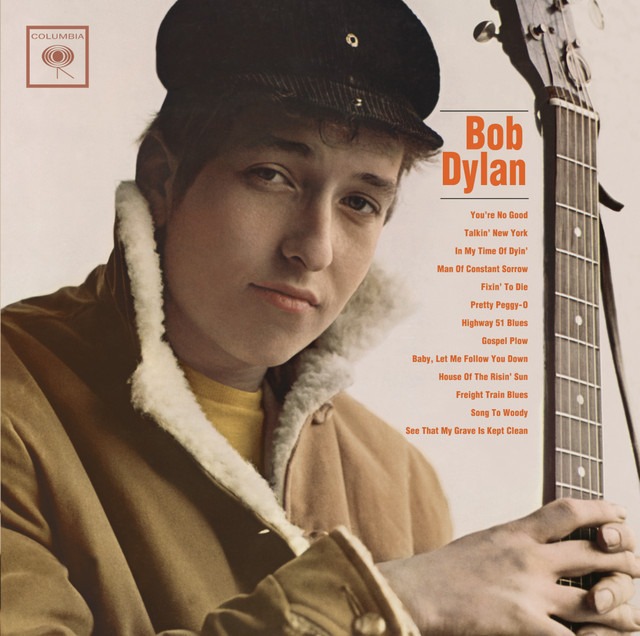
- His debut album Bob Dylan was released March 19, 1962, and sold only 5,000 copies in its first year.
- On August 9, 1962, he legally changed his name to Robert Dylan in St. Louis County Court, Hibbing.
- “Blowin’ in the Wind” partly derived its melody from the traditional slave song “No More Auction Block.”
- Peter, Paul and Mary took “Blowin’ in the Wind” to number one before Dylan had a hit of his own.
- Dylan and Joan Baez sang together at the March on Washington on August 28, 1963.
- He walked out of The Ed Sullivan Show in 1963 rather than drop “Talkin’ John Birch Paranoid Blues” as CBS demanded.
- Johnny Cash wrote a letter to Broadside magazine in March 1964 defending Dylan, ending with: “Shut up! And let him sing!”
- Another Side of Bob Dylan was recorded entirely in a single evening on June 9, 1964.
- On July 25, 1965, Dylan headlined the Newport Folk Festival with an electric band, provoking cheers and boos in equal measure.
- Murray Lerner, who filmed the performance, said: “I absolutely think that they were booing Dylan going electric.”
- “Like a Rolling Stone,” his six-minute 1965 single, was ranked number one on Rolling Stone’s 500 Greatest Songs list in both 2004 and 2011.
- Bruce Springsteen recalled first hearing it: “That snare shot sounded like somebody’d kicked open the door to your mind.”
- Blonde on Blonde (1966) featured what Dylan called “that thin wild mercury sound.”
- At the climax of a 1966 Manchester show, an audience member shouted “Judas!” to which Dylan responded, “I don’t believe you. You’re a liar!” before telling his band to “play it fucking loud.”
- On July 29, 1966, Dylan crashed his motorcycle near his home in Woodstock, New York, breaking vertebrae in his neck.
- The crash gave him the chance to escape the pressures around him. He did not tour again for almost eight years.
- During his Woodstock seclusion, he recorded over 100 songs with The Band, which became The Basement Tapes.
- “All Along the Watchtower,” from John Wesley Harding (1967), was famously covered by Jimi Hendrix, whose version Dylan acknowledged as definitive.
- Nashville Skyline (1969) featured a duet with Johnny Cash and revealed a mellow-voiced Dylan that surprised everyone.
- Variety wrote of his Nashville Skyline voice: “Dylan is definitely doing something that can be called singing.”
- He rejected an invitation to appear at Woodstock, choosing instead to headline the Isle of Wight Festival on August 31, 1969.
- Greil Marcus famously asked “What is this shit?” upon first hearing Self Portrait in 1970.
- Blood on the Tracks (1975) is now widely considered one of his masterpieces, though it received mixed reviews on release.
- His song “Hurricane” (1975), about imprisoned boxer Rubin Carter, ran over eight minutes and was performed at every date of his 1975 Rolling Thunder Revue.
- The Rolling Thunder Revue featured over 100 performers, including Joan Baez, Joni Mitchell, Roger McGuinn, and Mick Ronson.
- He discovered violinist Scarlet Rivera for the Revue by spotting her walking down the street with her violin case on her back.
- In November 1976, Dylan appeared at The Band’s farewell concert alongside Eric Clapton, Muddy Waters, Van Morrison, Neil Young, and Joni Mitchell, documented in Martin Scorsese’s The Last Waltz.
- His 1978 world tour encompassed 114 shows across Japan, the Far East, Europe, and North America, reaching a total audience of two million.
- In the late 1970s, Dylan converted to Evangelical Christianity, attending a three-month discipleship course in California.
- His gospel album Slow Train Coming (1979) was produced by veteran R&B producer Jerry Wexler, who told Dylan during recording: “Bob, you’re dealing with a 62-year-old Jewish atheist. Let’s just make an album.”
- Dylan won the Grammy Award for Best Male Rock Vocal Performance for “Gotta Serve Somebody.”
- John Lennon, shortly before his murder, recorded “Serve Yourself” in response to that song.
- Dylan initiated the Never Ending Tour on June 7, 1988, and has performed roughly 100 dates a year ever since.
- By April 2019, he and his band had played more than 3,000 shows.
- He co-founded the Traveling Wilburys with George Harrison, Jeff Lynne, Roy Orbison, and Tom Petty in 1988.
- Their debut album Traveling Wilburys Vol. 1 reached number three on the US albums chart.
- Despite Orbison’s death in December 1988, the remaining four recorded Traveling Wilburys Vol. 3 in May 1990.
- Oh Mercy (1989), produced by Daniel Lanois, was described by Michael Gray as “the nearest thing to a great Bob Dylan album in the 1980s.”
- “Make You Feel My Love” from Time Out of Mind (1997) has been covered by Billy Joel, Garth Brooks, Adele, and many others.
- Time Out of Mind won Dylan the Grammy Award for Album of the Year, his first.
- Before its release, Dylan was hospitalized with life-threatening pericarditis. He left the hospital saying, “I really thought I’d be seeing Elvis soon.”
- He performed before Pope John Paul II at the World Eucharistic Conference in Bologna in 1997, before an audience of 200,000.
- In 2001, Dylan won an Academy Award for Best Original Song for “Things Have Changed,” written for the film Wonder Boys.
- He released “Love and Theft” on September 11, 2001, producing the album under the alias Jack Frost.
- His 2004 memoir Chronicles: Volume One reached number two on The New York Times Hardcover Non-Fiction bestseller list.
- Martin Scorsese’s documentary No Direction Home premiered in 2005 and earned both a Peabody Award and a Columbia-duPont Award.
- Dylan’s Theme Time Radio Hour on XM Satellite Radio began May 3, 2006, running for 100 episodes with themes including “Weather,” “Weddings,” and, fittingly, “Whiskey.”
- Modern Times (2006) entered the US charts at number one, his first chart-topper since Desire in 1976.
- In October 2007, he appeared in a multi-media campaign for the 2008 Cadillac Escalade.
- He appeared with rapper will.i.am in a Pepsi ad during Super Bowl XLIII in 2009.
- In 2008, the Pulitzer Prize jury awarded him a special citation for “his profound impact on popular music and American culture, marked by lyrical compositions of extraordinary poetic power.”
- Rolling Stone ranked Dylan first on its 2015 list of the 100 Greatest Songwriters of All Time.
- On October 13, 2016, the Nobel Committee awarded Dylan the Nobel Prize in Literature “for having created new poetic expressions within the great American song tradition,” making him the first musician to receive the award.
- Nobel Committee member Horace Engdahl described him as “a singer worthy of a place beside the Greek bards, beside Ovid, beside the Romantic visionaries.”
- In December 2020, Dylan sold his entire song catalog to Universal Music Publishing Group for an estimated $300 to $400 million.
- His album Rough and Rowdy Ways (2020) made him the oldest artist to score a UK number one album of new, original material.
- “Murder Most Foul,” his 17-minute song about the Kennedy assassination, became his first number one on any Billboard chart under his own name.
- Since 1994, Dylan has published ten books of paintings and drawings.
- His sculpture exhibition Mood Swings, featuring seven wrought iron gates, debuted at London’s Halcyon Gallery in 2013.
- One of his most prominent US sculpture installations, Portal, is permanently displayed at the entrance of the MGM National Harbor resort in Maryland.
- A 2021 recording of “Blowin’ in the Wind” sold at Christie’s in London for nearly $1.8 million.
- In November 2022, Dylan apologized for using an autopen to sign books and artwork that had been sold as “hand-signed” since 2019.
- The Bootleg Series Vol. 18: Through the Open Window 1956–1963, released October 31, 2025, received a score of 97 on Metacritic, indicating universal acclaim.
- He has a 2026 touring run underway, still performing, still moving, still refusing to stand still. At 85, the Never Ending Tour continues. As it should.