AVRA BOOM has released her debut EP ‘Live From My Dreams,’ a five-track project blending pop, R&B, and dance music through an emotionally driven lens. The EP opens with the title track “Live From My Dreams,” built around expansive synths and a steady rhythmic pulse that places AVRA’s vocals front and center. The collection establishes a consistent focus on movement, with songs designed to be felt as much as heard. The release presents a cohesive introduction to her sound, shaped by both melody and physical rhythm.
Based in Dallas, Texas, AVRA BOOM is a singer-songwriter, dancer, and composer whose background in dance informs the structure and energy of the EP. Across the project, she explores themes including grief, frustration, and guilt, pairing direct lyrical expression with production that maintains forward motion. She describes her creative approach simply, stating, “I believe that the feelings that live inside your body will always find a way to be released.” The EP closes with “Float,” a spacious, atmospheric track that brings the project to a reflective conclusion.
Max Styler has released ‘Nexus 001,’ the debut compilation from his newly launched Nu Moda imprint. The five-track EP serves as a foundational statement for the label, spotlighting a focused group of rising artists from the indie dance and house underground. The release features exclusive tracks from Welker, Josh Gigante and Ugo Banchi, Mishell, Pavel Petrov, and DvirNuns alongside DOX. Each contribution is designed for late-night club settings, emphasizing groove, tension, and controlled momentum.
The compilation is led by Welker’s “Ice In My Eyes,” which sets the tonal framework for the project. Additional tracks include “Kill Bill” by Josh Gigante and Ugo Banchi, “Desire” from Mishell, “Feel Good Inside” by Pavel Petrov featuring Tyler Hill, and “Here We Go” from DvirNuns and DOX. Collectively, ‘Nexus 001’ presents a concise snapshot of current intersections between indie dance and house, positioning Nu Moda as a label rooted in club functionality and intentional curation.
Australian singer-songwriter Airling has released her new single “Better When You Groove,” the second track revealed from her upcoming EP ‘Retrieve,’ set for release on March 6, 2026. Described by Shepherd as her “love-hate letter to music,” the song centers on creative vulnerability and emotional honesty. Built around smooth R&B-leaning dream-pop production and clear, understated vocals, the track reflects an ongoing dialogue between self-doubt, expression, and artistic commitment. The single functions as a thematic anchor for the EP, highlighting its reflective tone.
Airling, the musical project of Hannah Shepherd, returned in late 2025 with “Mona Lisa,” her first release in eight years. During her time away from music, Shepherd pursued nursing, later returning to songwriting with renewed perspective. ‘Retrieve’ explores themes of loss, recovery, infatuation, and personal power, and was written and recorded with longtime collaborators Tom Iansek and Graham Ritchie. The EP was recorded between Brisbane and Melbourne, with all tracks performed and programmed by the trio.
Vmake AI is a browser-based AI editing tool that helps users improve video quality without turning the process into a technical chore. No downloads or software updates to worry about, just open it up on your laptop, tablet or desktop and you’re good to go.
The entire system is designed for individuals who only need to enhance video quality occasionally rather than becoming a full-on video editing whiz. It takes care of some of the most common issues, like cleaning up the footage, improving the visibility, and clarity of the visual.
Common Use Cases of Vmake AI
Main Features of Vmake
1. Vmake AI Video Enhancer
The Vmake AI Video Enhancer is among Vmake’s primary tools for anyone who wants to improve the clarity of their videos without dedicating a lot of time to manual editing. It can be a great solution for phone videos, old camera footage, or any video that has lost its quality due to compression.
What Vmake AI Video Enhancer does:
Scales videos to 4K
Auto fixes brightness and contrast
Enhances sharpness and clarity
Boosts color quality
Keeps 30 frames per second throughout
How Vmake AI Video Enhancer works: Simply upload your video, keeping it under 200MB. The tool will go frame by frame to spot any issues. Then, it will enhance every little detail, fix blurry parts, and balance the colors throughout. The whole process is done automatically. You are not required to adjust the settings manually.
Vmake AI Video Enhancer is Best for:
User-generated content from customers
Old video footage that looks grainy
Phone videos shot in poor lighting
Social media content that needs to look professional
2. Vmake AI Video Watermark Remover
Removing watermarks usually takes time and manual effort. With Vmake’s video watermark remover, however, this is no longer the case. Vmake does all the work for you, the only thing you have to do is upload your video.
Vmake AI Video Watermark Remover features include:
Removes static text and logos
Removes overlays that move, including TikTok style overlays
Removes semi transparent watermarks
Processes most videos in less than 30 seconds
How Vmake AI Video Watermark Remover works: The tool’s algorithm analyzes each frame to find a watermark block. It then reconstructs the background where the watermark appears. For moving watermarks, Vmake AI Video Watermark Remover monitors watermark position from one frame to the next, filling in the background along the way to make the removal flawless across the entire video.
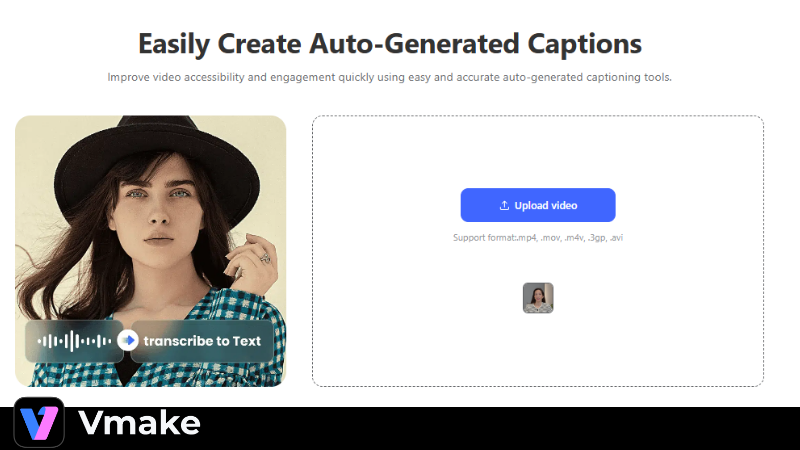
3. Vmake AI Auto Captions
Vmake AI Auto Captions automatically turns spoken words into clear on-screen text without manual transcription. This saves creators from spending hours typing or fixing captions line by line. It works well for anyone who needs captions added fast but does not have time for extra editing work.
Language support by Vmake AI Auto Captions:
English
Spanish
Portuguese
Indonesian
Japanese
Korean
Chinese
What makes Vmake AI Auto Captions useful: The AI listens to your audio and writes out the words with perfect timing. You get synced captions that match exactly when people speak. The tool supports 18+ dynamic templates designed for platforms like Instagram, TikTok, and YouTube.
Customization options of Vmake AI Auto Captions:
Change fonts and colors
Adjust subtitle position
Add animations and effects
Translate captions to other languages
Edit text directly if the AI makes mistakes
Export as video (with burned-in captions) or SRT file
Why people use Vmake AI Auto Captions: Social media videos with captions get 80% more engagement. Captions make your content accessible to people with hearing difficulties and those who watch without sound (which is most mobile users).
4. Vmake AI Background Remover
Vmake AI Background Remover separates the main subject from the background in a video. Once processed, you get a clean subject that can be placed on a new background or used on its own. This helps create more polished videos without needing a green screen setup.
Use cases of Vmake AI Background Remover:
Creating green screen effects
Changing video backgrounds
Making professional marketing videos
Removing distracting elements
How to use Vmake AI Background Remover: Upload your video to the Background Remover tool and get the process rolling. The system then does the magic by automatically detecting the subject and removing the background. When the processing is complete, you can view the outcome and adjust it slightly. Once you are completely satisfied, export the video with a transparent background or place it over another one.
5. Other Notable Features of Vmake AI
Vmake AI Thumbnail Generator:
The Vmake AI Thumbnail Generator is a great tool that can help you create eye-catching thumbnail visuals for your videos and social media. It analyzes your video content to get a vibe of the overall mood and then creates thumbnails that fit your style perfectly—so you don’t have to rush to come up with a design at the last minute.
There are lots of templates available to help you get started, and you can put words down wherever you want without any trouble. Want to spotlight something important or make your message pop? No problem. You get thumbnails that look like you planned them, even if you’ve never touched a design tool in your life.
Vmake AI Noise Reduction:
Do you ever make a perfect video only to find out that the audio is noisy and filled with unwanted sounds? It can be anything from the traffic noise outside, people talking, or simply a mic that is letting you down. In such cases, Vmake’s noise reduction feature is the one to rely on.
Vmake’s noise reduction tool focuses on improving audio quality in videos recorded in imperfect environments. It removes unwanted background sounds so voices come through more clearly and feel easier to listen to.
Vmake AI Video Generation:
Vmake AI Video Generation feature allows users to create videos using text prompts or simple image inputs. This makes it possible to produce basic marketing or product videos without filming new footage.
It works well for fast content creation when time or resources are limited. The tool helps turn ideas into usable video assets that can support ads, product pages, or social posts.
Tips for Getting the Best Results
Start with the best source quality possible. AI can improve videos, but can’t create details that don’t exist.
Test with one video first. Use the preview feature before processing multiple videos.
Use the right resolution. Don’t upscale to 4K if you only need HD – it uses more credits.
Compress large files before uploading. If your video is over 200MB, use a compressor first.
Check subtitle accuracy. Auto captions are about 95% accurate – always review and edit before publishing.
Shoot better footage when possible. Enhancement is great for rescue work, but good original footage is always better.
Pricing and Plans
Is Vmake Safe?
Yes, Vmake is safe for personal and commercial use. The platform:
Uses GDPR-compliant servers
Stores videos for only 7 days
Employs standard security measures
Has clear privacy policies
As with any online service, don’t upload extremely sensitive content without considering the risks.
Bottom Line
Vmake can be a great option for individuals who need QUICK video tweaks without learning complicated technology. Not only does it save several hours of manual effort with the auto features, but the quality produced is quite astonishing. Moreover, the tool improves its features with regular updates. The recent addition of AI hooks and thumbnail generators shows Vmake is adapting to creator needs.
Data and information are provided for informational purposes only, and are not intended for investment or other purposes.
Every artist has a breaking point. Sometimes it’s a bad day in the studio. Sometimes it’s a political mood. Sometimes the amps just accidentally get turned up and nobody stops it. Here are 20 moments when usually non-heavy artists leaned into distortion, volume, rage, or sheer sonic weight – and surprised everyone.
“The Beautiful Ones” – Prince A slow burn that detonates. Prince’s screams at the end sound less like singing and more like emotional freefall.
“Exit” – U2 Dark, grinding, and relentless. Bono sounds possessed, and the band locks into a groove that never lets up.
“Misunderstood” – Wilco Starts inward-looking and ends in shouted existential collapse. Wilco at their most confrontational.
“The Nile Song” – Pink Floyd Proto-punk fury hiding in the Floyd catalogue. Fuzzed-out guitars and zero psychedelia.
“I’m So Afraid” – Fleetwood Mac Especially live, this becomes a showcase for Lindsey Buckingham’s barely contained guitar rage.
“She Shook Me Cold” – David Bowie Sweaty, distorted, and unapologetically heavy. Bowie flirting openly with hard rock and early metal.
“Fire (Mrs. O’Leary’s Cow)” – The Beach Boys Avant-garde chaos from the Smile era. No harmonies, no sunshine, just pure sonic panic.
“State of Grace” – Taylor Swift Big guitars, bigger momentum. A reminder that arena rock lives comfortably in her songwriting DNA.
“Violet Hill” – Coldplay Militaristic drums, distorted bass, and political bite. Coldplay briefly embrace grit over gloss.
“Kiwi” – Harry Styles Raw, chaotic, and loud. Styles tearing through glam-rock energy with zero restraint.
“Don’t Hurt Yourself” – Beyonce Industrial stomp and vocal fury. Beyoncé weaponizes distortion and attitude like a veteran rocker.
“Pressure” – Billy Joel New wave anxiety meets hard-edged rock. Joel sounds genuinely stressed, and it works.
“Dirty Diana” – Michael Jackson Slashing guitars and aggressive vocals. One of the darkest moments in his catalogue.
“Leave It Open” – Kate Bush Unsettling rhythms and clipped vocals. Heavy through tension rather than volume.
“The Overload” – Talking Heads Inspired by post-punk bands they hadn’t even heard yet. Oppressive, slow, and ominous.
“Zombie” – The Cranberries Crunching guitars and raw anger. Dolores O’Riordan sounds ferocious and unfiltered.
“Ogre Battle” – Queen Fantasy lyrics riding a proto-metal riff. Queen flexing their heaviest instincts early on.
“The Knife” – Genesis Violent dynamics and sharp edges. Peter Gabriel-era Genesis going darker than expected.
“Slow Train” – Bob Dylan Lyrically heavy and musically blunt. Dylan trades subtlety for fire-and-brimstone urgency.
“Crazy Horses” – The Osmonds Yes, those Osmonds. A genuinely heavy, proto-metal stomper with a snarling riff and environmental anger, this song blindsided everyone in 1972 and still sounds improbably hard coming from a family pop group.
In a partnership primed for flavor-forward content and one-of-a-kind recipe inspiration, the McCormick brand announces a two-year long collab with lifestyle icon, Paris Hilton and her next-gen media company, 11:11 Media. This partnership is a celebration of delicious food and memorable film and TV moments, all highlighted in a new ad from McCormick that shares how the best food and flavor brings us together.
“I love having family and friends over to enjoy delicious food— whether it’s a big dinner party or a family movie night. There’s nothing quite like sharing a good meal made with the best ingredients,” said Paris Hilton, pop culture icon, co-founder and CEO of 11:11 Media. “I can’t wait to share my favorite ways to use McCormick spices to make flavorful food, lasting memories, and sliving our best lives around the table!”
Just like the iconic scenes from film and TV featured in the new spot – coming soon in January 2026 – McCormick makes even everyday meals best-in-class with their spices, seasonings, and extracts. Hilton and 11:11 Media will serve as a multi-year strategic partner to help the brand evolve and meet the next generation of taste chasers, honoring McCormick heritage while propelling the classic house of flavor into what’s ‘hot’.
“McCormick brings the best flavor to every table, and we’re excited to announce this collaboration with Paris Hilton as we roll out our new McCormick creative spot,” said Tabata Gomez, Chief Marketing Officer at McCormick & Company, Inc. “With Paris’s cultural influence and the unmatched culinary expertise behind the McCormick brand, this partnership inspires consumers everywhere to make their best meals and have fun doing it. We’re excited to connect with them in a fresh, exciting way.”
One year after the Eaton Fire destroyed more than 9,400 structures in Altadena and surrounding communities, Grammy-nominated artist Aloe Blacc is rebuilding his family’s home using an approach that dramatically shortens construction timelines, prioritizes structural resilience and keeps communities whole. Blacc, whose family was also affected by the January 2025 fires, selected LiveLarge Home’s modular building system, a decision that reflects a broader shift among California homeowners seeking faster, more durable rebuilding solutions.
Blacc’s rebuild illustrates challenges facing thousands of displaced families across Los Angeles County. Traditional reconstruction can stretch 18 to 24 months or longer, leaving homeowners in temporary housing as insurance assistance expires and construction costs continue climbing. The emotional and financial strain of prolonged displacement has pushed many residents to explore alternatives that can deliver permanent homes in a fraction of conventional timelines.
“Altadena is home for so many,” said Aloe Blacc, “Through my work helping fire survivors, and managing our property loss, one thing became clear: our community can’t survive if rebuilding takes years. Families need permanent, safe homes they can move into quickly, finding ways to rebuild faster without sacrificing quality, that’s how we keep Altadena whole.”
In November 2025, LiveLarge Home installed the first modules of Blacc’s new residence, marking a tangible milestone in his family’s return to Altadena. The factory-built approach allowed construction to advance in weeks rather than months, with two residential units already in place on the property. This accelerated timeline represents a structural difference from conventional building methods, not simply faster execution of traditional processes.
“Speed matters, but only when quality is not compromised,” said Endong Zhang, CEO of LiveLarge Home. “Traditional rebuilding can take two years or more. We’re cutting that to months, not through shortcuts, but through systematization and precision manufacturing.”
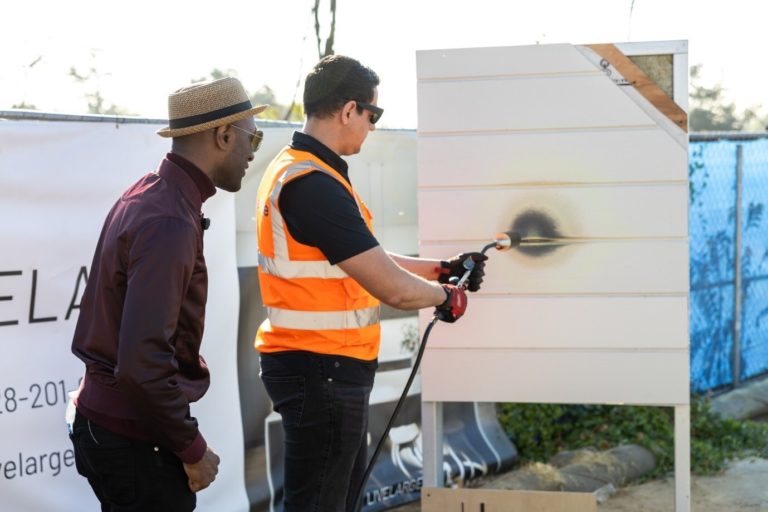
LiveLarge Home’s system centers on light steel frame construction, a non-combustible structural approach that addresses wildfire risk at the foundational level rather than through surface treatments or retrofits. The company has conducted real-world fire resistance testing on its exterior wall systems, demonstrating the ability to withstand direct flame exposure without structural ignition.
The modular units incorporate triple-pane windows, fire-resistant exterior materials, and sealed building envelopes designed to prevent ember penetration, a primary cause of structure loss during wildfires. Factory construction allows for precision installation of these components under controlled conditions, eliminating many variables that can compromise quality in field-built homes.
“This project represents more than a single home,” said Thalia Cheng, President of LiveLarge Home. “It demonstrates a rebuilding pathway that prioritizes speed, safety, and long-term livability model that can be replicated for many families facing the same reality after wildfire.”
Beyond speed, many homeowners are prioritizing structural durability and lower ongoing maintenance compared to traditional builds. Factory-built homes eliminate weather-related construction delays, reduce material waste, and incorporate quality control checkpoints that can be difficult to replicate on conventional job sites.
Blacc, who has helped channel $8 million in direct assistance to 2,300 fire survivors through his work with nonprofit The Change Reaction, understands the urgency families face. “People need to get home,” he said. “Not into temporary housing or stopgaps, but into real, permanent homes where they can rebuild their lives.”
As California confronts the reality of recurring wildfire seasons, the choices homeowners make today are shaping a new standard for post-disaster housing across the state. From Altadena to other fire-vulnerable communities, the conversation has shifted from whether to rebuild to how to rebuild smarter, faster, and more durably than conventional methods allow.
ONES – The Beatles #1 Hits arrives in Toronto for a limited run at the Princess of Wales Theatre, running July 28 through August 2, 2026. Presented by Mirvish Productions, the multi-media concert focuses exclusively on the band’s chart-topping singles, performed note-for-note by Canadian session musicians and five lead vocalists recreating the group’s intricate harmonies. The production also features a live orchestra performing the original string and brass arrangements heard on the recordings.
The show incorporates period-correct instruments, including 28 guitars and vintage amplifiers and drums used to match the sound of the original sessions. Visual elements and archival-style clips are integrated throughout the performance, with narration provided by Toronto radio broadcaster Al Joynes. Performances are scheduled Tuesday through Saturday evenings at 7:30 PM, with matinees Wednesday at 1:30 PM and Saturday and Sunday at 2 PM.
Shintaro Sakamoto shares the new single “Numb,” a tightly wound, groove-driven cut from his forthcoming album ‘Yoo-hoo.’ The track arrives alongside an exclusive live in-studio performance video and highlights Sakamoto’s sharp instinct for rhythm, space, and tone. Built on a minimalist riff and wah-wah guitar, “Numb” locks into a funk-forward pulse, elevated by the crisp horn lines of Tetsu Nishiuchi. The song carries a subtle lyrical warning that unfolds naturally, giving it depth without sacrificing momentum. The response to the track has been immediate and energized, with its groove landing hard and staying there.
‘Yoo-hoo’ is written and produced by Sakamoto and performed with his long-running live band, featuring AYA on bass and Yuta Suganuma on drums and percussion. The album moves fluidly through 1960s soul, surf instrumentals, tropicalia, and mood kayō, reflecting the feel of Sakamoto’s recent international touring. Mixed and mastered by Soichiro Nakamura, the record also includes the singles “Dear Grandpa” and “Is There A Place For You There?” Tracklist highlights include “Protect Your Brain,” “Ghost Town,” and the title track “Yoo-hoo,” forming a cohesive set that sounds lived-in, focused, and joyfully precise.
Phone-based verification is a widely used mechanism in modern digital services, designed to confirm user authenticity and limit automated abuse. It is commonly applied during account registration, login confirmation, or security-sensitive actions such as password recovery. By requiring access to a mobile communication channel, platforms introduce an external validation step that helps distinguish real users from automated systems.
Unlike usernames or passwords, a phone number functions as a persistent identifier. It often remains unchanged for long periods of time and may be reused across multiple services. When shared repeatedly, the same number can become associated with different accounts, technical logs, and usage records. This persistence gives phone numbers a unique role in digital identity structures, but it also introduces challenges related to data management and privacy.
Many online platforms request phone numbers for short-term verification purposes but retain them well beyond their original function. Over time, these numbers may be stored in backups, monitoring systems, or analytical datasets. Each additional instance increases the amount of personal data under a platform’s responsibility and expands the potential impact of future data breaches.
From a security standpoint, phone numbers are frequently targeted in SMS-based phishing and impersonation attacks. Leaked or aggregated number databases are often used to deliver fraudulent messages that imitate legitimate services. Because SMS messages are typically perceived as direct and urgent, they can be more effective than other attack vectors. The broader the distribution of a phone number, the higher the likelihood of misuse.
These factors have led to a gradual reassessment of how phone verification is implemented. Rather than treating phone numbers as permanent identity anchors, some systems now approach verification as a limited, purpose-specific process. This shift reflects broader trends in data minimization and proportional data use, which aim to reduce long-term exposure of personal identifiers.
Services such as smspva.com illustrate this approach by focusing on access to verification workflows rather than long-term identity storage. This model allows users to complete required verification steps while limiting how deeply their personal contact information is embedded across multiple platforms.
Phone verification also plays an important role in professional and technical environments. Developers, testers, and security researchers often need to create accounts for temporary tasks such as validating onboarding flows, testing authentication limits, or analyzing system behavior. Using personal phone numbers in these scenarios can introduce unnecessary risk and complicate data governance, particularly in non-production environments.
From an architectural perspective, phone verification highlights a broader principle in digital system design: not all identifiers need to be permanent. Treating verification data as temporary and context-bound reduces long-term dependencies and simplifies data protection obligations. It also aligns with evolving regulatory and ethical expectations around personal data handling.
As online ecosystems continue to grow and diversify, phone-based verification is likely to remain a common mechanism. However, its role is changing. Instead of serving as a fixed identity marker, the phone number is increasingly viewed as a functional tool with limited scope. This evolution supports more flexible, privacy-aware systems while preserving the security benefits that verification is meant to provide.
In this context, phone verification is not merely a technical feature but a structural element of modern online services—one that reflects ongoing efforts to balance security, usability, and responsible data management in an increasingly interconnected digital environment.
Data and information are provided for informational purposes only, and are not intended for investment or other purposes.