Home Blog Page 371

Rock Guitarist Laura Cox Announces May 2026 UK Tour Supporting New Album ‘Trouble Coming’

0

Celebrated guitarist and singer-songwriter Laura Cox will embark on her UK tour in May 2026. The six-date UK tour includes Edinburgh’s Voodoo Rooms, Newcastle’s Cluny 2, Bristol’s Louisiana, London’s 100 Club, Manchester’s Gullivers, and Nottingham’s Bodega. The tour news coincides with the release of Laura’s fourth studio album ‘Trouble Coming’ via earMUSIC/VeryRecords. To celebrate album release day, Laura released a new single from the album entitled “The Broken,” with Powerplay Magazine’s Mark Lacey noting the single has a pop/punk vibe which is sure to be a live mainstay. Recorded at ICP Studios in Brussels, the album features 11 tracks, mixed and engineered by Jean-Marc Pelatan at Studio des Muses, and mastered by multi-GRAMMY award-winning Ted Jensen.

In 2008, Laura embarked on her journey as a guitar prodigy on YouTube, where she captivated millions of people with her fiery classic rock covers and blues-infused solos. Her talent and charisma quickly propelled her from viral sensation to a celebrated figure in the rock scene, earning widespread acclaim for her raw, retro-inspired sound. After stepping into the spotlight thanks to her own cover versions of blues and rock classics on YouTube, accumulating 903K subscribers and 105 million views, Laura became the guitarist and singer with the most views in the French rock music scene thanks to her first two albums ‘Hard Blues Shot’ from 2017 and ‘Burning Bright’ from 2019. Her album ‘Head Above Water’ from 2023 received praise for its classic-meets-modern rock fusion, and she’s played prominent stages for rock music in France including Hellfest, Download Festival, and Guitare en Scène. With ‘Trouble Coming’, she reveals a more introspective, soulful side without losing the edge that made her stand out in the first place.

Tour Dates:

May 4 – Voodoo Rooms, Edinburgh, UK

May 5 – Cluny 2, Newcastle, UK

May 6 – Louisiana, Bristol, UK

May 8 – 100 Club, London, UK

May 9 – Gullivers, Manchester, UK

May 10 – Bodega, Nottingham, UK

Darkwave Veterans Cold Cave Announce West Coast Tour With Buzz Kull And Rosa Anschütz

0

Cold Cave stay in perpetual motion with the announcement of a West Coast tour in February 2026. In tow will be Sydney’s Buzz Kull, who recently signed with Wes Eisold’s Heartworm Press for their next LP. The creative project of Marc Dwyer, Buzz Kull transcends the archetypal boundaries of darkwave, linking pop sensibilities with spectral, foreboding emotional states that go beyond the circumstantial. Also on the tour is Berlin-born artist Rosa Anschütz, who recently released her album ‘Sabbatical’ via Heartworm Press. Swapping pulsing club beats for raw, cinematic intimacy, Anschütz channels the spectral beauty of Moon Pix-era Cat Power, the mystique of Nico, and the experimental clarity of Björk and Dead Can Dance. Anschütz has shared a new music video for ‘Sabbatical’ album single “Plaster Copy.”

Formed in 2007 by Wesley Eisold, Cold Cave jump started and popularized the resurgence in modern synth and darkwave genres after releasing seminal and influential albums, and were subsequently invited to tour with Depeche Mode, Nine Inch Nails, Ministry, The Cult and The Jesus and Mary Chain along with collaborations and performances with legends Genesis P-Orridge and Mark Lanegan. Eisold and his partner Amy Lee’s mix of celebrated poetry and urgent romantic new wave grants Cold Cave a rare 100% DIY approach to all aspects of their universe, producing and releasing their own music, involved directly with their fans and curating by their own rules.

Tour Dates:

February 13 – The Bellwether, Los Angeles, CA

February 14 – The Observatory, Santa Ana, CA

February 15 – The Chapel, San Francisco, CA

February 20 – Music Box, San Diego, CA

February 21 – Fremont Country Club, Las Vegas, NV

February 22 – La Rosa, Tucson, AZ

February 26 – Neptune Theatre, Seattle, WA

February 28 – Roseland Theater, Portland, OR

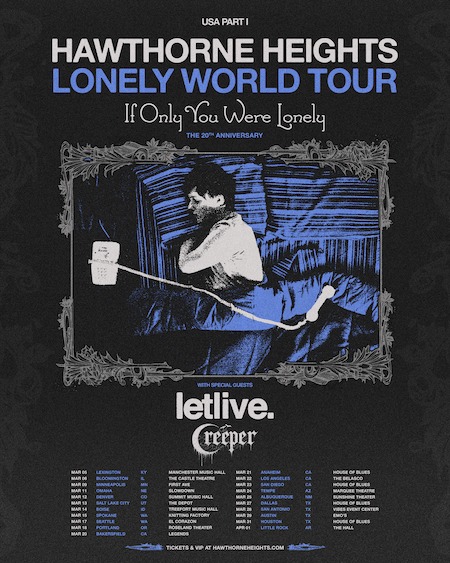
Hawthorne Heights Announce ‘If Only You Were Lonely’ 20th Anniversary Tour With Letlive. And Creeper

0

Headline: Emo/Post-Hardcore Band Hawthorne Heights Announce ‘If Only You Were Lonely’ 20th Anniversary Tour With Letlive. And Creeper

Tags: Hawthorne Heights, JT Woodruff, Mark McMillon, Matt Ridenour, letlive., Creeper, Chiodos, E.N.D. Cruise, Sonic Temple Festival, Slam Dunk Festival, Manchester Music Hall, Castle Theater, First Ave, Summit, The Depot, Treefort Music Hall, Knitting Factory Spokane, El Corazon, Roseland, House of Blues, The Belasco, Marquee, Sunshine Theater, Vibes Event Center, Emo’s, The Hall, Hal and Mal’s, Jack Rabbits, Club LA, The Rex Theater, Wescott Theater, The Blue Note, GLC Live at 20 Monroe, Mercury Ballroom, The Signal, Ozark Music Hall, Minglewood Hall, Mars Music Hall, The Ritz Ybor, Tabernacle, The Dome, Nevermore Hall, Wind Creek Event Center, The Wellmont Theater, Citizens House of Blues, Toyota Oakdale Theater, Empire Live, Electric City, KEMBA Live!, Bogart’s, The Rave, Val Air Ballroom, VooDoo Lounge

Blog Post:

Rock band Hawthorne Heights invites fans to join them in celebrating their acclaimed album ‘If Only You Were Lonely’ in 2026 with a special 20th Anniversary Tour. Featuring special guests letlive. and Creeper, the tour’s first leg kicks off March 5 in Lexington, with stops to follow in Denver, Seattle, Los Angeles, Dallas, Austin, and more. Tickets, including VIP packages, became available October 31 at 10am local time. Frontman JT Woodruff shares, “The best thing about looking back on the last 20 years is that you can do it without the fear of the past, but with the reverence that comes with the time that has actually passed. I feel like all of the noise of that time period was drowned out by the panic and stress that we were living under, when creating If Only You Were Lonely. The pressure of creating a 2nd album was almost too much to enjoy the magic we were creating, or even thinking about it as magic at all.” He continues, “That is how we are approaching the LONELY WORLD TOUR. We will be playing the entire album, with a career spanning setlist, that is a full-on rollercoaster ride designed to make you forget what you are going through alone, while hopping in the car so we can all go through it TOGETHER.”

Formed in Dayton, Ohio in 2001, Hawthorne Heights built their reputation on emotionally raw songwriting, blending the urgency of post-hardcore with the melodic sensibilities of early 2000s emo and punk. Throughout their career, the band has overcome obstacles from unscrupulous record labels and shifting musical trends to unimaginable personal tragedy, yet they’ve persevered. The quartet of JT Woodruff, Mark McMillon, and Matt Ridenour has earned two Gold albums with ‘The Silence in Black and White’ from 2004 and ‘If Only You Were Lonely’ from 2006, written genre-defining anthems like “Ohio Is for Lovers” and “Saying Sorry,” and remained a relentless touring force. Ahead of the anniversary tour, Hawthorne Heights will be on the road this fall for headline dates in addition to supporting Chiodos, with appearances on the E.N.D. Cruise in January and at Sonic Temple Festival and UK’s Slam Dunk Festival in May.

If Only You Were Lonely Tour Dates:

January 22-26 – E.N.D. Cruise, Miami, FL **

March 5 – Manchester Music Hall, Lexington, KY

March 6 – Castle Theater, Bloomington, IL

March 9 – First Ave, Minneapolis, MN

March 12 – Summit, Denver, CO

March 13 – The Depot, Salt Lake City, UT

March 14 – Treefort Music Hall, Boise, ID

March 15 – Knitting Factory Spokane, Spokane, WA

March 17 – El Corazon, Seattle, WA

March 18 – Roseland, Portland, OR

March 21 – House of Blues, Anaheim, CA

March 22 – The Belasco, Los Angeles, CA

March 23 – House of Blues, San Diego, CA

March 24 – Marquee (Half House), Tempe, AZ

March 25 – Sunshine Theater, Albuquerque, NM

March 27 – House of Blues, Dallas, TX

March 28 – Vibes Event Center, San Antonio, TX

March 29 – Emo’s, Austin, TX

March 31 – House of Blues, Houston, TX

April 1 – The Hall, Little Rock, AR

May 14-17 – Sonic Temple Festival **

May 23 – Slam Dunk Festival, Hatfield, UK **

May 24 – Slam Dunk Festival, Leeds, UK **

** – Indicates Festival Date

Payment Orchestration Platform vs Traditional Payment Gateway: Key Differences for Enterprises

0

By Mitch Rice

As digital commerce continues to expand globally, enterprises face increasingly complex payment infrastructure decisions. The choice between implementing a traditional payment gateway and adopting a modern payment orchestration platform can significantly impact operational efficiency, transaction success rates, and overall business growth. Understanding the fundamental differences between these two approaches is crucial for businesses looking to optimize their payment operations in 2025 and beyond.

Understanding Traditional Payment Gateways

A traditional payment gateway serves as a digital bridge between a merchant’s website or application and the payment processor, enabling the secure transmission of transaction data. When a customer initiates a payment, the gateway encrypts sensitive card information and forwards it to the acquiring bank for authorization. Once approved, the gateway communicates the transaction status back to the merchant’s system, completing the payment cycle.

While payment gateways have been the backbone of online transactions for decades, their architecture typically limits businesses to working with a single payment provider or a small number of integrated services. This creates dependencies that can constrain growth, particularly for enterprises operating across multiple markets or seeking to optimize conversion rates. Companies interested in how to build a payment gateway often discover that developing proprietary solutions requires substantial technical resources and ongoing maintenance commitments.

The Evolution to Payment Orchestration

Payment orchestration platforms represent the next generation of payment infrastructure, designed to address the limitations inherent in traditional gateway models. Rather than connecting to a single provider, orchestration platforms integrate with hundreds of payment service providers, acquiring banks, alternative payment methods, and financial institutions through a unified API. This architecture transforms payment management from a linear, single-provider relationship into a dynamic, multi-provider ecosystem that businesses can control and optimize.

The orchestration layer sits above individual payment gateways and processors, managing the entire payment flow across multiple channels and providers. This positioning enables enterprises to route transactions intelligently, implement sophisticated retry logic, and maintain consistent reporting across all payment touchpoints — capabilities that would require extensive custom development with traditional gateway implementations.

Key Architectural Differences

The structural contrast between payment gateways and orchestration platforms creates fundamental operational distinctions. Traditional gateways typically offer one-to-one integration, where each payment provider requires separate technical implementation, testing, and maintenance. Scaling to multiple providers means multiplying integration complexity, with each connection demanding individual attention for updates, compliance changes, and feature enhancements.

Payment orchestration platforms eliminate this multiplicative complexity through a single integration point. Enterprises connect once to the orchestration platform and immediately gain access to 600+ pre-integrated payment providers, banks, and alternative payment methods. When new providers need to be added or existing ones updated, these changes occur at the platform level without requiring merchants to modify their integration. This architecture dramatically reduces technical overhead while increasing flexibility and speed to market.

Transaction Routing and Optimization

One of the most significant differences lies in transaction routing capabilities. Traditional payment gateways process transactions through a predetermined path — each payment follows the same route to the same provider, regardless of variables like card type, transaction amount, customer location, or time of day. This rigid approach can result in suboptimal approval rates and unnecessarily high processing costs.

Payment orchestration platforms introduce intelligent routing engines that evaluate each transaction against customizable parameters and automatically direct it to the best-performing provider. Businesses can configure routing rules based on cost optimization, approval rate maximization, geographic requirements, or any combination of factors relevant to their operations. If a transaction is declined on the first attempt, the platform’s cascading functionality immediately reroutes it through alternative channels, increasing the likelihood of approval within a single payment attempt. This dynamic approach can boost approval rates by up to 30% compared to static gateway configurations.

Provider Redundancy and Resilience

Traditional payment gateways create single points of failure in payment infrastructure. When a gateway experiences downtime, technical issues, or processing disruptions, all transactions dependent on that gateway fail. Businesses have limited recourse beyond waiting for the provider to resolve the problem or implementing complex failover mechanisms that require significant development resources.

Orchestration platforms build resilience into the payment architecture by design. With multiple providers connected simultaneously, the platform can automatically shift transaction volume away from underperforming or unavailable providers without manual intervention. This redundancy ensures business continuity even when individual providers experience difficulties, maintaining consistent payment acceptance and protecting revenue streams from provider-specific outages.

Global Expansion and Localization

Expanding into new geographic markets presents distinct challenges with traditional payment gateways. Each region often has preferred local payment methods, regulatory requirements, and consumer expectations that may not be supported by a business’s existing gateway. Adding coverage for new markets typically requires integrating additional gateways or providers, compounding technical complexity and operational overhead.

Payment orchestration platforms simplify global expansion by providing immediate access to local and regional payment methods across multiple markets through existing platform integration. Enterprises can activate payment options for new countries, configure local currency processing, and implement region-specific routing rules without developing new integrations. This capability allows businesses to test new markets rapidly, adapt to local preferences, and scale internationally without proportional increases in technical complexity.

Data Consolidation and Reporting

Transaction data management differs substantially between the two approaches. Traditional gateways provide reporting and analytics specific to transactions processed through that particular provider. Businesses using multiple gateways must manually consolidate data from different sources, each with its own reporting formats, reconciliation processes, and data structures. This fragmentation creates inefficiencies in financial operations and obscures comprehensive performance insights.

Orchestration platforms aggregate transaction data across all connected providers into unified reporting interfaces. Enterprises gain a single source of truth for payment performance, enabling consistent reconciliation, comprehensive analytics, and strategic decision-making based on complete data rather than provider-specific silos. Automated reconciliation capabilities match transactions across multiple providers and streamline settlement tracking, reducing manual effort and potential errors in financial operations.

Security and Compliance Management

Both payment gateways and orchestration platforms must maintain rigorous security standards and compliance with regulations like PCI DSS. However, the management burden differs significantly. With traditional gateways, especially when using multiple providers, businesses must ensure compliance across each separate integration, multiplying the scope of security audits and compliance maintenance.

Payment orchestration platforms centralize security and compliance management. Network-level tokenization protects sensitive card data across all connected providers, reducing fraud risk by up to 28% while boosting authorization rates. The platform maintains PCI compliance for the entire orchestration layer, simplifying the compliance burden for merchants and enabling consistent security policies across all payment channels. Additionally, advanced fraud prevention engines built into orchestration platforms provide over 150 customizable fraud filters based on decades of combined expertise, adapting to evolving threats in real time.

Cost Structure and Operational Economics

The economic models underlying payment gateways and orchestration platforms reflect their structural differences. Traditional gateways typically charge per-transaction fees, and businesses using multiple gateways pay separate fees to each provider along with the costs of maintaining multiple integrations. While individual gateway fees may appear straightforward, the total cost of ownership includes technical resources for integration and maintenance, opportunity costs from suboptimal routing, and revenue losses from preventable transaction failures.

Payment orchestration platforms introduce transparent cost structures with the potential for significant total cost reduction. By enabling intelligent routing to the most cost-effective providers for specific transaction types and automating many manual processes, orchestration can reduce processing costs by up to 30%. The platform investment is offset by operational efficiencies, reduced technical overhead, improved approval rates, and the ability to negotiate better terms with multiple providers based on comprehensive transaction volume.

Implementation Timeline and Resource Requirements

Implementing traditional payment gateways varies in complexity but typically requires dedicated development resources for integration, testing, and deployment. Each additional gateway multiplies these requirements. Businesses looking to build proprietary solutions face even more substantial commitments, often requiring months of development and ongoing maintenance teams.

Payment orchestration platforms dramatically compress implementation timelines. Enterprises can get payment processing operational within days rather than months, with new provider integrations launching in approximately two weeks. The platform’s unified API eliminates the need to learn multiple provider specifications, and pre-built integrations remove the development burden for each new payment method or provider. This speed enables businesses to respond quickly to market opportunities and competitive pressures.

Strategic Control and Flexibility

Perhaps the most profound difference lies in strategic control. Traditional payment gateway relationships often create vendor lock-in, where switching providers requires significant technical rework and potential business disruption. This dependency limits negotiating leverage and constrains strategic flexibility in response to changing market conditions or business requirements.

Payment orchestration platforms shift control to the enterprise. Businesses can add, remove, or modify provider relationships without disrupting their core payment integration. This flexibility enables continuous optimization, rapid testing of new providers or payment methods, and the ability to negotiate from a position of strength with multiple providers competing for transaction volume. The platform architecture supports experimentation and iteration that would be prohibitively expensive with traditional gateway models.

Conclusion

The distinction between traditional payment gateways and payment orchestration platforms represents more than a technical evolution — it reflects a fundamental shift in how enterprises approach payment infrastructure. While payment gateways remain viable for businesses with simple, single-market payment needs, the complexity of modern commerce increasingly demands the sophistication, flexibility, and optimization capabilities that orchestration platforms provide.

For enterprises operating globally, managing high transaction volumes, or seeking to maximize approval rates and minimize costs, payment orchestration platforms offer compelling advantages. The ability to connect with 600+ payment providers through a single integration, implement intelligent routing and cascading, consolidate data and reporting, and maintain strategic control over payment operations addresses challenges that traditional gateways cannot efficiently solve.

As payment ecosystems continue to evolve with emerging technologies, new payment methods, and changing consumer preferences, the architectural advantages of orchestration platforms position enterprises for long-term success. The investment in modern payment orchestration infrastructure pays dividends through improved conversion rates, reduced operational complexity, enhanced resilience, and the agility to adapt to future payment innovation. In an increasingly competitive digital landscape, the choice of payment infrastructure can determine whether businesses merely process transactions or truly optimize their payment operations as a strategic advantage.

Data and information are provided for informational purposes only, and are not intended for investment or other purposes.


David Bowie Performs 13-Song Set For Live By Request In New York Including “Ziggy Stardust” And “Heroes”

0

David Bowie performed a 13-song set for Live By Request on June 15, 2002 in New York. The performance featured a mix of classics and newer material, opening with “Fame” and “Changes” before moving into “China Girl” and “Slow Burn” from his then-recent album ‘Heathen’. The setlist included iconic tracks like “Starman,” “Let’s Dance,” “Ziggy Stardust,” and “Heroes,” alongside deeper cuts such as “Slip Away,” “5:15 The Angels Have Gone,” and “Sound And Vision.” The show concluded with “Ashes To Ashes” and “I’m Afraid Of Americans,” showcasing Bowie’s ability to blend career-spanning material into a cohesive performance that honored both his past and present work.

LA Rock Duo Jade Street Team With Apple Martin For Dreamy New Single “Satellites”

0

New on the scene with a sound beyond their years, independent LA rock duo Jade Street, comprised of Eli Meyuhas and Zachary Zwelling, has teamed up with Apple Martin and released their highly anticipated new song “Satellites.” The dreamy, atmospheric track was written by Jade Street and features vocals by Martin, marking her musical debut, with an official video now available. Formed in May 2025, Jade Street is a guitar-driven duo from Los Angeles whose music captures the tension between reckless freedom and quiet introspection. “Satellites” is their third release following debut singles “Bad Man” and “Politics,” and showcases a more stripped-down side of the duo. On how the collaboration with Martin came together, Jade Street said, “We wrote ‘Satellites’ around a year ago but it never quite settled into what it wanted to be. It lingered in the background for months until we played it for Apple. Her voice instantly reframed the entire song and gave it a whole new identity. It was clear that she was the missing piece the song needed and from there, the rest of the recording process felt completely instinctive.”

With coverage in Consequence, Harper’s BAZAAR, NME, Vanity Fair and more, buzz for the ethereal track has been growing online and in music circles. Jade Street previewed “Satellites” at their October 17 show at Nashville’s Cannery Hall where Martin joined the duo on-stage for the track’s live debut. As an extension into the ambient world created with “Satellites,” Jade Street released an additional song today in tandem. “June” is now available to stream.

Avoid Announce ‘Creature Of Habit’ EP With New Single “Sour Apple” Visualizer

0

Avoid are thrilled to announce their EP titled ‘Creature of Habit’, arriving via UNFD, is out now. The band has shared the visualizer for the single “Sour Apple.” Vocalist Benny Scholl says, “We’re so stoked to release our new track ‘Sour Apple.’ What’s funny is this name initially came up just as a demo name. ’cause there was a Sour Apple-flavored vape in the room. We worked out the instrumentals, and then when we finished the vocals and the lyrics, we were trying to come up with what the song will be called. The song is about reflecting on the past and letting go, but also being able to be upset when things haven’t always gone your way. In a way, kind of being a ‘Sour Apple’ about things sometimes and we realized that the name ended up representing the song perfectly.”

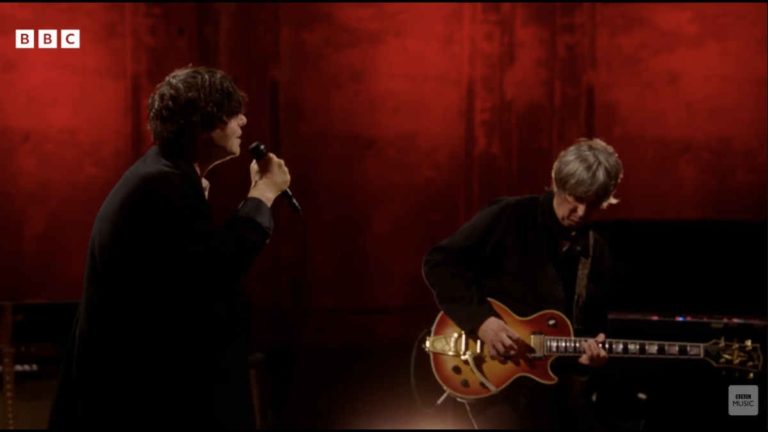
The Charlatans UK Perform Title Track “We Are Love” On Later…With Jools Holland

0

The Charlatans UK brought the title track from their album ‘We Are Love’ to Later…with Jools Holland, with BBC Music sharing the performance online. The album via BMG represents the band’s first release in eight years, marking their longest gap between records. Burgess calls “We Are Love” an open-top car ride through the credits of your favorite movie, driving along the coast to somewhere amazing, while Collins notes the track established the direction for everything else, carrying an energy that pushed the band forward. Their second single “Deeper and Deeper” leans into swirling Hammond organ with thick bass and fuzzy guitars, showing the band’s psychedelic roots while exploring fresh ground.

Spanning four decades with 13 albums, 22 Top 40 UK singles, and three Number One albums, The Charlatans UK remain one of Britain’s most beloved bands behind anthems like “The Only One I Know” and “North Country Boy.” For ‘We Are Love’, the five members scattered across Europe brought in production help from Dev Hynes, Fred Macpherson, and Stephen Street, recording at Rockfield in Wales and their Big Mushroom studio in Cheshire. Returning to Rockfield held deep meaning, as they hadn’t recorded there since making ‘Tellin’ Stories’ nearly 30 years ago, the album where keyboard player Rob Collins died in a car crash during sessions. Burgess says going back to Rockfield honored every member who has played in the band while creating something completely new.

Emo/Post-Hardcore Band Seahaven Announce ‘Winter Forever’ 15th Anniversary Tour With Full Album Performance

0

Seahaven will celebrate the 15th anniversary of their debut album ‘Winter Forever’ with a special tour in early 2026, performing the record in full for the first time. The run gives fans a chance to hear the entire album live, a release that became a cornerstone for the band and resonated across emo, indie, and post-hardcore communities. An exclusive vinyl variant of ‘Winter Forever’ will be sold at shows. The band notes the record holds special significance for them and they’re looking forward to sharing this milestone with longtime supporters. Released through Run For Cover Records in November 2011, ‘Winter Forever’ emerged during a pivotal time for American emo and alternative music, combining atmospheric guitar work with vulnerable lyrics and raw emotion that set the band apart from contemporaries.

Songs like “Black & White,” “Save Me,” and “PV” connected with listeners through their emotional honesty and dynamic range, creating a bridge between post-hardcore intensity and indie-rock sensitivity. The album earned comparisons to Balance and Composure, Title Fight, and Brand New while establishing Seahaven’s distinct voice. The band later released ‘Reverie Lagoon: Music for Escapism Only’ in 2014, which shifted toward minimalist atmospheres, and returned in 2020 with ‘Halo of Hurt’ after six years away. The Winter Forever 15th Anniversary Tour features support from Commoner and Flycatcher on select dates, launching January 22 in Phoenix and continuing through February 6 across the United States and Canada.

Tour Dates:

January 22 – Valley Bar, Phoenix, AZ

January 23 – House of Blues Voodoo Room, San Diego, CA

January 24 – Teragram Ballroom, Los Angeles, CA

January 25 – The Chapel, San Francisco, CA

January 29 – Subterranean, Chicago, IL

January 30 – Blind Pig, Ann Arbor, MI

January 31 – The Garrison, Toronto, ON

February 2 – The Sinclair, Cambridge, MA

February 4 – Racket, New York, NY

February 5 – The Foundry @ The Fillmore, Philadelphia, PA

February 6 – A&R Music Bar, Columbus, OH

Hardcore Band Fox Lake Announce UK/EU Tour With Poppy And US Dates With Greyhaven

0

Fox Lake have announced a UK/EU tour with heavy, boundary-pushing artist Poppy next spring. The dates kick off March 4 in Glasgow and wrap April 8 in Stockholm. Fox Lake recently collaborated with Phase One for a remix of their lead single, with “Freestyle” (Phase One Remix) released via Sounds of Mayhem. Rising from the heart of Colorado’s heavy music scene, Fox Lake are redefining what modern hardcore can sound and feel like. Known for their explosive live performances, crushing riffs, and unflinching emotional depth, Fox Lake channel the intensity of life’s chaos into anthems that hit with both fury and honesty.

Fox Lake’s upcoming touring, both domestically and overseas, demonstrates how universal the band’s sound is and that it can reach and delight audiences far and wide. Their new album ‘New World Heat’ is available now.

Tour Dates:

WITH POPPY:

March 4 – Galvanizers SWG3, Glasgow, UK

March 6 – O2 Ritz, Manchester, UK

March 8 – O2 Institute Birmingham, Birmingham, UK

March 9 – Electric Bristol, Bristol, UK

March 10 – Roundhouse, London, UK

March 13 – Headbangers Parade 2026, Eindhoven, NL

March 17 – Komplex 457, Zurich, CH

March 18 – Alcatraz, Milan, IT

March 21 – Raiffeisen Halle im Gasometer, Vienna, AT

March 24 – SaSaZu, Prague, CZ

March 27 – Klub Progresja, Warsaw, PL

April 5 – Vega, Copenhagen, DK

April 7 – Sentrum Scene, Oslo, NO

April 8 – FÃ¥llan, Stockholm, SE