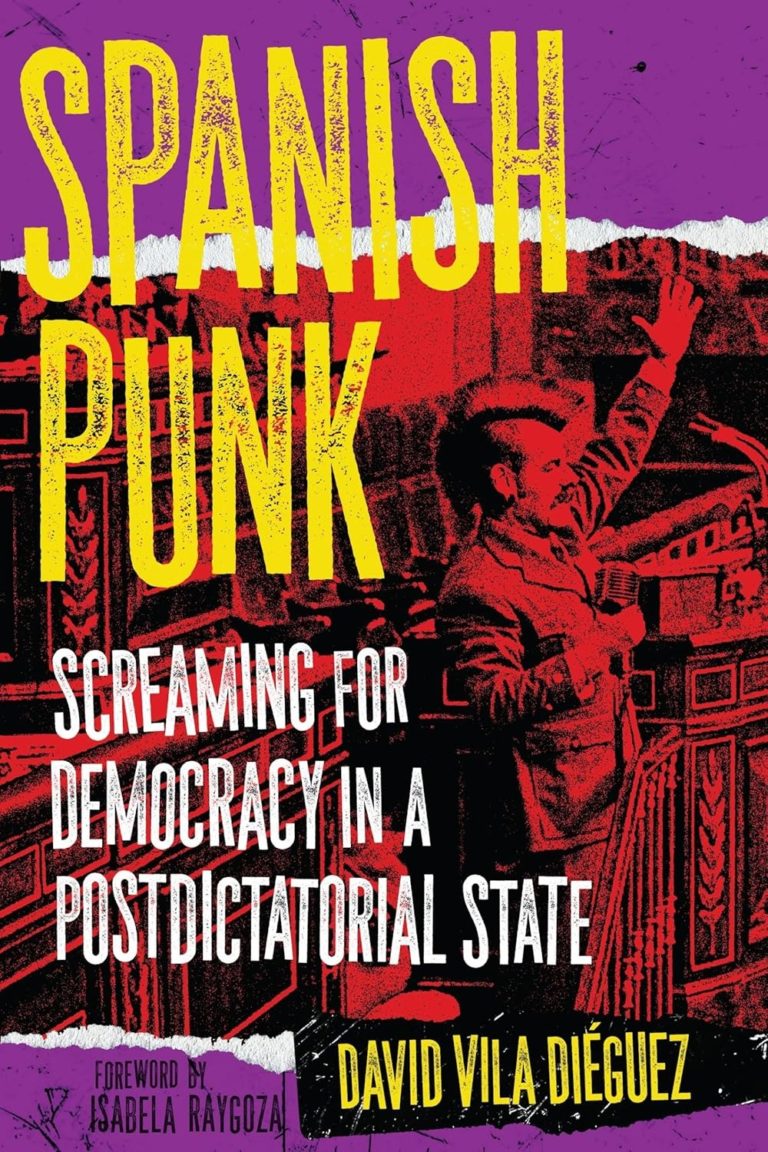
What does democracy sound like when it’s shouted through a distortion pedal? This is the central question of David Vila Diéguez’s groundbreaking new study, Spanish Punk: Screaming for Democracy in a Postdictatorial State, released today, December 19, 2025. Emerging from the long shadow of Francisco Franco’s dictatorship in 1975, Spain’s transition to democracy was anything but smooth. Diéguez argues that punk was far more than a raucous musical export; it was a “rebellious cultural matrix” and a DIY response to the contradictions of a state attempting to reinvent itself. Through a meticulous analysis of fanzines, lyrics, and subcultural style, the book explores how bands like Eskorbuto, La Polla Records, and Kortatu challenged the hegemonic “Transition” narrative, posing urgent questions about who was being left out of the newly “free” society.
Blending historical, philosophical, and musicological research, Diéguez—a scholar and musician himself—demonstrates how punk served as the “cultural glue” for oppositional movements and anti-establishment identities. With a foreword by Isabela Raygoza, the book delves into the “rupturist discourse” of the era, examining how a generation used noise to navigate the uneasy aftermath of literal fascism. From the working-class streets of the Basque Country to the broader anti-capitalist struggles of the 1980s, Spanish Punk verifies that the movement’s supposed “nihilism” was actually a deeply engaged political commitment. It is a long-overdue and intellectually captivating exploration of cultural resistance that finally gives the Spanish punk epoch the scholarly searchlight it deserves.