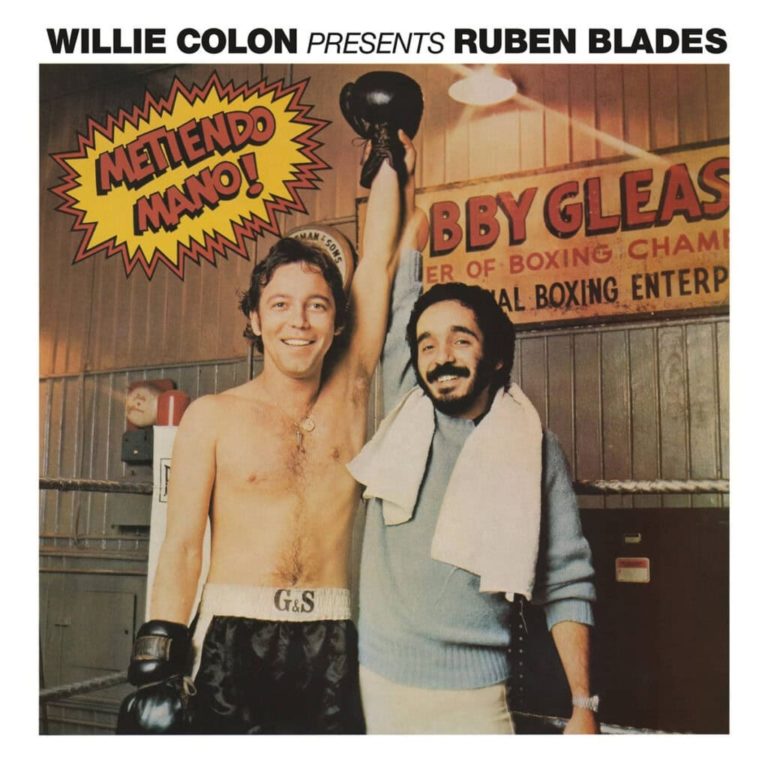
Craft Latino proudly announces the return of Metiendo mano!, the influential 1977 debut from Willie Colón and Rubén Blades that started it all. In the late ’70s, bestselling bandleader, producer, and trumpet player Willie Colón and Panamanian singer-songwriter Rubén Blades forged a musical partnership, blending Blades’ socio-political lyricism with Colón’s innovative approach to salsa music, resulting in what would become known as “conscious salsa.” The first of four LPs by Colón and Blades, Metiendo mano! changed the Latin music landscape with thought-provoking tracks like “Pablo Pueblo,” “Plantación adentro” and “Según el color.” The album, which has long been out of print in the US, returns to its original format, out now, featuring all-analog mastering and 180-gram vinyl. A limited-edition (only 300) “KO Red” color vinyl variant is available exclusively at Fania’s online store, bundled with a Fania Retro logo T-shirt. Both vinyl options are available for order.
The story begins a decade earlier with Willie Colón (b. 1950). A Latin GRAMMY Lifetime Achievement Award winner and multiple GRAMMY nominee, Colón was instrumental in shaping the sound of salsa through his prolific work on and off the stage. The Bronx native launched his storied career at just 15 years old when he signed to New York’s own Fania Records. Partnering with singer Héctor “El Cantante” Lavoe, Willie became a sensation in the Latin music scene—thanks in large part to the duo’s 11 genre-defining albums, including 1967’s El malo, 1970’s Cosa nuestra, and the 1971 Christmas classic, Asalto Navideño. By the mid-’70s, after the duo’s amicable split, Colón expanded his horizons as a producer, composer, arranger, and musical director. But he was also eager to return to the studio for his own projects. As he sought a new vocalist for his orchestra, a young Panamanian singer-songwriter caught his attention.
A 12-time GRAMMY and Latin GRAMMY winner, Rubén Blades (b. 1948) began his career in Panama, serving as a vocalist for such popular groups as Los salvajes del ritmo and Bush y sus magníficos, while also balancing his studies in political science and law. In 1970, Blades released his US debut with De Panamá a New York (alongside Pete Rodriguez) and, eventually, relocated to New York, where a job in Fania’s mailroom led to collaborations with the label’s biggest stars, including Ray Barretto, Larry Harlow, and Willie Colón. After appearing on the latter artist’s 1975 album, The Good, the Bad, the Ugly (with Lavoe and Yomo Toro), Blades was tapped to take over vocal duties for Colón’s orchestra.
While Lavoe is remembered as one of Latin music’s most charismatic and rousing frontmen, Blades brought an entirely different element to his tenure with Colón. “There was no space for comparisons…. Those were two different styles and sensibilities,” writes journalist Jaime Torres-Torres. Blades, he adds, offered “…a fresh approach to salsa. Anchoring his musical identity on salsa narratives, he revealed to the world the vicissitudes, dreams, thoughts, and struggles of people in Latin American cities.”
With Colón’s guidance and blessing, Blades was given the freedom to write and perform in his own style, resulting in original compositions like “Pueblo,” “Fue varón,” “La maleta,” and the revolutionary “Pablo Pueblo.” Considered to be among the earliest examples of conscious salsa, the heartbreaking song revolves around a man trying, in vain, to lift his family out of poverty. The duo also included a musically diverse selection of works by other artists, including Felix Hernández’s reflection on life’s contradictions, “Según el color,” Johnny Ortiz’s “Lluvia de tu cielo,” in which the narrator—a farmer—expresses anguish over a drought, and Tite Curet Alonso’s biting commentary on oppression and capitalism, “Plantación adentro.” Bringing these songs to life were lush arrangements by Colón, Luis Ortíz, and Louie Ramírez, as well as an ensemble of top-tier musicians, including Yomo Toro (cuatro, acoustic guitar), Milton Cardona (percussion), Sonny Bravo (piano), and a robust brass section that featured the likes of Tom Malone (tuba) and trombonists Leopoldo Pineda and Papo Vasquez.
While Metiendo mano! was not the most famous album from the Blades-Colón partnership, it was unlike anything that came before it in the relatively young salsa scene. Torres-Torres writes, “Metiendo mano! saw Colón and Blades singing to the exploited factory worker, whose income is not enough to provide for his wife and children; to the crossroads of the Hispanic migrants in the Big Apple; to the brutal genocide of the indigenous people; and the sociological realities of the barrio.” Speaking to listeners in a fresh, honest voice, the album launched a new tradition of socio-political narrative in salsa music, while inspiring a multitude of releases in its wake.
Colón and Blades continued their collaboration with three more albums, including their 1978 follow-up, Siembra—ranked as the best-selling salsa LP of all time—and 1981’s GRAMMY-nominated Canciones del solar de los aburridos. Blades, who rose from relative obscurity to broader stardom with Metiendo mano!, soon became one of Latin music’s most successful singer-songwriters, as well as an EMMY-nominated actor, activist, and politician. Today, the highly decorated artist remains active in the studio, on the road, and in front of the camera (most recently as a series regular on AMC’s Fear the Walking Dead). Earlier this year, he released Fotografías, his latest album with longtime collaborators Roberto Delgado & Orquesta.
Colón, meanwhile, has long been recognized for his immeasurable contributions to Latin music and remains among the top-selling salsa artists of all time, with over 30 million albums sold. In addition to his collaborations with Lavoe and Blades, Colón has released multiple bestselling albums with Celia Cruz, plus projects with David Byrne, Soledad Bravo, and Ismael Miranda. Along the way, Colón has dedicated his time to activism and local politics in New York. Among other honors, Colón was inducted into the International Latin Music Hall of Fame and the Latin Songwriters Hall of Fame, while in 2015, Billboard named Willie Colón one of the 30 most influential Latin Artists of All Time.
Click here to find the exclusive bundle including the “KO Red” color vinyl with a Fania Retro logo T-shirt.
Tracklist:
Side A
- Pablo Pueblo
- Según el colór
- La maleta
- Me recordaras
- Plantación adentro
Side B
- La mora
- Lluvia de tu cielo
- Fue varón
- Pueblo
*Digital tracklist mirrors Vinyl