


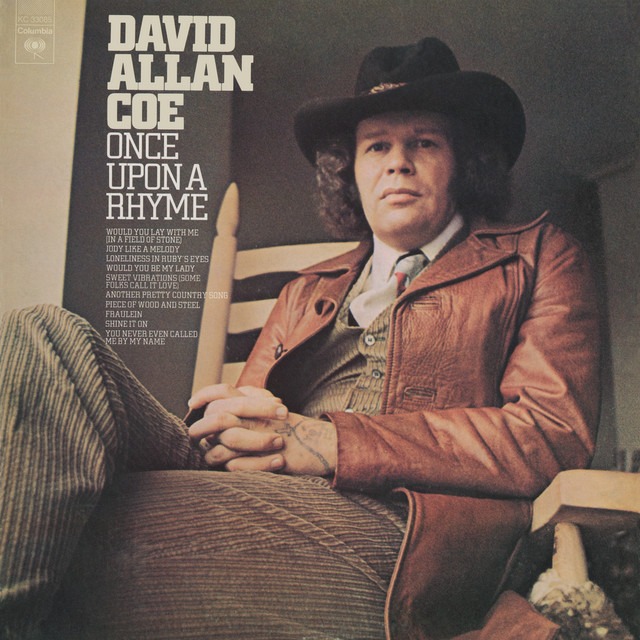
David Allan Coe died on April 29, 2026, at the age of 86, in an intensive care unit. His widow Kimberly confirmed the news to Rolling Stone. “One of the best singers, songwriters, and performers of our time and never to be forgotten,” she wrote. “My husband, my friend, my confidant and my life for many years.” No cause of death was immediately provided.
Coe was one of country music’s most contradictory and compelling figures, a man who lived most of the outlaw life that others only sang about. Born September 6, 1939, in Akron, Ohio, he spent much of his youth in reform schools and correctional facilities before arriving in Nashville in 1967, parking a hearse in front of the Ryman Auditorium and busking on the street. He caught the ear of producer Shelby Singleton and signed to Plantation Records, launching a career built entirely on his own impossible-to-categorize terms.
His songwriting legacy arrived before his performing career caught up. Tanya Tucker took his “Would You Lay With Me (In a Field of Stone)” to number one in 1973, making him one of Nashville’s most in-demand writers overnight. His own recording of “You Never Even Called Me by My Name,” co-written by Steve Goodman and an uncredited John Prine, became a jukebox perennial in 1975, a track that managed simultaneously to honor and gently mock the entire country tradition. Then came “Take This Job and Shove It,” which Johnny Paycheck took to number one in 1977 and which lodged a phrase permanently into the American vocabulary. That song was entirely Coe’s creation, and the fact that Paycheck got most of the credit fed a bitterness Coe carried for years.
His own performing peaks came in the early 1980s. “The Ride,” a ballad about a hitchhiker’s encounter with the ghost of Hank Williams, cracked the top five in 1983. “Mona Lisa Lost Her Smile” reached number two in 1984, his highest chart position as a performer. Through it all, his image, the rhinestone suits, the Lone Ranger mask, the long hair and braided beard, the Harley Davidson on stage, the hearse in the parking lot, kept him at arm’s length from the country mainstream even as his songs were everywhere. He shared stages with Willie Nelson, Waylon Jennings, and Johnny Cash and was described by Jennings in his autobiography as “the most sincere of the bunch,” while simultaneously being told to knock off the grandstanding.
His legacy carries real complications. Two independently released albums in the late 1970s and early 1980s contained material widely condemned for its use of racial slurs and misogynistic content. Coe consistently maintained the songs were intended as parody, citing his friendship with Shel Silverstein as the inspiration. The debate never fully resolved, and it shadowed his reputation for the rest of his career.
In later years, Coe recorded ‘Rebel Meets Rebel’ with Pantera’s Dimebag Darrell, Vinnie Paul, and Rex Brown, appeared in Johnny Cash’s “God’s Gonna Cut You Down” video, collaborated with Kid Rock, and kept playing over 300 shows a year well into his eighties. His son Tyler Mahan Coe created the celebrated country music podcast Cocaine & Rhinestones. Coe is survived by his wife Kimberly and his children. He was 86, and he was, as Stephen Thomas Erlewine once wrote, “none more outlaw.”