


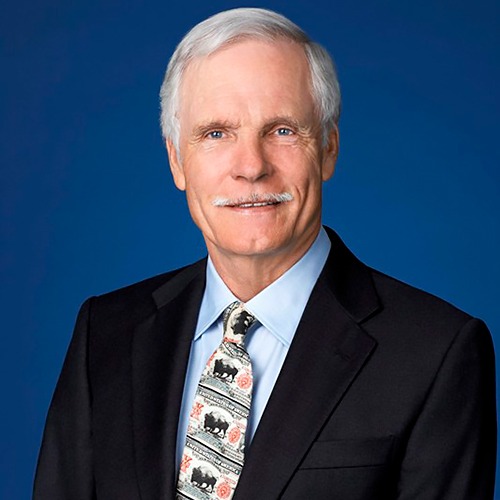
Ted Turner, the brash, visionary media mogul who founded CNN and forever changed the way the world receives its news, died on Wednesday, May 6, 2026. He was 87.
Turner, who had been living with Lewy body dementia since his diagnosis in 2018, died peacefully surrounded by his family. He leaves behind five children, 14 grandchildren, and two great-grandchildren, along with a media legacy that reshaped the 20th century.
Born Robert Edward Turner III on November 19, 1938, in Cincinnati, Ohio, he grew up in Savannah, Georgia, the son of a billboard magnate whose influence over his son was both formative and brutal. His father, a demanding and mercurial man who once wrote that his son’s choice to study classics at Brown University made him “almost puke,” took his own life in 1963, leaving a 24-year-old Ted Turner in charge of the family advertising business. What followed was one of the most audacious careers in the history of American enterprise.
Turner took a struggling Atlanta UHF television station in 1970 and turned it, step by improbable step, into a broadcasting empire. He invented the superstation, used satellites to beam old movies and Braves games into living rooms across the country, bought the Atlanta Braves and the Atlanta Hawks partly just to have programming, and built Turner Broadcasting System into a name that belonged on the same breath as the great American networks he had always wanted to beat.
But the thing that made Ted Turner immortal was CNN.
On June 1, 1980, he launched the first 24-hour cable news channel out of a converted mansion in Atlanta with $21 million and a staff the industry dismissed as the Chicken Noodle Network. A decade later, when CNN broadcast the Gulf War live from Baghdad while the other networks sat their anchors behind desks in New York, the argument was settled. He had changed journalism permanently and irrevocably. “For the first time in history,” Turner wrote in his 2008 autobiography Call Me Ted, “a war was being televised live from behind the scenes.” Time magazine named him Man of the Year in 1991.
He followed CNN with TNT, Turner Classic Movies, Cartoon Network, and a string of other ventures that demonstrated a man perpetually incapable of thinking small. In 1997 he donated $1 billion to the United Nations, at the time the largest single gift in philanthropic history. He co-founded the Nuclear Threat Initiative. He owned more than two million acres of American land, the largest private bison herd in the world, and 14 ranches across six states.
His personal life was as outsized as his professional one. He was married three times, most famously to actress Jane Fonda from 1991 to 2001, a union that generated as many headlines as any of his business deals. His nicknames, the Mouth of the South and Captain Outrageous, were earned honestly. He compared Rupert Murdoch to Hitler. He challenged him to a televised fistfight. He showed up drunk to his own America’s Cup victory press conference in 1977 after piloting his yacht Courageous to one of the great sporting triumphs of his era. He called the AOL Time Warner merger “better than sex,” a remark he spent years regretting after losing an estimated $7 billion when the stock collapsed.
He was contradictory, combustible, and utterly alive in a way that made him impossible to dismiss. CNN CEO Mark Thompson said in a statement Wednesday that Turner was “the presiding spirit of CNN” and “the giant on whose shoulders we stand.”
He was also, in his way, prophetic. His environmental activism, his warnings about overpopulation and climate change, his creation of the animated series Captain Planet in 1990 to reach young people about the planet, all of it looked eccentric at the time and looks prescient now.
Ted Turner was not a man who did anything quietly or halfway. He built things nobody believed in, said things nobody else would say, and left behind a world that looks meaningfully different because he passed through it.
He had nothing more to say. He said it all.