To mark the centenary of Miles Davis, Decca Records France will release new deluxe vinyl and CD editions of the legendary soundtrack to Louis Malle’s 1958 film Ascenseur pour l’échafaud. Recorded in Paris in December 1957, the music remains one of the most influential jazz soundtracks ever created, and one of the only film scores in which the music was entirely improvised while the musicians watched the film. Pre-order here.
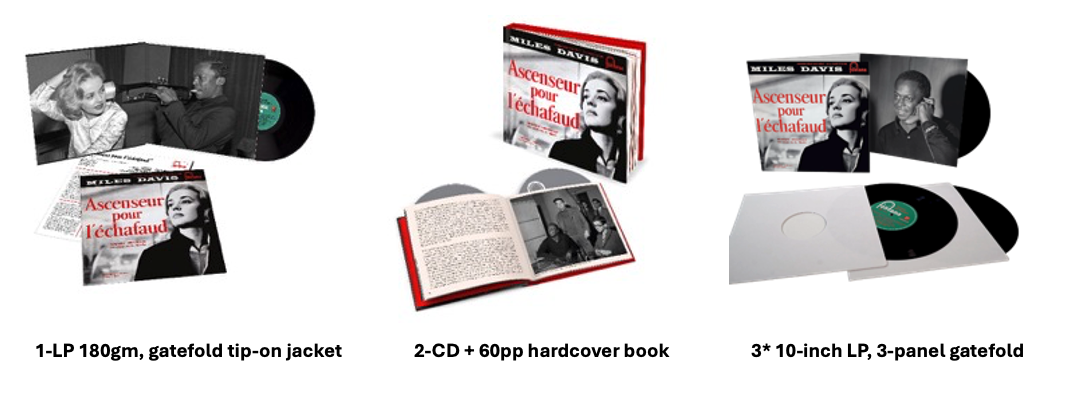
The reissue programme, available from May 22, presents the recording across three deluxe formats. A 180g vinyl LP reproduces the original album in a gatefold tip-on sleeve with an English translation of Boris Vian’s original liner notes. A deluxe 3x 10” vinyl edition expands the release to include the original soundtrack alongside the complete session takes from the December 1957 recordings, presented in a three-panel gatefold with Franck Bergerot’s essay A Present from Miles Davis to Louis Malle. A limited edition 2-CD set brings together the original album and all surviving takes from the sessions of December 4 and 5, 1957, accompanied by a 60-page hardcover book featuring notes by Ashley Kahn and Franck Bergerot.
First released in 1958 by Fontana in Europe and Columbia in the United States, the recording quickly took on legendary status. Few film scores have contributed so decisively to the atmosphere and reputation of a film. Nearly seventy years later, beyond the mythology surrounding its creation, the recording still stands as one of Davis’s most striking works: a tense, nocturnal score charged with dramatic intensity and spare, haunting lyricism.
The circumstances of its creation have become part of jazz folklore. While Davis was performing at the Club Saint-Germain in Paris in late 1957, Louis Malle, dissatisfied with the music originally planned for his debut feature, was persuaded to approach the trumpeter. After attending a private screening, Davis agreed to record a soundtrack. On December 4 he arrived at the studio with four musicians then based in Paris: Barney Wilen on tenor saxophone, René Urtreger on piano, Pierre Michelot on bass and Kenny Clarke on drums.
Little preparation had been done. Davis had sketched only a few simple harmonic sequences in his hotel room and shared them with the band shortly before recording began. With the plot explained, loops of key scenes from the film were projected in the studio while the musicians improvised directly to the images, without any pre-composed themes. Bassist Pierre Michelot later recalled that “Miles just asked us to play two chords – D minor and C7, four bars of each, ad lib.” It was typical of Davis: minimal instruction paired with an unerring sense of atmosphere.
François Leterrier, the film’s second assistant director, remembered the session beginning around ten in the evening and continuing until dawn while the musicians watched black-and-white sequences shot by cinematographer Henri Decaë, including Jeanne Moreau’s celebrated walk through the Champs-Élysées at night. “All of us there in the dark auditorium were aware that something extraordinary was taking place,” he later recalled. “Something that had definitely never happened before.”
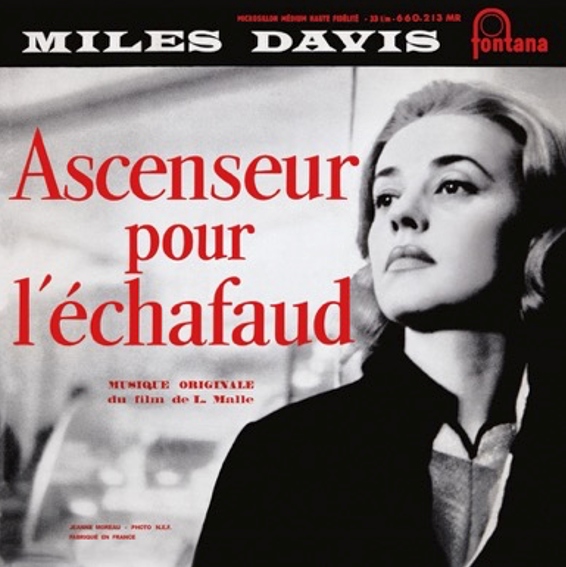
The soundtrack was first issued on a 10-inch LP by Fontana and awarded the Grand Prix du Disque from France’s Académie Charles Cros. In the United States it later appeared on Columbia’s Jazz Track, earning a Grammy nomination in 1960. The new reissue revisits the recording across three deluxe editions: a 180g vinyl LP presenting the original album in a gatefold sleeve with Boris Vian’s liner notes and Jean-Pierre Leloir’s iconic studio photograph of Miles Davis with Jeanne Moreau, alongside expanded 3x 10” vinyl and limited 2-CD sets that bring together the complete session takes from the nights of 4 and 5 December 1957.