


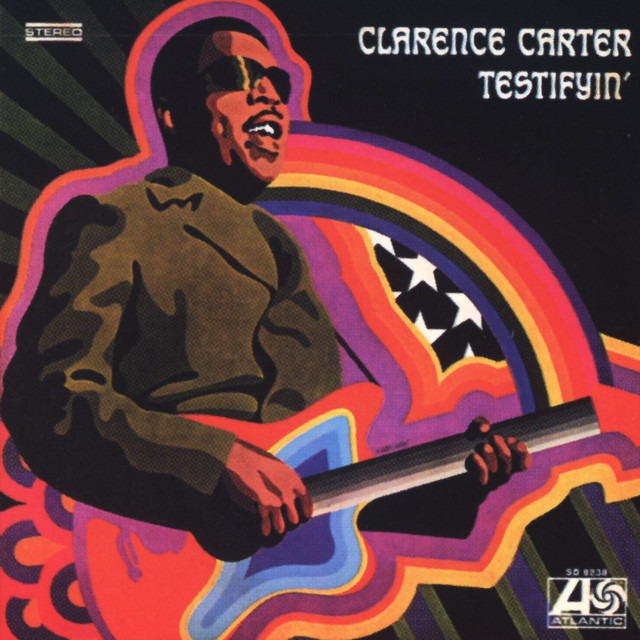
Clarence Carter was blind from the age of one. He could not see the faces in the crowd, could not read the charts his songs climbed, could not watch the world that watched him. What he could do – what he did better than almost anyone of his generation – was make you feel every single word he sang. That voice, that enormous, anguished, deeply human baritone, did the seeing for him. It saw straight through you. Clarence Carter died on May 13, 2026, in Atlanta, Georgia, of complications from pneumonia. He was 90 years old, and he earned every one of them.
Born in Montgomery, Alabama in 1936, Carter grew up listening to blues records his stepfather brought home, lying in bed at night and promising himself he would one day play just like that. He attended the Alabama School for the Blind, graduated from Alabama State University with a degree in music in 1960, and briefly taught school before the pull of music proved too strong. He began performing with friend Calvin Scott as Clarence & Calvin and later the C & C Boys, recording steadily through the early 1960s without much commercial traction. When Scott was seriously injured in a car accident, Carter stepped forward alone – which, as it turned out, was exactly where he was meant to be.
His early solo work with producer Rick Hall at the legendary FAME Studios in Muscle Shoals produced a string of R&B hits that showcased both his gift for melody and his instinct for storytelling. “Slip Away,” released in 1968, remains one of the finest cheating ballads ever recorded – a mournful, strutting masterpiece that reached number 2 on the R&B chart and crossed him over to the pop chart for the first time. It has since accumulated over 45 million plays on Spotify, appeared on the soundtracks of The Commitments, Almost Famous, and Licorice Pizza, and sounds just as devastating today as it did the first time anyone heard it. That same remarkable year also brought “Back Door Santa,” a winking, funky Christmas record that has outlasted virtually every respectable holiday song released in its era and was later sampled by Run DMC for their classic “Christmas in Hollis.”
His greatest commercial moment came in 1970 with “Patches,” a cover of the Chairman of the Board song that Carter transformed into something profound – a working-class story of fathers and sons and the weight of expectation, delivered with spoken word gravity and sung with raw, open-hearted feeling. It reached number 4 in the United States and number 2 in the UK, sold over a million copies, and won the Grammy Award for Best R&B Song in 1971. Carter was also nominated for Best R&B Vocal Performance that year. He deserved to win that too. During this period he also introduced his backing singer Candi Staton to producer Rick Hall, co-wrote several of her finest songs, married her in 1970, and then, by his own complicated legacy, gave her plenty of material to write about after their divorce in 1973. Their creative entanglement remains one of the great bittersweet chapters in soul music history.
In the late 1980s, Carter found a second life with “Strokin’,” an unashamedly ribald track that radio wouldn’t touch and jukeboxes made a phenomenon, and which later appeared in The Nutty Professor and William Friedkin’s Killer Joe – Friedkin calling Carter the Mozart of Southern music, which is exactly the kind of compliment that sounds outrageous until you listen carefully and realise it might just be right. Carter released 22 studio albums across six decades, continued performing live well into his later years, and never once sounded like someone going through the motions. He sounded like someone who genuinely loved music, who was grateful for it, who understood that it had not only earned him a living but had, in his own words, been a tremendous comfort to him when he was down and feeling low.
That comfort was mutual.