


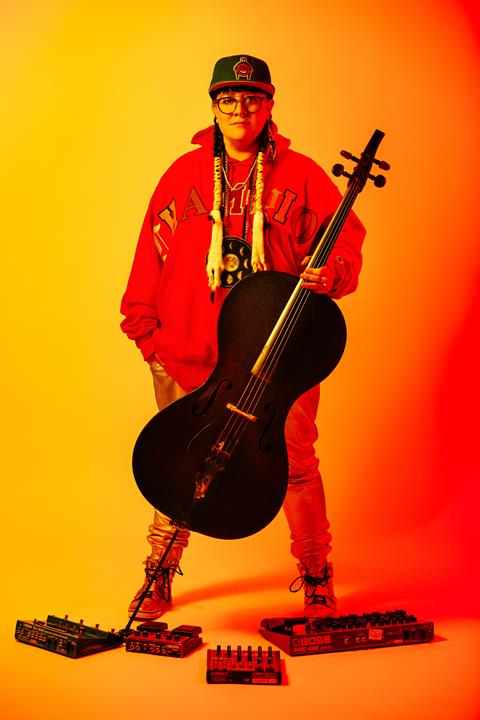
Canada lost one of its most singular musical voices on May 15. Cris Derksen, 45, died in a highway crash in northern Alberta, fatally injured while driving home after attending the funeral of their father in Tallcree First Nation. Derksen’s wife, Rebecca Benson, remains in critical condition.
Born in Treaty 8 territory in Alberta, Derksen was of dual Cree and Mennonite ancestry, and saw music as a powerful tool for storytelling, connection, and advocacy. She began playing cello with the Edmonton Public Strings Program at age 10, attended the Victoria School for the Performing Arts in Edmonton, and went on to earn a bachelor of music in cello performance from the University of British Columbia, where she served as principal cellist with the UBC Symphony Orchestra.
Derksen’s sound was unlike anything else out there, integrating a drum machine, loop station, synthesizer, and guitar multi-effects pedals into her compositions, going well beyond that foundational mix of powwow and classical. The result was a body of work that consistently moved audiences and opened classical music to entirely new communities.
Her career began gaining national momentum around 2006 when she performed the music festival circuit alongside Inuit singer Tanya Tagaq, and she soon became a fixture on Canada’s symphony stage. She performed internationally, including across Europe, Mexico, Sweden, Australia, and the United States, and served as the composer for the Canadian Pavilion at the World Expo in Dubai in 2022 and again in Osaka in 2025.
She made her Carnegie Hall debut in 2024 performing with the Orchestre Métropolitain and conductor Yannick Nézet-Séguin, presenting her commissioned work Controlled Burn. The piece, rooted in traditional Indigenous fire stewardship practices and brought to life through cello, electronic effects, and col legno technique, became one of the defining works of her career.
Just weeks before her death, the Toronto Symphony Orchestra presented the world premiere of Still Here, a work composed through sessions with First Nations, Inuit, and Métis clients of the Centre for Addiction and Mental Health’s Shkaabe Makwa centre, as part of CAMH’s Art of Healing Program. It was entirely characteristic of Derksen, who consistently made her art meaningful beyond the concert hall.
Derksen founded the Indigenous Classical Gathering at the Banff Centre for the Arts, served as artistic advisor for the Calgary Philharmonic Orchestra, and chaired the equity committee for Orchestras Canada, working to make classical music more reflective of Canada’s diverse population and opening doors for BIPOC composers and performers.
Her most recent album, ‘The Visit,’ was released in 2025. Her final major work, Cikilaxwm: Controlled Burn, a full-length narrative contemporary ballet created with Indigenous choreographer Cameron Fraser-Monroe, debuted at Ballet Kelowna earlier this month, exploring Indigenous fire stewardship.
The tributes from across the music world have been immediate and unambiguous. Saskatoon Symphony Orchestra CEO Mark Turner wrote: “Much should be said about Cris’ exceptional artistic genius. As a composer, as a performer, as a mentor, she was special. A friend with an immense generosity of the human spirit. A calm level head, a warm laugh, a true leader without ego, and a full heart.”
Tanya Tagaq, one of Derksen’s earliest and closest collaborators, posted simply: “We were so young. Baby musicians. You’ve been part of my life for so long. I miss you already. I love you Cris.”
Cris Derksen is survived by her wife, Rebecca Benson. She was 45.