


Marjane Satrapi, the French-Iranian graphic novelist and filmmaker whose landmark memoir “Persepolis” introduced millions of readers to a child’s-eye view of revolution and exile, died in Paris on 4 June 2026 at the age of 56. Her family said she had “died of sadness” following the death of her husband, Mattias Ripa, the previous year.
Born Marjane Ebrahimi in Rasht, in northwestern Iran, on 22 November 1969, she grew up in an upper-middle-class, politically engaged family in Tehran, attending the French-language Lycée Razi. Her childhood was shaped by upheaval. After the Iranian Revolution of 1979, she watched as friends and family were persecuted, arrested, and in some cases murdered, including her beloved uncle Anoosh, a political prisoner who was executed and who chose the young Marjane as his final visitor. Strong-willed and increasingly at odds with the new regime’s restrictions, she was sent abroad at fourteen to Vienna, where she endured years of dislocation, a period that included a stretch of homelessness before a near-fatal bout of bronchitis. She would later return briefly to Iran, study visual communication in Tehran, and ultimately settle in France.
It was there that she transformed her life story into art. Published in French in four parts between 2000 and 2003, “Persepolis” recounted her childhood under the Islamic Republic and her fraught adolescence in Europe with disarming black-and-white directness and wit. The work became a global phenomenon, winning the Coup de Coeur Award at the Angoulême International Comics Festival and entering classrooms around the world, though not without controversy; in 2013, an attempt to remove it from Chicago schools sparked protest and outcry. Satrapi followed it with “Embroideries” and “Chicken with Plums,” the latter winning Angoulême’s top album prize.
She bristled at pretension about the form she loved. “People are so afraid to say the word ‘comic’,” she told The Guardian in 2011. “Change it to ‘graphic novel’ and that disappears. No: it’s all comics.”
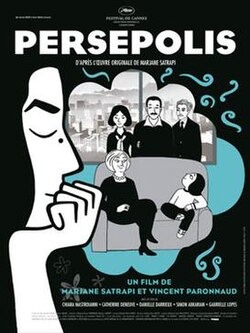
In 2007, Satrapi and co-director Vincent Paronnaud adapted “Persepolis” into an animated film that shared the Jury Prize at Cannes and earned an Academy Award nomination for Best Animated Feature, making Satrapi the first woman ever nominated in the category. The Iranian government denounced the picture, but it triumphed elsewhere, winning Best First Film at the César Awards. She went on to a varied directing career that ranged across the live-action “Chicken with Plums,” the black comedy “The Voices” starring Ryan Reynolds, the Marie Curie biopic “Radioactive,” and her 2024 film “Dear Paris.”
Satrapi never separated her art from her conscience. She spoke out after Iran’s disputed 2009 election, championed the “Woman, Life, Freedom” movement following the death of Mahsa Amini, and edited a graphic anthology documenting the uprising for Western readers, believing a true revolution to be a cultural one. In January 2025, she declined France’s Légion d’honneur in protest at what she called the country’s hypocrisy toward Iran, while taking care to add that her refusal was no rejection of France, which she said she deeply loved.
A naturalised French citizen who spoke six languages, Satrapi was honoured late in her life with the Princess of Asturias Award for Communication and Humanities in 2024. After her husband’s death, she established a foundation in both their names to support foreign students wishing to study filmmaking in Paris.
Marjane Satrapi spent her life turning displacement, grief, and defiance into work of rare humanity and humour. The little girl who once stared down a regime grew into one of the most important visual storytellers of her generation, and she leaves behind a body of work that will continue to give voice to the silenced for many years to come.