


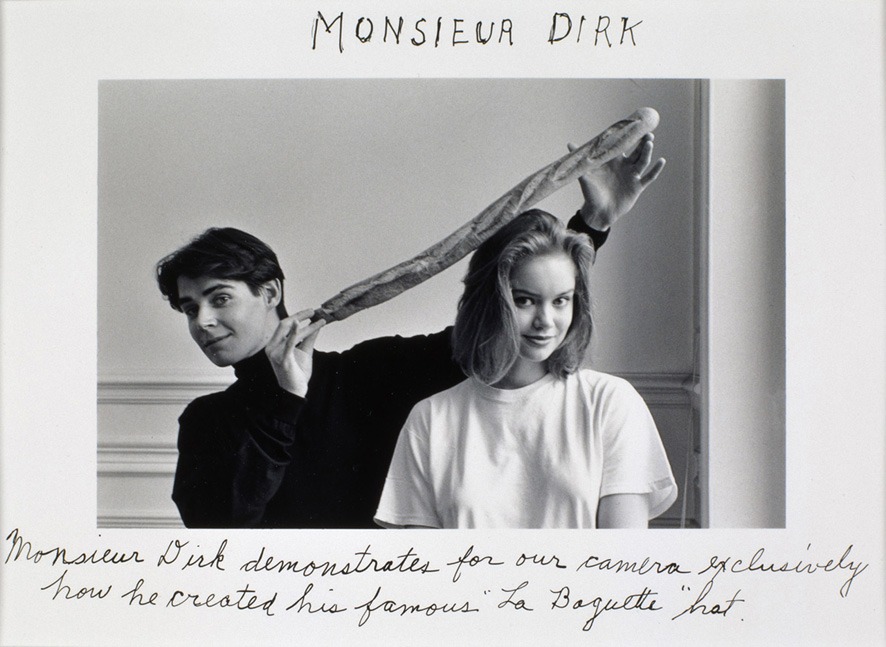
Duane Michals, the inventive American photographer who broke open the boundaries of his medium by stringing images into sequences and scrawling handwritten poetry beneath them, has died in Manhattan at the age of 94. He passed away on June 9, 2026.
Across nearly seven decades, Michals turned photography into something closer to storytelling and philosophy than documentation. While his contemporaries chased the perfect single frame, he was busy asking what a photograph could not show, and then finding ways to show it anyway.
Born in McKeesport, Pennsylvania on February 18, 1932, Michals found his way to art early, taking watercolor classes at the Carnegie Institute in Pittsburgh at age 14. He earned a bachelor’s degree from the University of Denver in 1953, served two years in the U.S. Army, and briefly studied at the Parsons School of Design with thoughts of becoming a graphic designer. He never finished. As a photographer, he was, in his own words, completely self-taught.
His path to the camera was almost accidental. In 1958, on holiday in the USSR, he discovered an interest in photography, and the pictures he made on that trip became his first exhibition in 1963 at the Underground Gallery in New York City. He went on to work commercially for Esquire, Mademoiselle, and Vogue, covering the filming of The Great Gatsby in 1974. Notably, he worked without a studio, photographing his subjects in their own environments, a quiet rebellion against the polished studio style of contemporaries like Richard Avedon and Irving Penn.
It was in the 1960s and 1970s that Michals developed the two innovations that would define his legacy. The first was the photo-sequence, telling a story across a series of images, as in his 1970 book Sequences. The second was text, handwritten near or beneath his photographs to convey what the picture alone could not, lending his work a confessional, literary intimacy. Themes of memory, desire, dreams, mortality, and spirituality ran throughout, as did gay themes that he explored openly even as he stayed apart from the formal civil rights movement.
His range was remarkable. He was hired by the Mexican government to photograph the 1968 Summer Olympics, exhibited at the Museum of Modern Art in New York in 1970, and received a National Endowment for the Arts grant in 1976. He even crossed into the music world, creating the cover art for The Police’s 1983 album Synchronicity and for Richard Barone’s Clouds Over Eden in 1993.
Michals cited an eclectic set of muses, among them Balthus, William Blake, Lewis Carroll, Thomas Eakins, René Magritte, and Walt Whitman. In turn, he shaped a younger generation of image-makers, including David Levinthal and Francesca Woodman.
Honors accumulated across his life, including an Honorary Fellowship from The Royal Photographic Society in 1991, a gold medal from the National Arts Club in 1994, the Masters Series Award from the School of Visual Arts in 2000, and induction into the International Photography Hall of Fame in 2020. His work was shown everywhere from the Carnegie Museum of Art to the Morgan Library & Museum, and in a fitting full-circle moment, his final solo exhibition, Beyond Likeness, opened in 2026 at the University of Denver, where his journey in art had begun.
Michals was predeceased by his partner Frederick Gorrée, who died in 2017. The two had been together since 1960, a partnership of nearly six decades.