Home Blog Page 2695

The List Of Winners IHeartRadio Canada Much Music Video Awards

0

Between the explosive live performances from artists like Hedley and Fifth Harmony and fans screaming at the top of their lungs for Shawn Mendes, Shawn Hook and Alessia Cara, there were a bunch of hardware handed out at the IHeartRadio Canada Much Music Video Awards on Sunday night. For video footage of the press Q&A, you can check out my Periscopes here.

Here’s a list of who took home the prizes:

Video of the year: Drake – “Hotline Bling”
Best post-production: Majid Jordan – “Every Step Every Way”
Best EDM/dance video: Grandtheft (featuring Lowell) – “Quit This City”
Best director: Drake – “Hotline Bling,” Director X
Best pop video: Shawn Mendes and Camila Cabello – “I Know What You Did Last Summer”
Best rock or alternative video: The Strumbellas – “Spirits”
Best hip hop video: Drake – “Hotline Bling”
Best MuchFact video: Majid Jordan (featuring Drake) – “My Love”
IHeartRadio international Artist of the Year: Nick Jonas
Most buzzworthy Canadian: Drake
Most buzzworthy international artist or group: Fifth Harmony
Best new Candaian artist: Alessia Cara
IHeartRadio international duo or group of the year: Macklemore and Ryan Lewis
IHeartRadio Canadian single of the year: The Weeknd – “Can’t Feel My Face”
Fan Fave artist/group: Justin Bieber
Fan fave video: Shawn Mendes and Camila Cabello – “I Know What You Did Last Summer”
Fan fave international aritst or group: Fifth Harmony
Fan fave Vine musician: Rajiv Dhall

Daniel Lanois On “His” Sound, And Working With Brian Eno And U2

0

People talk about the Lanois sound. What, to you, is your sound?

Daniel Lanois: Maybe in the ’80s it was more specific to a certain approach, when I was doing a lot of records with Eno. We did a lot of textural work and I was really just serving Brian and his vision with those records, but I really got hooked on my effects. Since then, things have evolved and I don’t use so much of that now. My recent record coming out in the fall called Goodbye to Language, I developed this system of taking samples of already existing components and extracting them from—putting them out of sync with the track and then doctoring them externally through other boxes, maybe changing them to slow them down, and if I hit on something special then I go back in and find a spot for that special sound back into the track. It won’t work for most of the songs. I just run it randomly.

Is there a moment where you say, “Listen, guys, why don’t you try this instead?”

Lanois: There have been cases where maybe we just haven’t gotten the magic yet, and everybody is hoping to get it, and the best way to make a suggestion is to play a suggestion rather than talk about a suggestion. I reference the U2 song named “Beautiful Day.” We’d done a hand-played version of it, which never quite found its magic. So Eno and myself designed a more electronic, electro angle on it, which was built on a box [sings]—quite Germanic. We quickly put a version of it together in the morning prior to the band’s arrival and when they came in, they said, “What’s that? That sounds interesting.” We said, “Well, that’s your song. It’s just a rendition of it.” What was nice for Larry [Mullen] on drums, it got him away from the responsibility of playing the straight beat, so it gave him some freedom to experiment with something more unusual on the top. Sometimes people just need a little more of encouragement to go in a different direction. I never tell people that they’re wrong, or that it should be done this way rather than that. We might promote another approach, but by example, never by criticism. Criticism doesn’t work that way.

Via

Watch a filmed version of Paul McCartney speaking to BBC 4’s John Wilson about his career.

0

In this filmed version of Mastertapes, Paul McCartney talks to John Wilson about his career and answers questions from the audience at Maida Vale studios.

Indie labels have 38% recorded music market share, contributed $5.6 billion to global music industry

0

New research undertaken by The Worldwide Independent Network (WIN), the organization that represents the interests of the global independent music community, has provided the most accurate picture to date of the global value of the independent music sector.

The new report, entitled WINTEL, was commissioned by WIN to analyse the global economic and cultural impact of the independent music sector. It is authored by Mark Mulligan of MIDiA Research in conjunction with Dr. Chris Bilton from Warwick University’s Centre for Cultural Policy.

The report will be launched at Midem on Friday.

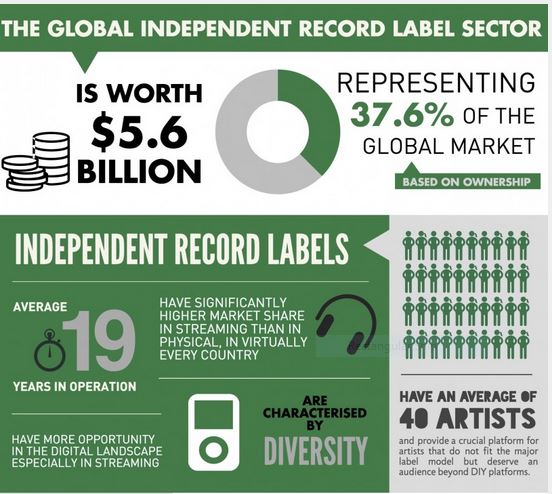
Key findings from the research include the fact that, based on rights ownership, the global market share of independent record labels is 37.6%, representing $5.6 billion in 2015.

Beneath the global figure there is a hugely diverse range of national trends, with independent label market share ranging from just 16% in Finland up to 88% in South Korea.

The report focuses on the criterion of value ‘based on rights ownership’ when analyzing market share. This is an important distinction because, where independent companies use major labels in various territories around the world to distribute their music, the major labels include the value of revenues derived from the distribution of independently owned rights into the label’s assessment of the majors’ own market share.

Most independent labels do not have the international infrastructure needed to compete globally. The WINTEL report establishes that approximately 72% use international distributors and 52% use major labels or major label owned distributors. The claiming of market share by international corporations, which should be attributed to independent right holders, distorts the true picture of market value. WINTEL’s analysis by reference to rights ownership provides a much more accurate overview of the marketplace.

It is also important because market share is used by the leading digital music companies such as Apple, Google and Spotify in negotiations with the independent sector and often determines the levels of remuneration paid by these companies to music right holders.

To emphasize this point, the report also makes clear that digital music, and streaming in particular, has created increased opportunities for independent labels and that in virtually every country independent labels have significantly higher market share in streaming than they do in physical formats.

The report also found that averaging 19 years in operation, independent record labels have built sustainable businesses in the digital era. With an average roster of 40 artists each, they provide a crucial platform for artists that do not fit the major label ‘mainstream model’ yet have built broad audiences beyond ‘DIY’ platforms, locally and internationally.

This diversity on both a national and international level is hugely valuable to the cultural life of countries all over the world, giving a platform to artists that otherwise might not have the opportunity to reach a wider audience. Independent labels are the bridge between indigenous cultural content and global markets, while still maintaining the integrity and authenticity of differing traditions.

Alison Wenham, CEO of WIN said, “This is an important report, giving us the first truly global overview of the economic and cultural value of independent music. With a 37.6% market share based on rights ownership, and a contribution of $5.6 billion it is clear that the independent music community is playing an increasingly important part within the global music industry. Quite apart from the significance of the independent sector’s real market share, the vital contribution to the creation of local music in countries around the world assures that the cultural value and contribution of music is in very good hands with the independent sector.”

The full report can be downloaded as a PDF file

Via

Grammy Eligibility Rules Changed To Incorporate Streaming

0

The Recording Academy has shifted its rules to include streaming-only projects as eligible for Grammy consideration. For the next ballot, recordings must be available to the public as stand-alone purchases or streams between Oct. 1, 2015 and Sept. 30, 2016.

The Recording Academy previously considered general distribution to be “sales by label to a branch or recognized independent distributor, via the internet, or mail order/retail sales for a nationally marketed product.” However the news guidelines include streaming services, which are “paid subscription, full catalogue, on-demand streaming/limited download platforms that have existed as such within the United States for at least one full year as of the submission deadline.”

This would include Spotify (paid tiers), Apple Music, Tidal, Google Play, etc., while product released only to Pandora, which has no on-demand service, would not qualify.

The change was one of five changes outlined for next year’s Grammy Awards, which will be held Feb. 12.

Via

Merlin: Streaming Revenues Go Global, Payouts Increase 73% to $232m

0

Speaking at A2IM’s Annual Meeting, Charles Caldas, CEO Merlin, the global digital rights agency for the independent label sector, has announced the results of Merlin’s 2016 member survey. Merlin is the global digital rights agency for the world’s independent label sector. The organisation’s members command in excess of 12% of the global digital recorded music market and embody more than 20,000 independent record labels and distributors from 46 countries and all continents. These include Beggars Group, Secretly Group, Domino, Epitaph, !K7, Kobalt Label Services, [PIAS], Merge and Warp, representing some of the world’s most important and successful artists.

Merlin acts to ensure these companies have effective access to new and emerging revenue streams and that their rights are appropriately valued and protected.

Since commencing operations in May 2008, Merlin has licensed key digital services including SoundCloud, YouTube Red, Spotify, Pandora, Google Play, Deezer, Vevo, KKBOX and Guvera.

The organization has just released their membership survey, which saw global payouts reach $232 million, up 73% from the year before. Other findings include:

  • Digital consumption unlocks global markets – 39% report over half of digital revenues originate from outside their home territory, compared with just 16% reporting the same for physical
  • Overall business growth remains consistently high among Merlin members. 79% state they are optimistic about the future of their business
  • Almost half (46%) of Merlin’s members report audio streaming/subscription as their primary source of digital revenue
  • Usage of Merlin members’ repertoire on audio streaming/subscription services is 27% higher on paid tiers compared to free ad-funded tiers

Representing the most valuable set of rights outside of those controlled by the three major labels, Merlin’s 700-strong membership commands in excess of 12% of the global digital market across more than 20,000 labels – including the likes of Beggars Group, Domino, Epitaph, Kobalt Label Services, Merge, Ninja Tune, [PIAS], Secretly Group and Warp Records.

Drawing on anonymized responses from across 35 countries, this is the fourth time Merlin has surveyed its membership in this way. The findings are combined with a new analysis of Merlin’s own internal data, which reveals a surge in both revenues received from leading audio streaming services and the consumption of independent music on those platforms – and particularly so on paid streaming tiers:

Year-on-year (April-March 2014/15 to April-March 2015/16) digital revenues paid out to Merlin’s independent label members increased by 73% year-on-year to $232m. Following a 20% reduction in administration fees, announced in February 2016 – the fifth such reduction in four years – Merlin continues to deliver maximum value to members’ digital businesses.

Comparing usage in the month of March 2016 with March 2015, the volume of audio streams reported to Merlin increased by 80%. In March 2016 alone, audio tracks by Merlin’s members were streamed more than 4bn times, up from 2.5bn in March 2015.

Drawing on an analysis of over 11.5bn audio streams (Jan-March 2016) usage of Merlin members’ repertoire on audio streaming & subscription services was 27% higher on paid streaming tiers compared to free ad-funded tiers.

Almost two-thirds of respondents (62%) state that digital now accounts for more than 50% of their overall business revenue. For 1 in 3, it accounts for over 75%.

Streaming is now the primary source of digital revenue for almost half (46%) of Merlin members – up from one-third last year.

The global scale of digital music consumption clearly benefits independent record labels and distributors. 39% of respondents report that over half of digital revenues came from outside their home territory – compared with only 16% reporting the same for physical

Downloads are the primary digital revenue source for 28% of respondents – down from 41% in 2015. For 64% of respondents, video-streaming platforms like YouTube account for less than 10% of overall digital revenues.

Despite continued transition in the digital music market, the majority (65%) of Merlin members report overall business growth – the same percentage as last year.

79% of respondents state they are “optimistic” about the future of their business, while 86% of respondents say that membership of Merlin is important to their business.

Charles Caldas, CEO of Merlin, said: “2016’s survey offers yet more evidence that Merlin’s independent record label members continue to grow and break new ground in the digital space. Over successive years we have seen audio streaming revenues surge for the vast majority, and it is particularly heartening to see members capitalize on consumer demand in new or previously untapped international markets. The digital business is a global business, and Merlin members are at the heart of it.”


 

Winnie Cooper from The Wonder Years is all grown up, and here is her story

0

What happens when you’re no longer the girl next door from The Wonder Years?

Former television heartthrob Danica McKellar told us how math helped her to discover that she is so much more than the child actress who played Winnie Cooper.

Cool Crowdfunding Project: Maximum Plunder – The Poster Art of Mike King

0

Mike King has made more concert posters than any designer in America. This book now in the final 3 weeks of crowfunding contains more than 1000 of them.

If you’re a music fan, chances are you’ve come across Mike King’s concert posters.

Maybe you were getting soaked waiting in line for a show at one the Northwest’s legendary concert venues and you were checking out the posters stapled on a nearby telephone pole, or you needed something to look at while holding your friend’s hair back in a filthy bathroom in a nameless dive, so you fixated on a poster for an upcoming concert. Wherever you were, whether it was La Luna, Satyricon, The Moore Theater, The Showbox, Roseland Theater, Crystal Ballroom, Doug Fir, etc. Mike King’s art was probably there too.

Spanning three decades of music, Maximum Plunder gathers together Mike’s work into a comprehensive retrospective. A five-year project, the book presents nearly 1,100 of his remarkable posters from every period in nearly every musical genre, from country to death metal, jazz to punk. You’ll see striking examples of Mike’s work for both internationally famous bands to barely-known local artists.

  • 280 pages of posters in glorious color and crappy black and white
  • Forward by noted graphic designer, writer, and former Kinko’s employee Sean Tejaratchi
  • Introduction by Mike King using actual words
  • Nine chapters of various lengths and content
  • Extensive, frequently interesting commentary
  • Fully alphabetical Index
  • For those with low expectations, this book contains everything you need to know

Mike is a prolific designer – having produced more than 5000 posters, from the Afghan Whigs to ZZ Top. His works have appeared in books, magazines, museums and galleries across various parts of the globe including: The Experience Music Project (Seattle), The Museum of Design (Atlanta), the Bold Hype Gallery (NYC), Gallery 1988 (L.A.), to name just a few. He has been published in Spin, Juxtapoz, and numerous anthologies of contemporary art and design, and his works are sought by collectors the world over.

A native of suburban Portland, Mike got his start making posters for the punk/noise bands he played in. From those early days of bad xeroxes and trading poster design for admission to shows, Mike now works full-time as a designer and artist in NYC.

\