


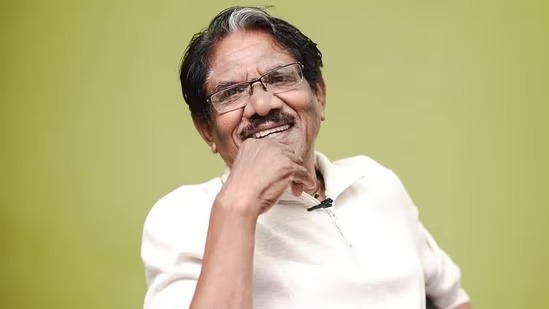
Bharathiraja, the visionary filmmaker who pulled Tamil cinema out of the studio and into the dust, fields, and sunlight of the Indian village, has died. The director, producer, screenwriter, and actor passed away on June 10, 2026, in Chennai, of age-related complications, at the age of 84.
Born Chinnasamy to K. Periyamaya Thevar and Karuthammal on August 23, 1941, in Allinagaram in present-day Theni district of Tamil Nadu, he rose from rural roots to become one of the most revered figures in Indian film. Across a career spanning nearly five decades, he was honored so completely by audiences and peers alike that he was known simply as Iyakkunar Imayam, “The Pinnacle of Directors.”
His arrival was a thunderclap. After serving as an assistant to the Kannada master Puttanna Kanagal and others, Bharathiraja made his directorial debut in 1977 with 16 Vayathinile, a film he also wrote. It broke with the conventions of its era to create an entirely new genre of village cinema and is today regarded as a milestone in the history of Tamil film. At a time when movies were shot almost entirely inside studios, he insisted on real locations, and an entire wave of village-set Tamil films followed in his wake. He even changed how characters looked on screen, dressing his male leads simply and casting dusky-complexioned heroines in an industry that had long favored fair-skinned stars.
He proved early that he refused to be boxed in. After being criticized as a director who could only speak to village audiences, he answered with Sigappu Rojakkal, a thoroughly westernized psychological thriller, then the experimental Nizhalgal and the taut Tik Tik Tik. Yet rural themes remained his great strength, and his run of poetic village love stories, including Alaigal Oivathillai, Mann Vasanai, and Muthal Mariyathai, defined the 1980s. Muthal Mariyathai, starring Sivaji Ganesan as an aging village head drawn to a poor young woman across barriers of age, caste, and class, remains a touchstone of tender, humane storytelling. With Vedham Pudhithu, he confronted caste discrimination head-on in one of the boldest films of his career.
Bharathiraja’s brilliance was recognized with an extraordinary haul of honors: six National Film Awards, four Filmfare Awards South, six Tamil Nadu State Film Awards, and a Nandi Award. His National Awards stretched from Seethakoka Chiluka in Telugu in 1982 through Mudhal Mariyathai, Vedham Pudhithu, Karuththamma, Anthimanthaarai, and his 2001 screenplay for Kadal Pookkal. In 2004, the Government of India awarded him the Padma Shri, the nation’s fourth-highest civilian honor, and the following year Sathyabama University conferred an honorary doctorate.
Perhaps his most enduring legacy is the talent he discovered. Bharathiraja introduced a remarkable roster of new faces who became stars, among them Karthik, Radha, Revathi, Radhika, and Vijayashanti, along with countless beloved supporting actors. Many filmmakers who later became household names, including K. Bhagyaraj, Manivannan, Manobala, and Ponvannan, first stepped before a camera in his films. He was instrumental in casting Sathyaraj in his first lead role, and later founded a film school, the Bharathi Raja International Institute of Cinema, to pass his craft to a new generation. He also coined the affectionate address that became his signature, opening with “En Iniya Thamizh Makkale,” meaning “My sweet Tamil people.”
In his later years he remained active as a character actor, earning a Vijay Award for Best Supporting Actor for Pandiya Naadu in 2013 and appearing in films up to 2025. His final years were also marked by personal grief: his son, the actor Manoj Bharathiraja, died of a heart attack in March 2025. Bharathiraja is survived by his wife, Chandraleela, whom he married in 1974, and his daughter, Janani.
A director who told complex truths in a language every common person could understand, Bharathiraja did more than make films. He taught Tamil cinema to look at itself, at its villages, its people, and its conscience, and find poetry there. The pinnacle, indeed.