


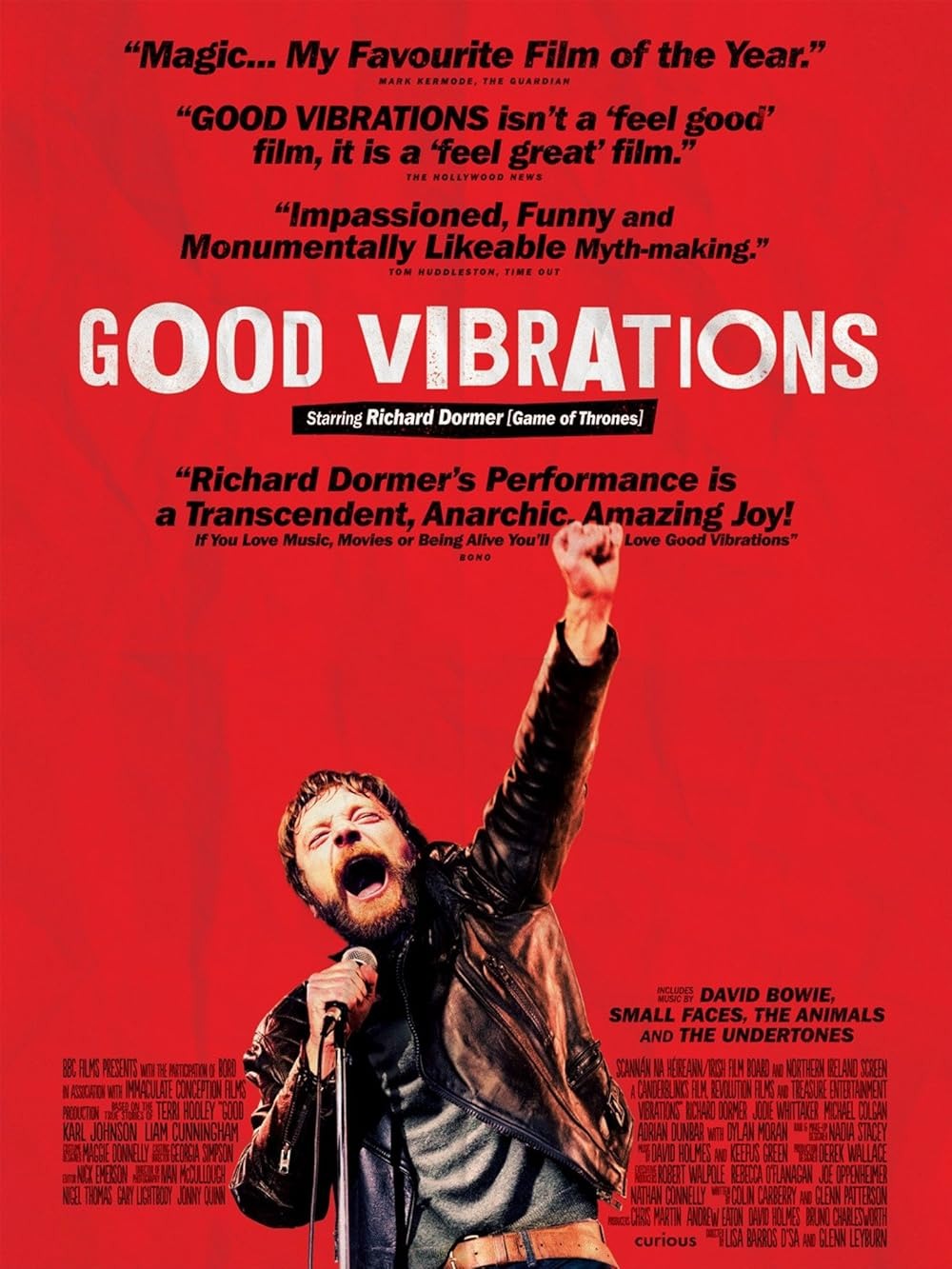
In the late 1970s, Belfast was one of the most dangerous cities in Western Europe. The Troubles had hollowed out the city centre, social life had retreated behind closed doors, and a generation of teenagers grew up with checkpoints, curfews, and the constant threat of violence as the backdrop to ordinary life. Social life more or less shut down with the onset of the Troubles as people stayed in their own homes and their own areas, and the once-vibrant music scene of central Belfast collapsed. Out of that bleakness came one of the most thrilling and improbable explosions in the history of popular music.
The unlikely hero of Belfast punk wasn’t a musician at all. He was a one-eyed record collector and idealist named Terri Hooley. At the height of the violence, Hooley decided that if he was going to get killed anyway, he might as well do something he loved, and in 1976 he opened a record shop called Good Vibrations on Great Victoria Street, then considered the most bombed quarter-mile in Europe. The area had been so badly hit that the landlord gave him the first six months rent-free.
The shop quickly became a refuge and a hub. Hooley began championing local bands, particularly in the emerging punk scene, and started releasing their music on a label he named after the shop, with its first release being the 1978 single “Big Time” by Rudi. What made the scene radical wasn’t only the noise. In a city violently split along sectarian lines, the punk scene was made up of young men and women who identified not as Protestant or Catholic but simply as punks, and soldiers and authority figures alike were openly baffled that musicians from both communities weren’t divided by religion. Punk gave Belfast kids a third identity, one that belonged to none of the warring tribes.
The defining moment of the scene happened in 1978, when two Northern Irish bands sent their debut singles to BBC DJ John Peel hoping for airplay. The Undertones’ “Teenage Kicks” got played twice in a row and passed into legend as Peel’s favourite track of all time, while Stiff Little Fingers’ “Suspect Device” was played every night for a week, with the only London shop stocking it constantly running out. Hooley took “Teenage Kicks” to London, left a copy with Peel as a last resort, and The Undertones signed an American record deal within the week.
The two bands represented opposite poles of the same scene. Stiff Little Fingers, formed in Belfast in 1977 and fronted by Jake Burns, started as a rock cover band before seeing The Clash live and turning to songs drawn from life during the Troubles. The Undertones, up in Derry, had been around since 1974 and evolved under punk’s influence, but sang about teenage angst and desire rather than the conflict. The rivalry was real: the two bands’ singles landed the same week, with Stiff Little Fingers accused of cashing in on the misery of the Troubles, and The Undertones accused of sidelining a conflict they had the reach to address.
What gives Belfast punk its lasting power is the way it transformed fear and boredom into something electric. Jake Burns described “Alternative Ulster” as written in the classic punk mode of having nothing to do, capturing the sheer tedium of having nowhere to go and nothing to do when you got there. Bands like Stiff Little Fingers, Rudi, and The Outcasts gave voice to young working-class people who were most likely to fall victim to paramilitary or state violence, and who lived with poverty and unemployment. The music was political, but it refused both the state and the paramilitaries; it was anti-violence and anti-sectarian above all. WikipediaPowderfingerpromo
The influence ran deep and wide. Asked in 2007 whether “Teenage Kicks” was the best song about being a teenager, Bono replied that his own soundtrack was more “Alternative Ulster” by Stiff Little Fingers. Stiff Little Fingers’ debut album Inflammable Material helped give Rough Trade the funds and confidence to become the market-leading indie label that would later give the world The Smiths. A scene born in the most bombed half-mile in Europe ended up reshaping the entire architecture of independent music. Vivid SeatsTicketmaster
Belfast today is a profoundly different place. The Troubles largely ceased with the Good Friday Agreement of 1998, and the city has since transformed itself into a vibrant hub for the entertainment industry, becoming home to the production wing of Game of Thrones. The anger that once poured out of cramped venues and a tiny record shop has become part of the city’s proudest cultural inheritance, a reminder that some of the greatest art is made by people with every reason to despair and a refusal to do so.
That same spirit of music as common ground carries into this summer, when Belfast hosts one of the great celebrations of Irish traditional music. Fleadh Cheoil na hÉireann takes place in Belfast, August 2–9, 2026. For more information visit fleadhcheoil.ie, visitbelfast.com, and discovernorthernireland.com.