Bonnie Raitt is heading back out for her fourth year on tour just months after being recognized for her lifetime of artistic achievements as part of the Kennedy Center’s 47th Class of Honorees in Washington, DC last December. Raitt and her world-class band will headline theaters and amphitheaters around the country performing songs from her enduring catalog. Her tour has taken her across the U.S. and Canada with stops overseas in Australia, England, Ireland, Scotland and Europe since the release of her critically acclaimed, three-time GRAMMY Award-winning studio album, Just Like That… in 2022.
Tickets go on sale Friday, February 7 at 10 a.m. at LiveNation.com, BonnieRaitt.com and Ticketmaster.com. Tickets will go on Fan Presale tomorrow, Wednesday, February 5 at 10 a.m. local time.
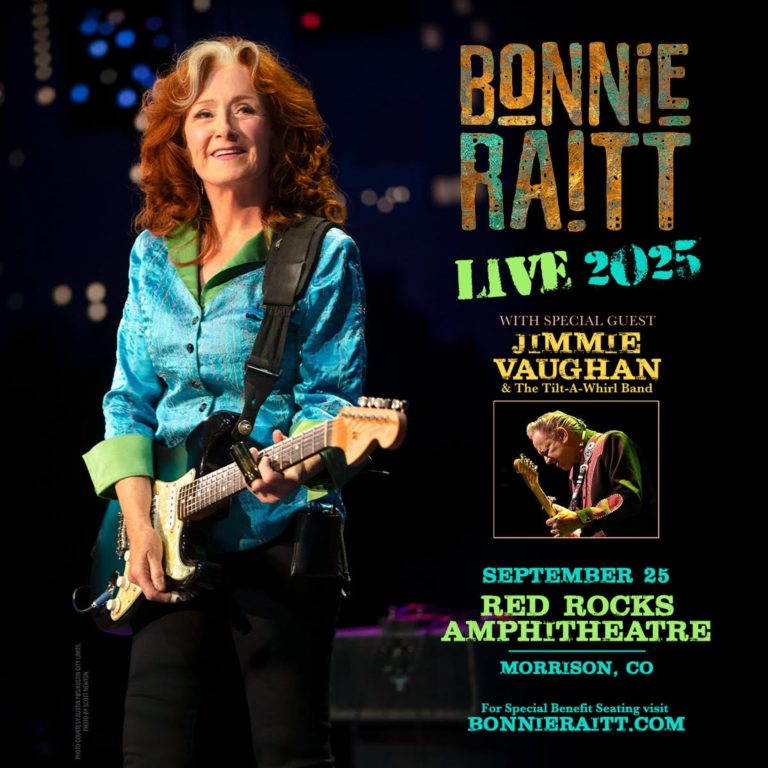
Raitt said, “I’m looking forward to having my longtime pal and one of my favorite artists, blues legend Jimmie Vaughan & The Tilt-A-Whirl Band be our special guests for the late Summer tour. We’ve shared many gigs and duets over the years but never as a ‘double trouble’ co-bill. Bound to be some good blues rockin’ going on – can’t wait to hit the road together!” Vaughan agrees, “Thrilled to play some shows with my talented friend Bonnie Raitt and her band! It’s been a long time coming! Myself and The Tilt-A-Whirl Band are excited to be part of this great tour.”
Raitt earned her 31st GRAMMY nomination in December, Best American Roots Performance, for her contribution to the track “Nothing In Rambling,” a wonderful cover of Memphis Minnie’s song featuring Fabulous Thunderbirds founding member Kim Wilson, along with Bonnie, Keb’ Mo’, Taj Mahal and Mick Fleetwood. The track appears on the Fabulous Thunderbirds’ latest album, Struck Down, also nominated for the GRAMMY Award for Best Traditional Blues Album.
Bonnie Raitt is a singer, songwriter, and guitarist whose unique style blends blues, R&B, rock, and pop. After 20 years as a cult favorite, she broke through to the top in the early 90s with her GRAMMY-award-winning albums, Nick of Time and Luck of the Draw, which featured hits, “Something To Talk About” and “I Can’t Make You Love Me” among others. The 13-time GRAMMY winner was inducted into the Rock & Roll Hall of Fame in 2000 and Rolling Stone named the slide guitar ace one of the “100 Greatest Guitarists of All Time” and one of the “100 Greatest Singers of All Time.”
The past few years have been very busy for Raitt. In 2022, Raitt embarked on a 75-date headlining U.S. tour; released her critically acclaimed 21st album Just Like That…, (the third release on her independent label, Redwing Records) which was #1 on six Billboard charts the week of release and was perched at #1 on the Americana Radio Album Chart for 10 consecutive weeks. The album’s first single, “Made Up Mind” remained in the top three spots on the Americana Radio Singles Chart for 17 weeks. Raitt also received the Icon Award at Billboard Women In Music Awards, the was recognized by the Recording Academy with a Lifetime Achievement Award and she saw her breakthrough album, Nick of Time added to the Library of Congress’ National Recording Registry.
The momentum rolled into 2023 with Raitt earning three GRAMMY™ Awards at the 65th Annual ceremony; Song Of The Year and Best American Roots Song for the title track of her most recent album Just Like That…, and Best Americana Performance for “Made Up Mind.” She then embarked on a busy year of touring not just in the U.S. but with stops in Australia, Canada, Ireland, and the UK. In 2024, Raitt returned to the U.S. and performed over 60 shows spanning coast to coast, and as the year came to a close, Raitt received another incredible accolade being recognized for her lifetime of artistic achievement as part of the Kennedy Center’s 47th Class of Honorees in Washington, DC.
Raitt is as known for her lifelong commitment to social activism as she is for her music, and has long been involved with the environmental movement, performing concerts around oil, nuclear power, mining, water, and forest protection since the mid-70’s. She was a founding member of MUSE (Musicians United for Safe Energy), which produced the historic concerts, album and film No Nukes (1979,) as well as a founding member of The Rhythm and Blues Foundation, which works for royalty reform and recognition of generations of pioneer R&B artists. She continues to work on safe energy issues in addition to environmental protection, social justice, Native American and human rights, as well as artist’s rights and music education.
When it comes to the blues today, there are a handful of guiding lights to make sure the music stays true to its history. For Jimmie Vaughan, he’s dedicated his life to making sure the blues not only stays alive, but remains full of life and an inspiration to all who listen. It’s a spirit he holds close to him, and for almost 60 years, Vaughan isn’t about to stop now.
As a bandleader, singer and guitarist, the four-time Grammy Award winner, Jimmie Vaughan is a master of how everything is captured for posterity. “Playing what you feel has always been my main goal,” Vaughan says. Considering the Texas guitarist and singer has had the kind of career that makes him a living legacy, those are no idle words. His first group when he was 13 years old played Dallas’ Hob Nob Lounge six nights a week, learning the kind of lessons that can’t be taught, they have to be lived.
Getting the chance to open for Jimi Hendrix when he was 16 years old along with being heavily influenced by B.B. King, Muddy Waters, Albert King, Freddie King and so many more, convinced the young Vaughan it was time to find a way to play the music he felt the strongest about: the blues.
That took him to hitchhiking to Austin in the early 70’s and carving out a new crew of blues players who shared his musical excitement. He formed The Fabulous Thunderbirds and their debut album Girls Go Wild on Takoma Records was released in 1979. After worldwide success with The Fabulous Thunderbirds during the 80’s, it came time to leave the band and build his own path in exploring different approaches to the blues. He and his brother Stevie Ray Vaughan collaborated and released Family Style to great acclaim and recognition in the music industry.
He then released his first solo album on Epic Records in the early 90’s and what Vaughan discovered was that he could take it anywhere; there were no boundaries. “I wanted to find out what I could really do,” he says, “and when I started singing it gave me a whole new side to explore. When I was young I didn’t really pay much attention to categories of music. I just heard what I liked and decided to explore that and that’s really what I‘m still doing.”
Jimmie is continuing his love affair with and staying spiritually connected to the American music he loves.
“BONNIE RAITT LIVE 2025” TOUR DATES
20-August Port Chester, NY The Capitol Theatre
22-August Bethel, NY Bethel Woods Center for the Arts
23-August Canandaigua, NY CMAC
26-August Uncasville, CT Mohegan Sun Arena
28-August Bangor, ME Maine Savings Amphitheatre
30-August Gilford, NH BankNH Pavilion
31-August Lenox, MA Tanglewood (Fan Presale begins 3/4, public on sale 3/6)
03-Sept Saratoga Springs, NY Broadview Stage at SPAC
05-Sept Chautauqua, NY Chautauqua Institution Amphitheater
06-Sept Huber Heights, OH Rose Music Center at The Heights
09-Sept Chicago, IL The Chicago Theatre
12-Sept Cincinnati, OH The Andrew J Brady Music Center
13-Sept Detroit, MI Fox Theatre
16-Sept Milwaukee, WI Riverside Theater
17-Sept Green Bay, WI Weidner Center for the Performing Arts
19-Sept Bayfield, WI Lake Superior Big Top Chautauqua (public on sale 2/11)
20-Sept Waite Park, MN The Ledge Amphitheater
23-Sept Omaha, NE The Astro Amphitheater
25-Sept Morrison, CO Red Rocks Amphitheatre
THE FOLLOWING BONNIE RAITT ‘LIVE 2025’ SHOWS ARE ON SALE NOW:
05-March Temecula, CA Pechanga Resort Casino [Special Guest Roy Rogers (solo)]
07-March Phoenix, AZ Arizona Financial Theatre [Special Guest Roy Rogers (solo)]
08-March Albuquerque, NM Kiva Auditorium [Special Guest Roy Rogers (solo)]
11-March Amarillo, TX Amarillo Civic Center [Special Guest Roy Rogers (solo)]
13-March Tulsa, OK River Spirit Casino Resort [Special Guest Roy Rogers (solo)]
15-March Norman, OK Riverwind Casino Showplace Theatre [Special Guest Roy Rogers (solo)]
16-March Kansas City, MO The Midland Theatre [(Special Guest Jon Cleary (solo)]
18-March Springfield, MO Juanita K. Hammons Hall [(Special Guest Jon Cleary (solo)]
19-March Wichita, KS Century II Concert Hall [(Special Guest Jon Cleary (solo)]
22-March Lubbock, TX The Buddy Holly Hall – Helen DeVitt Jones Theater [(special Guest Johnny Nicholas (solo)]
23-March Dallas, TX AT&T Performing Arts Center – Winspear Opera House [(Special Guest Jon Cleary (solo)]
Special Guest TBA
18-April Lancaster, PA American Music Theatre
19-April Atlantic City, NJ Borgata Hotel Casino & Spa
22-April Richmond, VA Altria Theater
23-April Asheville, NC Thomas Wolfe Auditorium
25-April Wilkesboro, NC MerleFest
26-April Savannah, GA Johnny Mercer Theatre
29-April Fort Lauderdale, FL Au-Rene Theater At The Broward Center
30-April Melbourne, FL Maxwell C. King Center for the Performing Arts
02-May Miramar Beach, FL Sun Sand and Soul
06-May Shreveport, LA Shreveport Municipal Memorial Auditorium
07-May Little Rock, AR Robinson Center
09-May Memphis, TN Orpheum Theatre – Memphis
10-May Louisville, KY Iroquois Amphitheater
Special Guest TBA
01-June Belfast, UK Ulster Hall
03-June Dublin, IE Vicar Street
04-June Dublin, IE Vicar Street
07-June Manchester, UK O2 Apollo
08-June Nottingham, UK Royal Concert Hall
10-June Edinburgh, UK Usher Hall
11-June Glasgow, UK Royal Concert Hall
14-June Wolverhampton, UK Civic Hall
16-June London, UK Royal Albert Hall
17-June Brighton, UK Brighton Dome