All photos by Mini’s Memories. You can contact her at minismemories@hotmail.com

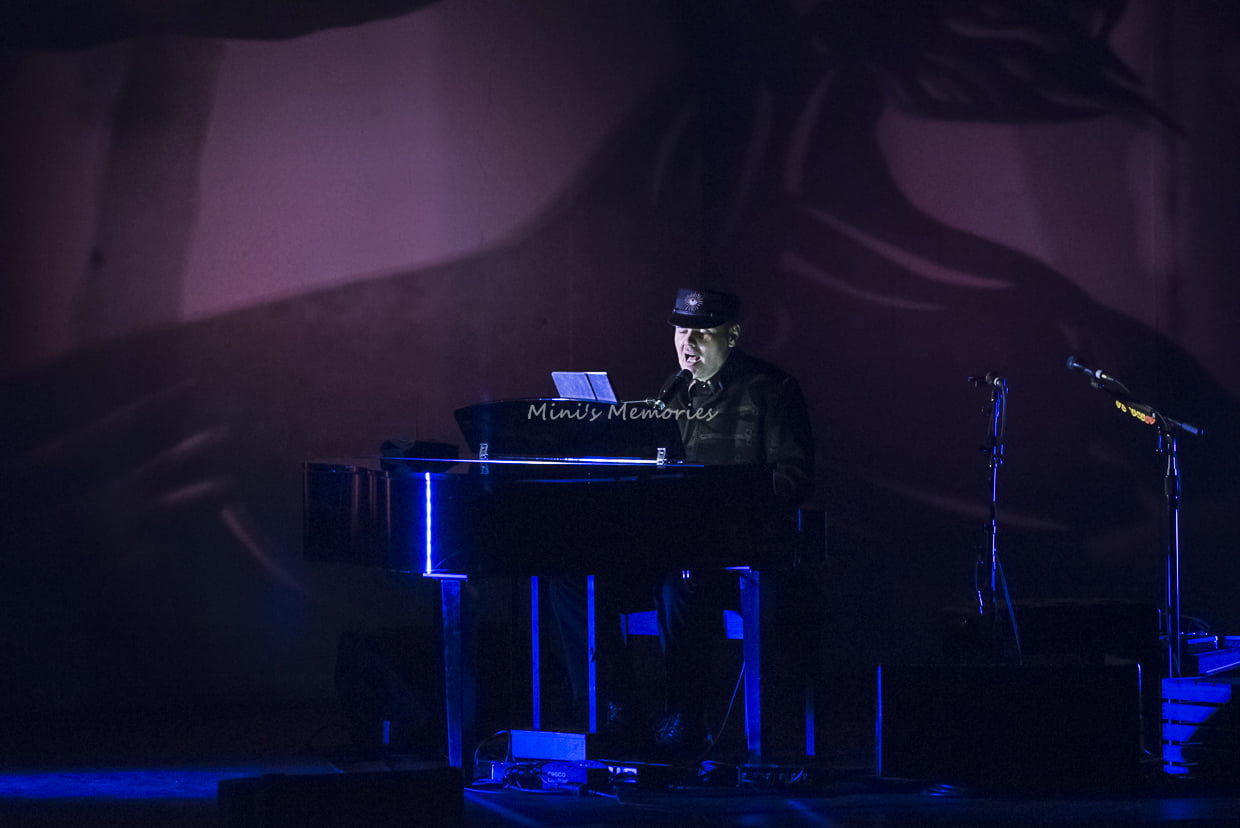


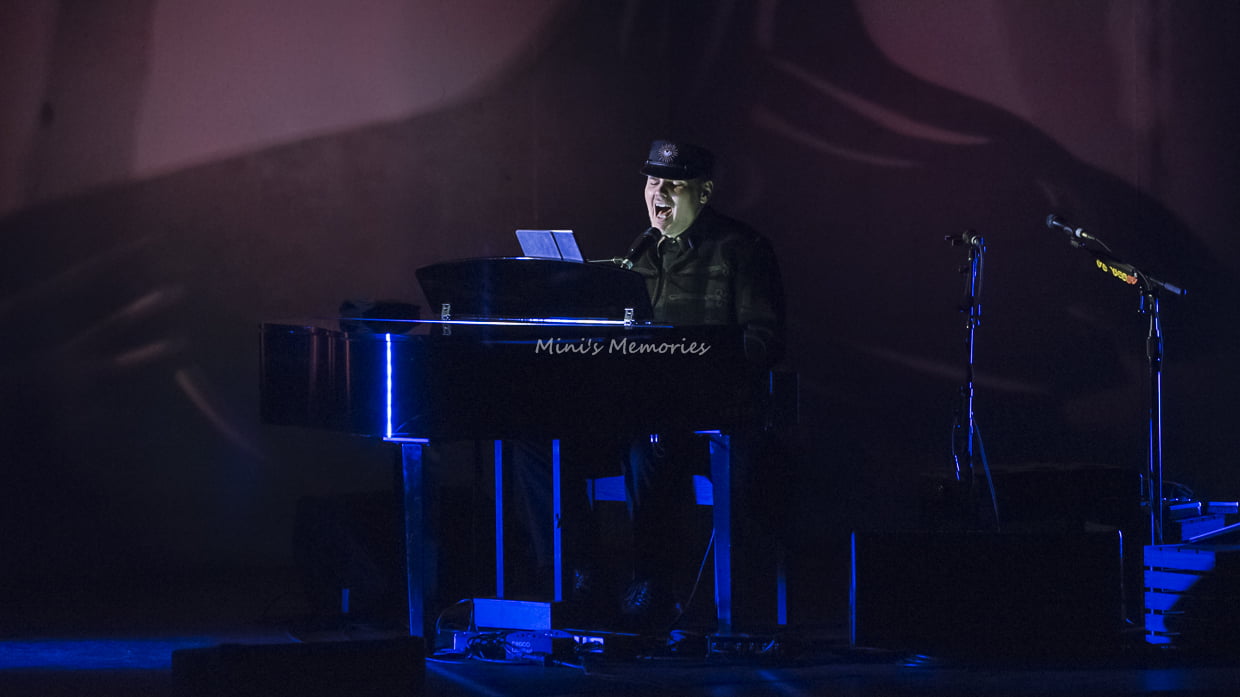

All photos by Mini’s Memories. You can contact her at minismemories@hotmail.com

FUKUOKA (TR) – Fukuoka Prefectural Police have sent a male fan of all-girl pop group AKB48 to prosecutors for the alleged dumping of nearly 600 of the group’s compact discs in the mountains of Dazaifu City, a crime committed after the defendant submitted votes for his favorite members.
On Monday, the Chikushino Police Station sent the man, 32, to prosecutors at the Fukuoka District Court on suspicion of violating the Waste Disposal Law over the dumping of 585 copies of the same AKB48 CD single in a forest in the middle of June.
“I dumped the CDs in the mountains to dispose of them after extracting the voting ballots necessary for the General Election,” the defendant was quoted by police.
The defendant received the CDs from another male fan of AKB48 in Chiba Prefecture, who shipped around 1,000 discs — valued at a around 1 million yen — in about 20 cardboard boxes to him in May and June after explaining he was unable to carry out the necessary voting himself.
After receiving the discs, the defendant and two accomplices worked together at an unspecified location in Fukuoka City to pull out the ballots contained inside the plastic cases on the night of June 9. They then input the serial numbers on the ballots into a web site that allowed them to vote for their favorite members of the group.
After the work was completed, the defendant took 11 of the boxes containing about 600 CDs to his residence. After dumping some of them in the trash, he took the remainder to the mountains in Dazaifu for disposal.

All photos by Mini’s Memories. You can contact her at minismemories@hotmail.com













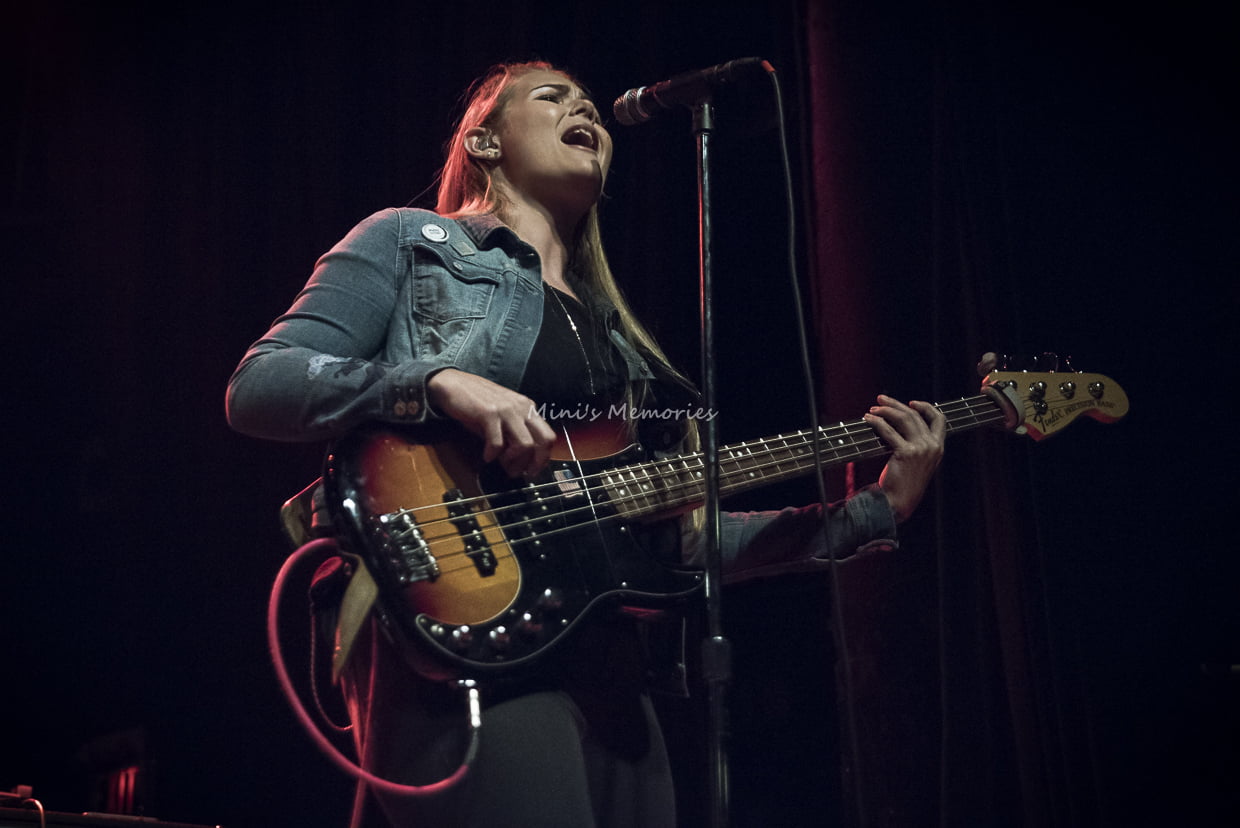

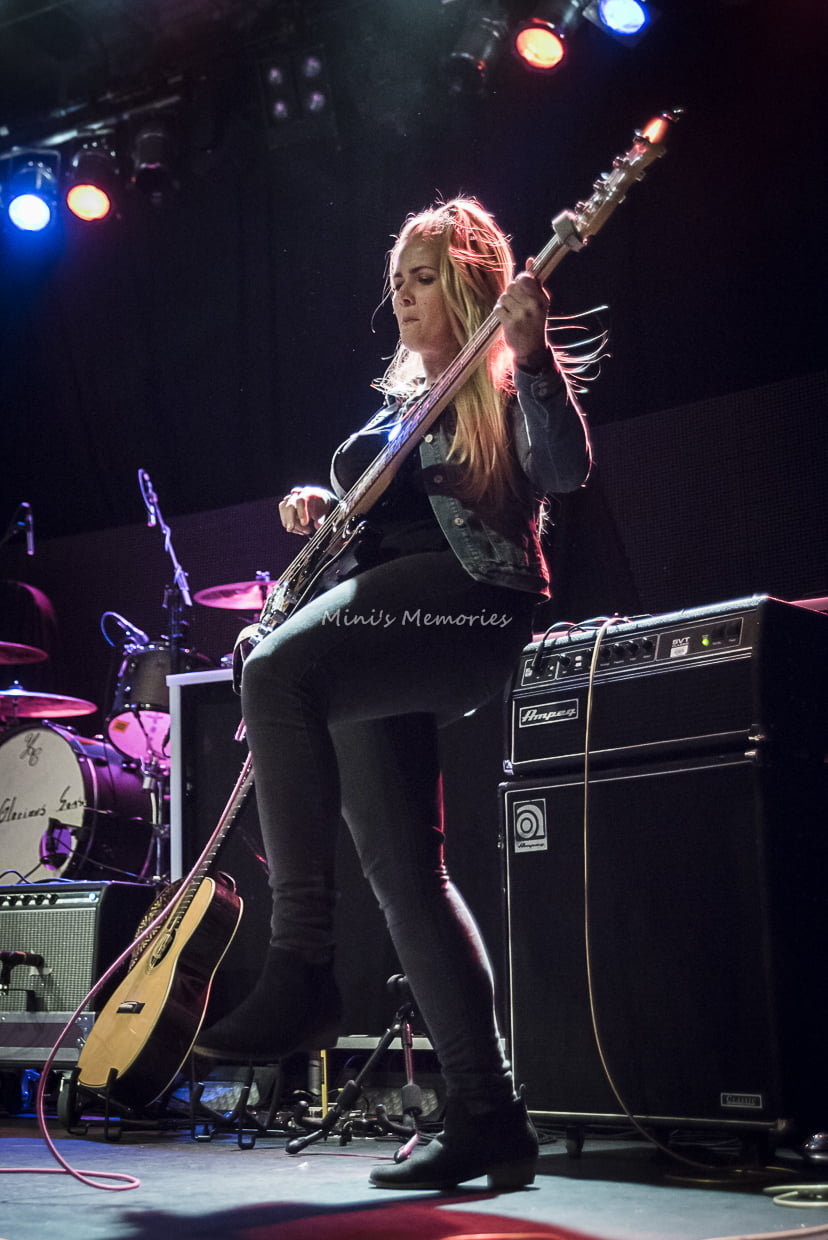


How do you make a good thing like SiriusXM Streaming even better? How about by adding 75 new Online Channels to their already outstanding line-up? I mean, that’s not even counting my own show on Channel 167, Canada Talks.
Whether you’re a fan of rock or talk, have a craving for classic covers, or love their theme channels that put you on a yacht or on the road, they’ve got 75 new channels for you and your ears. And with SiriusXM Streaming, you can hear all of them via your mobile device, computer, connected home and more.
Here’s a rundown of just a few of the heavy hitters SiriusXM Streaming subscribers now have access to:
SiriusXM will also be expanding its lineup to include more culturally diverse programming, including a suite of Spanish-language and Latin-focused music, news and sports channels, such as American Latino Radio, CNN en Español, En Vivo, ESPN Deportes, Flow Nación, La Kueva, Latidos, Luna and more.
SiriusXM Streaming subscribers have access to these channels, effective immediately. New subscribers can sign up now and take advantage of a very special offer.
Here is the complete list of brand new SiriusXM Streaming channels:
The Corporation of Massey Hall & Roy Thomson Hall is pleased to announce the exciting new details of Phase II of the Massey Hall Revitalization – a seven-year multiphase project to restore and renew both the interior and exterior of this National Historic Site, and construct a new addition, connected to the south of the building. This revitalization update includes new details about the enhancement of amenities for both artists and patrons, featuring the introduction of a state-of-the-art retractable seating system; the addition of two new venues – a 500 capacity artist performance venue in the south tower & a more intimate space in an expanded Centuries bar; the construction of passerelles for easy access to additional amenities; and the restoration of the original, 124 year-old stained glass windows.
“We are extremely proud and excited to share these new Massey Hall Revitalization details,” said Deane Cameron, President & Chief Executive Officer of the Corporation. “With these improvements, our goal is to keep the original inspiration of Hart Massey alive by continuing to operate as an eternal gift for the people of Toronto and making the hall more accessible for patrons and artists alike.”
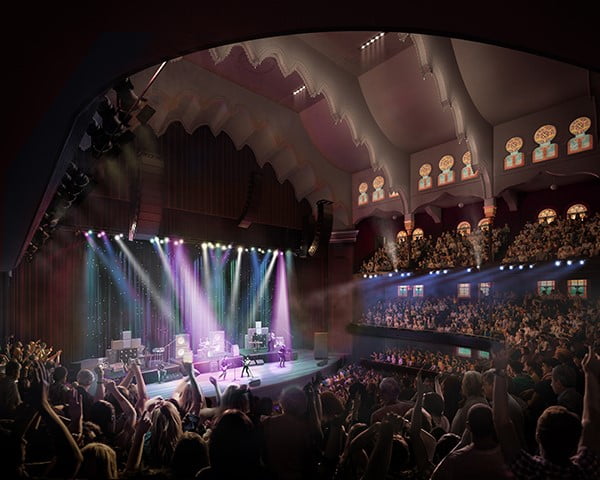
Early architectural renderings illustrating these enhancements have also just been released, created by KPMB Architects, who as previously announced, have been spearheading the Massey Hall Revitalization project.
“We will retain the qualities that make Massey Hall such a unique and vibrant performance space while complementing this treasured heritage venue with new spaces that will extend the role of the hall as a creative cultural hub,” said Marianne McKenna, design lead, founding partner KPMB Architects. “The revitalized Massey Hall will offer educational opportunities and additional performance venues to host events and support new Canadian talent well into the future.”
Local heritage and restoration advisors, as well as internationally renowned technical consultants have been hired to ensure that the original character and feel of this iconic cultural institution is not only preserved, but enhanced, using technology that just wasn’t available over a century ago. All with the desire for Massey Hall to operate more efficiently, and remain culturally vibrant for another century and beyond.
The first noteworthy enhancement that patrons will experience is the hall’s new seating flexibility: brand-new retractable seats that expand to a classic seating configuration, with greater comfort, or retract to allow a wide-open, general admission floor space.
“The ability to transform the orchestra level into a standing-room audience means a whole new category of acts will be attracted to Massey Hall,” explains Clemeth L. Abercrombie, senior consultant at Charcoalblue, the theatre consultant company behind the renovation. “From a patron standpoint, you get a seating layout that respects the heritage of Massey Hall but uses a higher-quality seat and a system with more flexibility. And when you’re in the standing room, it’s an open floor with space all around.”
For patrons who want to experience performances at ground level but still be seated at general admission shows, a raised parterre seating section will be built around the perimeter of floor.

As previously announced, the addition of the seven-story, south tower will house vital infrastructure, including artist dressing rooms, the venue’s first modern loading dock, and additional technical capacities for larger, more complex touring productions.
Today, it was revealed that the south tower will also boast a new 500 capacity performance space on the fourth floor, offering a much-needed small music venue in the wake of recent closures in Toronto.
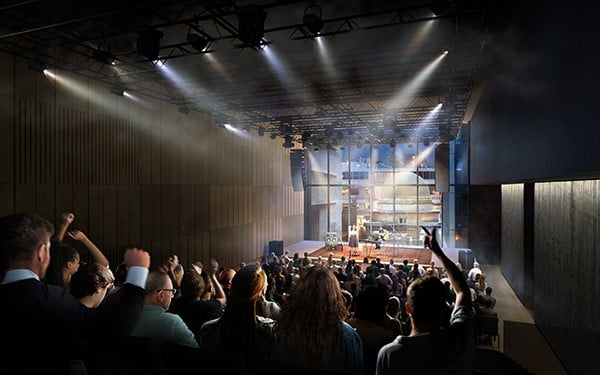
The main hall will also feature a smaller performance venue in the revered basement bar, Centuries, geared for more intimate artist and industry showcases.
“Because so many people want to live here (Toronto), and there are more developments, and rents are going up, it does put pressure on every independent business,” says Ward 15 Councillor Josh Colle, also chair of Toronto’s Music Industry Advisory Council. “Music venues face an added element: neighbourhoods that weren’t heavily populated are now becoming home to lots of condos and lots of new residents who might be more sensitive to what they perceive as noise.”
“I think most major cities around the world are finding that you want economic activity happening pretty much 24-7,” adds Colle. “It makes a main street healthier and safer to have activity at different hours, and not just shut down. It’s fitting that Massey would be the catalyst to make Yonge Street relevant again for music, because they’ve been there through everything.”
The south tower will also ease patron crowding and create greater accessibility with the construction of passerelles, attached to the original Massey Hall structure and connecting to much-needed additional washrooms (plus food & beverage concessions) that will be located on every level – instead of currently having to trek down three or four stairwells to the auditorium basement.

Also announced was the restoration of the 100 original stained glass windows, located on all four levels of the auditorium. Having been boarded up and concealed from view for over a century, it was only recently that they were uncovered as part of the Massey Hall Revitalization, and carefully prepared for restoration by teams of local stained glass experts.
“When the stained glass windows were uncovered it was really exciting,” says Sharon Vattay, architectural historian with Goldsmith Borgal & Company Ltd. Architects, a Toronto-based firm specializing in the restoration, rehabilitation and adaptive reuse of heritage buildings & charged with overseeing the restoration of the century old Massey Hall stained glass. “The colours were remarkable, and the light was unreal.”

In 1999, Jim Carrey portrayed his idol Andy Kaufman in “Man on the Moon.” For twenty years, the behind-the-scenes footage has been withheld…intil now. Jim & Andy: The Great Beyond – With a Very Special, Contractually Obligated Mention of Tony Clifton premieres November 17th, only on Netflix.

Do vending machines for the morning after pill promote risky sex? Do emojis make texting better, or worse? #Activism vs #Slacktivism? Bell Media Studios, in partnership with DAIS, ventures into uncharted territory tackling questions important to youth, with the brand-new, social media-first series SIDES*.
The first series of its kind from a Canadian broadcaster, each episode streams live around the world on Twitter @Sides on Wednesdays at 8 p.m. ET/5 p.m. PT, featuring a rotating panel of six teen hosts exploring and debating topics important to them and the series’ social media audience.
From political upheaval and leading news stories, to entertainment scandals and life advice, their dynamic and candid conversations allow viewers to listen, learn, and react using the hashtag #MySide. Fans worldwide can continue to engage with SIDES*, and watch clips and additional content 24/7 on Twitter, Instagram, Snapchat, YouTube, and Facebook.
SIDES* has found early success with its first-ever live stream on October 11 reaching more than 45,000 viewers, with live viewership up by a massive 400% during last night’s episode garnered more than half a million impressions on additional clips and videos posted across all social media platforms throughout the week.
Following the live broadcast, a one-hour episode of SIDES* joins Much’s revamped lineup of topical, millennial-focused programming on Saturdays at 9 p.m. ET/6 p.m. PT. TV episodes highlight the debates from that week’s social broadcast, while also incorporating what viewers had to say through tweets, comments, and videos posted using the #MySide hashtag. Each episode also includes host rants and other videos from the cast and guests on additional topics that are important to them.

SOCAN today announced it has partnered with Pioneer DJ Corporation of Japan to become the first music rights organization in North America to use direct metadata extraction technology, KUVO, to identify electronic dance music performances automatically and seamlessly in nightclubs and other electronic music venues.
The Pioneer-KUVO device is being provided voluntarily to nightclubs, beginning with the Toronto area, as an additional aspect of their SOCAN music license agreement. Once installed, the KUVO device easily plugs into a DJ’s mixing board, capturing metadata from the music, which is then collected and relayed to SOCAN to tabulate and distribute royalties more accurately to the copyright holders of the music.
Simply put, KUVO helps to ensure that the correct owners of music used in nightclubs are compensated accurately from the music licenses already being paid. There are no additional costs, expectations or maintenance required from electronic music venues that voluntarily adopt the easily-installed system.
“For years we’ve been dissatisfied with the system in place, knowing that not all licenses we pay are getting in to the hands of artists behind the music played in our venues and at our events,” said Joel Smye, owner of CODA nightclub in downtown Toronto, one of the largest and most successful electronic music venues in Canada and the first to adopt the technology. “Now, through technology, the use of a simple device will ensure that the music licenses that we pay and have always paid will go to the right people.”
The initiative is championed by the Association for Electronic Music (AFEM) in support of its global campaign “Get Played, Get Paid,” that seeks to ensure dance music creators are accurately compensated for the use of their work.
“Everyone wants to be paid fairly for their music, and I hope that clubs and festivals will be eager to use technology to help ensure that the right people get their fair share of the legal music licenses that they already pay. Props to SOCAN for using the latest technology of KUVO to be even more accurate and transparent for music creators like me,” said dance music DJ, producer, and SOCAN member, Richie Hawtin, who recently collaborated with KUVO through his own music-recognition platform, RADR.DJ.
SOCAN is the first music rights organization in North America to adopt such technology, and other performing rights organizations around the world have seen improved accuracy in their identification and distribution of royalties to electronic music rights holders.
“DJs spin more music in one show than the vast majority of other live musical performances, but it’s nearly impossible for them to submit accurate set lists of music for shows that they perform,” said Vice President of SOCAN’s Distribution department, Kit Wheeler. “Pioneer-KUVO technology addresses this problem and enables SOCAN to capture even more musical performances in real time and more accurately. Our partnership with Pioneer and KUVO is a great step forward in getting our more than 150,000 members fairly paid for their work.”
“We’re delighted that SOCAN will use metadata from KUVO and we hope that other PROs in North America will see how accurate the service is and come aboard,” said Pioneer DJ’s General Manager, Mark Grotefeld. “It’s a huge territory and currently there’s a lot of the money paid by the venues in license fees that isn’t finding its way to the artists who deserve it. KUVO can help solve that problem and reward those who produce the music played by DJs.”
Nightclubs are required by law to pay licenses to SOCAN and other music rights organizations for the blanket use of music that they use for their business. Without technology like KUVO, matching license payments with the correct music rights holders would be done manually and can be an onerous task for either the DJ or the nightclub. Music creators depend on royalties to sustain and build their career.
As a result of KUVO technology being implemented first at the CODA nightclub, royalties from the use of electronic music by DJs will begin flowing to SOCAN members and international rights holders as of November 2017.
Follow us on Instagram @thatericalper

Eric Alper is a 6-time nominee for Publicist of the Year during Canadian Music Week and has overseen the publicity campaigns for over 183 JUNO Award-nominated albums (and 16 in 2025), 45 Grammy-nominated albums, including 47 JUNO Award, 58 Canadian Folk Music Award, 126 Maple Blues Award-winning albums and is also truly honoured to work with some of the biggest and most important artists of our time.
Contact me: eric@thatericalper.com
© Copyright - That Eric Alper