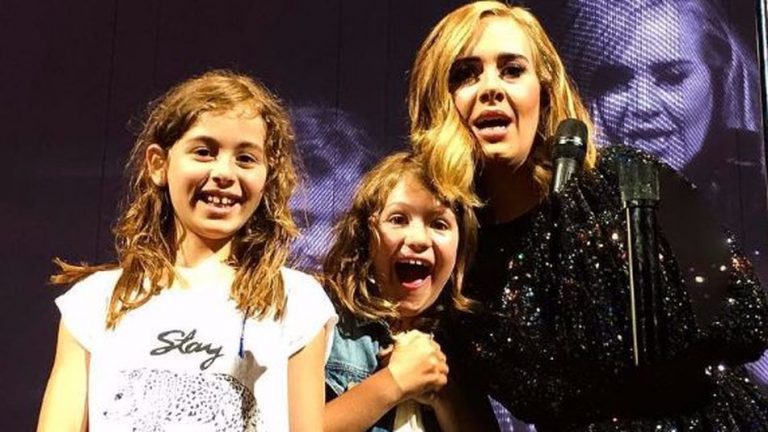
Life is good for Adele: Record-breaking album sales, sold out shows around the world, and even has happy freak outs when picking audience members to join her onstage.
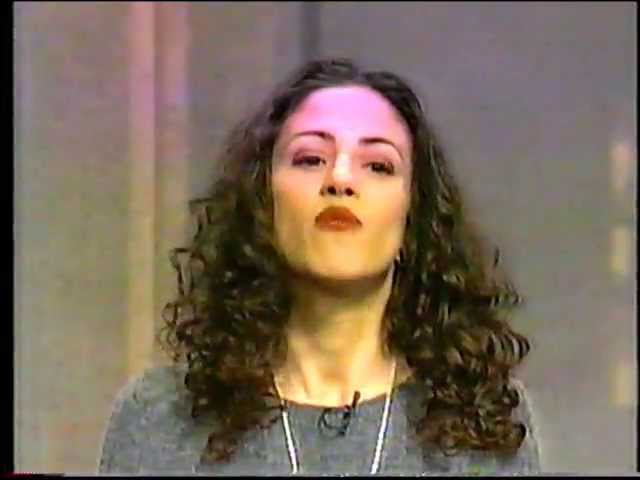
When the singer invited two seemingly random little girls on stage for the opening night in Amsterdam as part of her “25” World Tour, she blew her own mind when she realized she knew them.
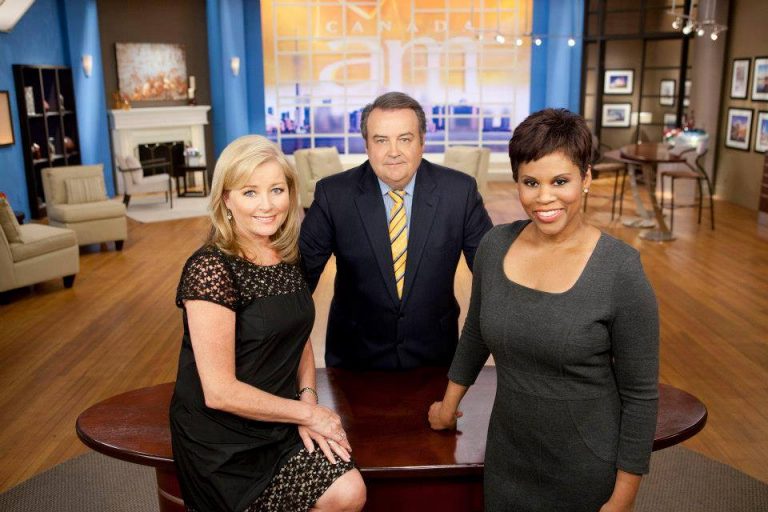
After more than four decades on the air, CTV’s Canada AM will broadcast its final episode on Friday, June 3. The show that truly gave me my start on the other side of the media will be missed.
A simulcast of live CTV News Channel programming will air in the time slot in place of Canada AM starting Monday.
“As the television landscape continues to evolve, so too must our programming. We look forward to building upon the success of ’Canada AM’ as we move forward,” said Randy Lennox, president of entertainment production and broadcasting at Bell Media.
“We invite viewers and fans to join us as we say goodbye tomorrow and acknowledge the lasting legacy this series and its talent — both now and in the past — have had on Canada’s broadcasting industry.”
CTV said co-hosts Beverly Thomson and Marci Ien will continue to stay with Bell Media while Jeff Hutcheson will begin his previously announced retirement.
Thomson will move to CTV News Channel while Ien will develop new projects with Bell Media In-House Productions.
A note from the program has been posted on Facebook. Thanks to every single person that had a hand in helping Canadian and International artists have a platform.
What a show! What a history! What an adventure we have had together. CTV has announced that Friday, June 3rd will be the final broadcast for Canada AM.
We are so deeply honoured that for more than 40 years, you have invited us into your living rooms to share a coffee, the day’s top news and the occasional laugh or two.
From those bleary-eyed mornings after an election, the Oscars or a playoff game, to those days when our hearts raced with the breaking news that too often broke all of our hearts, we have always felt the privilege of having you with us as history was unfolding. Thank you Canada for our mornings together, and thank you for the memories we will keep with us always.
We look forward to the next chapter for all of us. We would love to hear some of your memories of Canada AM, so feel free to share with us right here.
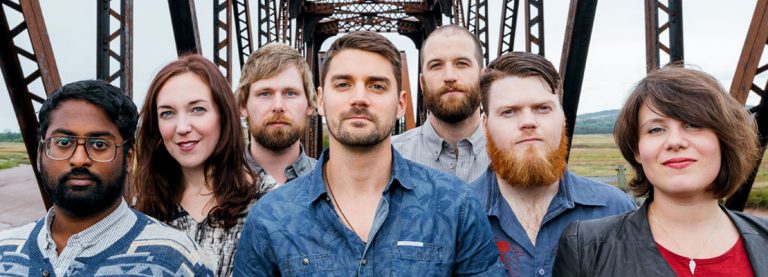
Hey Rosetta!, PUP, White Lung, and The Barr Brothers are among the initial acts announced for the Halifax Pop Explosion Music Festival’s 2016 lineup. Adding to their growing reputation for presenting stellar comedic programming, the festival also welcomes Cameron Esposito as a comedy headliner this year.
As previously announced, Mo Kenney performs with Symphony Nova Scotia during HPX 2016.
Earlybird wristbands for the festival are on sale here. This year’s Halifax Pop Explosion Music Festival takes place in Halifax, NS from October 19-22, 2016.
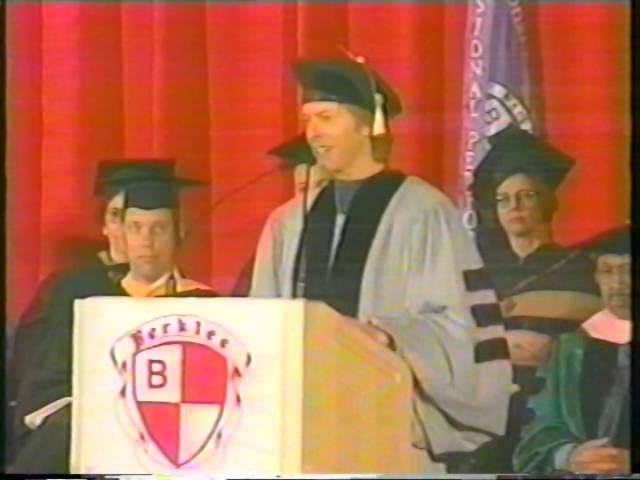
David Bowie did few interviews and, from what I find, this was his only commencement speech he ever gave – to the Berklee College of Music graduating class in 1999. There are several gems in his 8-minute talk, and the full transcript is below.
Thank you. Thanks very much. Rockers… Jazzers… Samplers… That was a fantastic concert last night. I think both Wayne and myself were just so moved to hear our compositions coming back at us through your ears and abilities. It was dynamite. You don’t know how much we appreciate it.
I chatted with some of the students last night and I asked one of them if he could give me a good joke to start today off with and also his worst fear.
He said, “I’ll give you both. How does a tuba player answer the telephone? Hello, Dominoes.”
“Thank you,” I said.
Oh, I should remind you that anybody left over from the proceedings today can join my wife and I at [local pizza place] Little Stevie’s for a slice. Dunkin Donuts, then, alright?
I’ve got a message here for the administration from my sometimes-collaborator and fellow musician Reeves Gabrels, ex-alumni. It says here, “I haven’t forgotten that $900 I owe from my last semester. I should point out that this has been owed since the spring of 1980. I read recently in Allegro that they are holding an unclaimed check for me backdating from my days with Tin Machine.”
Well, that should wipe out about $30-worth right there.
As always on occasions like this, I really never know what to do—which is pretty much the way that I’ve handled my career as a musician/writer. I guess any list of advice I have to offer to a musician always ends with “If it itches, go and see a doctor.” Real world! But that’s not going to be of any help today.
My sometimes-collaborator Brian Eno described himself as a non-musician. In fact he tried to get it put into his passport as his work definition. [faking British customs officer voice] “Non-musician? Made any records?” [impersonating Brian Eno] “Of course not. I’m a bloody non-musician.” Anyway I’d describe myself, I think, as a bit of a non-musician. I took classes, initially, after seeing the Little Richard band in a film with, at that time Britain’s foremost baritone jazz player Ronnie Ross. I was about 14 and I gave him a phone. I found his number in the phone book and he very kindly took me on. But I quickly found that what was written as “be doo boo doobie doop ba doo bip …” That’s a George Redman composition, West Coast band, 60s you wouldn’t know about it.
“Be doobiee doobie doop a doop bip,” when I started playing it, came out as “bdzzzz dzzzzz zzzz.” So it seemed that authenticity and the natural form of expression wasn’t going to be my forte. In fact, what I found that I was good at doing, and what I really enjoyed the most, was the game of “what if?” What if you combined Brecht-Weill musical drama with rhythm and blues? What happens if you transplant the French chanson with the Philly sound? Will Schoenberg lie comfortably with Little Richard? Can you put haggis and snails on the same plate? Well, no, but some of the ideas did work out very well.
So, I learned enough saxophone and guitar and what’s euphemistically called “composer’s piano” to get my ideas over to proper musicians, as we have here today. And then I went on a crusade, I suppose, to change the kind of information that rock music contained. I adored Coltrane, Harry Parch, Eric Dolphy, Velvet Underground, John Cage, Sonny Stitt. Unfortunately, I also loved Anthony Newley, Florence Foster Jenkins, Johnnie Ray, Julie London, the legendary Stardust Cowboy, Edith Piaf and Shirley Bassey.
A word about Shirley Bassey. During the very early days of Ziggy Stardust, we often used to play these fairly grotty clubs called the “workingman’s clubs.” They were sort of like nightclubs but you got a cheap meal. The whole family would come. A round of beer. A rock act. A stripper—sometimes one in the same. Well, backstage one night I was desperate to use the bathroom. I was dressed in my full, battle finery of Tokyo-spaceboy and a pair of shoes high enough that it induced nose bleeds. I went up to the promoter—actually I tottered over to the promoter—and I asked, “Could you please tell me where the lavatory is?”
And he said, “Yeah, look down that corridor. On the far end of that wall. You see that sink? There you go.”
I said, “My good man, I’m not taking a piss in the sink.”
He said, “Listen son, if it’s good enough for Shirley Bassey, it’s good enough for you.”
From which I learned that mixing elements of bad taste with good would often produce the most interesting results. So, in short, I didn’t feel comfortable as a folk singer or an R&B singer or a balladeer. I was drawn more and more to the idea of manipulation of signs, rather than individual expression—a concept that really had its start in the late 50s with Pop Art and by the early 70s I found myself making what British writer Simon Fricke described as “art pop.”
It wasn’t so much about how I felt about things, but rather, how things around me felt. To put it simply, I had discovered the Englishman’s true place in rock and roll. This all sounds, I suppose, quite dispassionate, but believe me, still, even now, when I hear the most fantastic solo being played on a CD and it’s on the fadeout, I still rush over to the volume switch and bring it up in proportion to the way it’s fading down, so I can catch that last note. It still is very much my life. It’s impossible for me to talk about popular music without mentioning probably my greatest mentor, John Lennon. I guess he defined for me, at any rate, how one could twist and turn the fabric of pop and imbue it with elements from other artforms, often producing something extremely beautiful, very powerful and imbued with strangeness. Also, uninvited, John would wax on endlessly about any topic under the sun and was over-endowed with opinions. I immediately felt empathy with that. Whenever the two of us got together it started to resemble Beavis and Butthead on “Crossfire.”
The seductive thing about John was his sense of humor. Surrealistically enough, we were first introduced in about 1974 by Elizabeth Taylor. Miss Taylor had been trying to get me to make a movie with her. It involved going to Russia and wearing something red, gold and diaphanous. Not terribly encouraging, really. I can’t remember what it was called—it wasn’t On the Waterfront, anyway, I know that.
We were in LA, and one night she had a party to which both John and I had been invited. I think we were polite with each other, in that kind of older-younger way. Although there were only a few years between us, in rock and roll that’s a generation, you know? Oh boy, is it ever.
So John was sort of [in Liverpool accent] “Oh, here comes another new one.” And I was sort of, “It’s John Lennon! I don’t know what to say. Don’t mention the Beatles, you’ll look really stupid.”
And he said, “Hello, Dave.” And I said, “I’ve got everything you’ve made—except the Beatles.”
A couple of nights later we found ourselves backstage at the Grammys where I had to present “the thing” to Aretha Franklin. Before the show I’d been telling John that I didn’t think America really got what I did, that I was misunderstood. Remember that I was in my 20s and out of my head.
So the big moment came and I ripped open the envelope and announced, “The winner is Aretha Franklin.” Aretha steps forward, and with not so much as a glance in my direction, snatches the trophy out of my hands and says, “Thank you everybody. I’m so happy I could even kiss David Bowie.” Which she didn’t! And she promptly spun around swanned off stage right. So I slunk off stage left.
And John bounds over and gives me a theatrical kiss and a hug and says “See, Dave. America loves ya.”
We pretty much got on like a house on fire after that.
He once famously described glam rock as just rock and roll with lipstick on. He was wrong of course, but it was very funny.
Towards the end of the 70s, a group of us went off to Hong Kong on a holiday and John was in, sort of, house-husband mode and wanted to show Sean the world. And during one of our expeditions on the back streets a kid comes running up to him and says, “Are you John Lennon?” And he said, “No but I wish I had his money.” Which I promptly stole for myself.
[imitating a fan] “Are you David Bowie?”
No, but I wish I had his money.
It’s brilliant. It was such a wonderful thing to say. The kid said, “Oh, sorry. Of course you aren’t,” and ran off. I thought, “This is the most effective device I’ve heard.”
I was back in New York a couple of months later in Soho, downtown, and a voice pipes up in my ear, “Are you David Bowie?” And I said, “No, but I wish I had his money.”
“You lying bastard. You wish you had my money.” It was John Lennon.
These are just a few moments from my life. This moment is very definitely yours. Thank you so much for indulging me for the last 10 minutes. I hope it’s been reasonably interesting for you.
Music has given me over 40 years of extraordinary experiences. I can’t say that life’s pains or more tragic episodes have been diminished because of it. But it’s allowed me so many moments of companionship when I’ve been lonely and a sublime means of communication when I wanted to touch people. It’s been both my doorway of perception and the house that I live in.
I only hope that it embraces you with the same lusty life force that it graciously offered me. Thank you very much and remember, if it itches, play it.
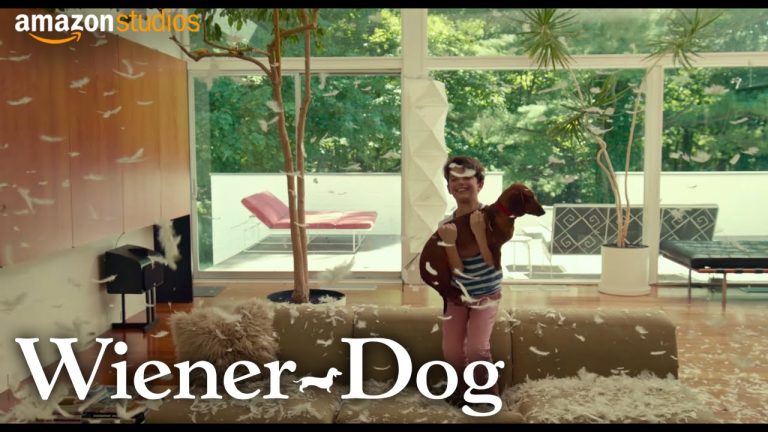
Wiener-Dog is a new film by writer/director Todd Solondz (Storytelling, Welcome to the Dollhouse, Palindromes) that tells four different stories all connected by one common character, a small wiener dog. The film stars Danny DeVito, Greta Gerwig, Julie Delpy, and Ellen Burstyn. Wiener-Dog will be released in theatres on June 24, 2016.
In another leading move, music rights organization SOCAN has unveiled an application program interface (API) portal that enables a marketplace of new innovative apps that will revolutionize how music creators and music publishers work with SOCAN to get paid when their music is played.
SOCAN is using API technology – the digital glue that links large databases such as SOCAN’s with apps, mobile phones, and websites – to push music royalty management innovation out to the marketplace, transforming how music rights are managed in the digital era.
The first two APIs announced today are “Song Registration” and “Concert Notification.” Song/Work Registration enables writers to use new workflow apps and software to register their songs more accurately with their music publishers, labels, digital services and SOCAN.
The Concert Notification API enables songwriters and music publishers to easily register their concerts with SOCAN to get paid faster and more accurately for their live performances.
Toronto-based SongSplits is “the world’s first cloud based split sheet,” enabling co-writers to negotiate their percentage contribution, or “splits,” and ensure that all of the associated data (title, writers, etc.) is accurate and thorough when it is registered with SOCAN via the Song/Work Registration API.
Montréal-based TGiT (“tag it”) is an open source music tagging software platform that allows music creators to manage the descriptive information, tags and metadata associated with their original compositions and sound recordings, for export to SOCAN through the Song/Work Registration API.
By ensuring that music creators can easily agree on and export the data that the music royalty system depends on, these apps and SOCAN’s API’s will go a long way to clean up missing, conflicting and inaccurate data that bogs down the current global royalty system, particularly in digital streaming.
“SOCAN is leading the transformation of music rights by using technology to get songwriters and music publishers paid fairly when their music is played, especially in the challenging digital music royalty area,” said Michael McCarty, Chief Membership & Business Development Officer at SOCAN. “We are enabling a new segment of what we call the ‘RightsTech’ industry – developers who are creating new digital tools that will help to modernize a royalty system that was developed for the vinyl era.”
Companies that wish to utilize the SOCAN API’s can do so at no cost through the SOCAN Developer Portal, where they can register, download software code, and develop and test their apps in a secure sandbox before going live, helping SOCAN members get paid when their music is played.
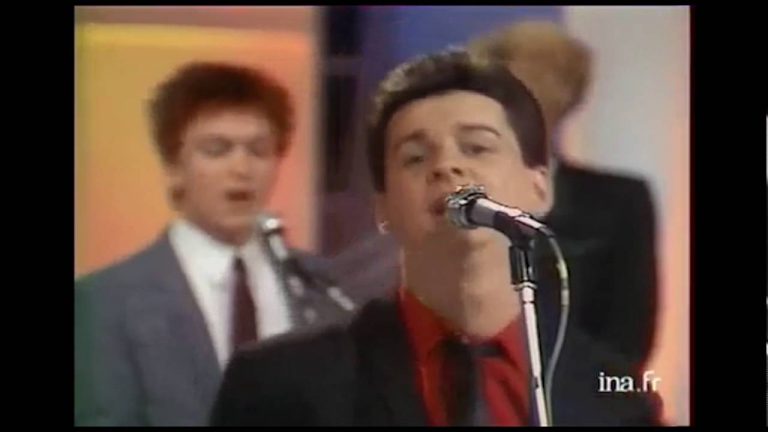
Depeche Mode’s Just Can’t Get Enough was the band’s first single to be released in the United States, and the final single to be written by founding member Vince Clarke, who left the band in November 1981.
Which is surprising, because as you can see from this television performance, it’s actually without any music or words except a holler and a hoot from lead singer Dave Gahan, thanks to another great re-imaging from Mario Wienerroither.