

“In March 1952 [John Williams] was reassigned to the 596th AF Band, Pepperrell Air Force Base, St. John’s, Newfoundland. During his stay at Pepperrell he was able to put his training to use with special arrangements penned for the 596th Dance band and Newfoundland folk songs re-arranged for the concert band sparking the many appearances of the Pepperrell Band. His greatest accomplishment during this period was the composing, arranging, directing and playing of a 22 minute film background score for a Newfoundland travelogue entitled “You Are Welcome.” The success of this accomplishment was reflected in the film being selected as “one of the outstanding travelogues for 1954” during a premier showing in New York City. The score was unique in that it utilized themes from Newfoundland folk songs for local color. In addition, the fact that the recording ensemble, composed of members of the 596th AF Band, was limited to 12 pieces and lacked the ever present “lush” string section necessitated Johnny to call upon his former training to gain proper utilization of the limited instrumentation and intricate scoring to give the over-all effect of a large orchestra.”
– Paul Galloway, The Beacon, Aug.27, 1954
Star Wars Composer John Williams’ First Score Was A 1952 Newfoundland Film

CIMA Partners With BuzzAngle Music To Launch First-Ever Canadian Indie Charts

The Canadian Independent Music Association (CIMA) and BuzzAngle Music are teaming up to bring the first-ever independent-only music sales and streaming charts to Canada, through the innovative technology of BuzzAngle Music.
Harnessing BuzzAngle Music’s comprehensive music data reporting technology, these new charts, set to launch later this year, will provide real-time, up-to-date data on the performance of releases from Canada’s independent music industry.
Both the new CIMA Top Independent Albums and CIMA Top Independent Songs charts, powered by BuzzAngle Music, will be published on a weekly basis on CIMA’s website (www.cimamusic.ca). CIMA and BuzzAngle Music are both proud to note that this is the first time that Canada will have an exclusive chart that puts the spotlight squarely on the strength of Canada’s domestic-owned independent music industry.
“We are extremely excited to partner with BuzzAngle music, in order to recognize the success of Canada’s independent music industry,” says Stuart Johnston, President of CIMA. “The introduction of this new service this year is a fitting way for CIMA to celebrate its 40th anniversary, and we thank BuzzAngle Music for providing the tools to make this happen. And the fact that CIMA members can access all of BuzzAngle’s data at an exclusive rate further demonstrates this company’s commitment to the Canadian independent music community.”
“There’s an endless amount of data to analyze in BuzzAngle Music’s daily charts, whether you’re an independent artist, label executive, journalist, record store clerk, or just a music fanatic,” said Jim Lidestri, Founder and CEO of Border City Media. “CIMA has been a tremendous organization and everyone involved deserves the timeliest, most specific and most accurate data available to them, so we’re thrilled to partner with them and make that happen for independent music in Canada.”
J. Robert Wood Announced as 2016 Recipient of Allan Waters Broadcast Lifetime Achievement Award

Canadian Music Week is pleased to announce J. Robert Wood as the 2016 inductee to the Canadian Broadcast Industry Hall of Fame. An innovator and veteran of the industry for more than five decades, Wood will be honoured for his achievements and longstanding career in broadcasting with the Allan Waters Broadcast Lifetime Achievement Award. The induction ceremony will take place during the Canadian Radio Music Awards luncheon beingpresented by Bell Media, on Friday, May 6, 2016 at the Sheraton Centre Toronto Hotel.
J. Robert Wood is a radio broadcast management consultant with more than 40 years experience in programming, operations, management, large-scale project development, network expansion, government lobbying and fund-raising. Born in Teulon, Manitoba, Wood began his career as an on-air deejay at CKSA in Lloydminster before moving to CKOM Saskatoon, CKY in Winnipeg and CHLO in St. Thomas. Following a successful tenure as program director of CHLO, he moved to CHUM in 1968 where he served as Program Director of CHUM, National Program Director of CHUM Group stations across Canada, and Manager of CHUM and CHUM-FM in Toronto.
“Bob Wood came to CHUM in 1968. Over the next ten years or so, he, and maybe the greatest radio staff ever put together, created magic on 1050 CHUM! Bob was imaginative, creative and a great leader”, said former CHUM Chairman Jim Waters. “His winning the Allan Waters Broadcast Lifetime Achievement Award is Iong overdue!”
Wood left CHUM in the mid-1980s to apply for a Toronto radio license; he went on to pursue broadcast management consulting, fund-raising and government lobbying activities. From 2000 to 2010, he helped launch the Aboriginal Voices Radio network (AVR), for which he raised more than $15 million.
“I feel very honoured to be selected for this Award and am grateful to accept it on behalf of the many talented men and women at CHUM whose hard work, dedication and creative brilliance enabled us to create one of broadcasting’s great radio stations,” said Wood.
Wood was inducted into the Canadian Music Industry Hall of Fame in May of 1978 by RPM Magazine. The former radio editor of Billboard Magazine, Claude Hall, ranked Wood as number 12 on his list of the 15 best Top 40 program directors in North America in 2012. In choosing Wood, Hall said, “Robert Wood was Canadian radio.”
An innovator and entrepreneur, Wood initiated a number of projects in the early days of Canadian content regulations to help promote the development of Canadian music, including the Maple Leaf Music Network (10 stations across Canada agreeing to play the consensus choice of three new Canadian records per week), the CHUM Free Ad Plan (providing free commercials for newly released songs by Canadian artists) and the CHUM Report (a weekly report he wrote which was distributed to radio and record companies to help promote new up-and-coming Canadian music and improve the relationship between radio and record people at the time.)
Wood has served on various industry committees including CAPAC, the CAB and the United Way’s media unit and has played a pivotal role in the launch of FACTOR (Foundation to Assist Canadian Talent on Record.) He has helped many broadcasters over the years, including the launch and advancement of the careers of many young broadcasters and has helped more senior broadcasters survive the difficulties visited upon them due to ill health.
The Story Of The Animals’ House of the Rising Sun
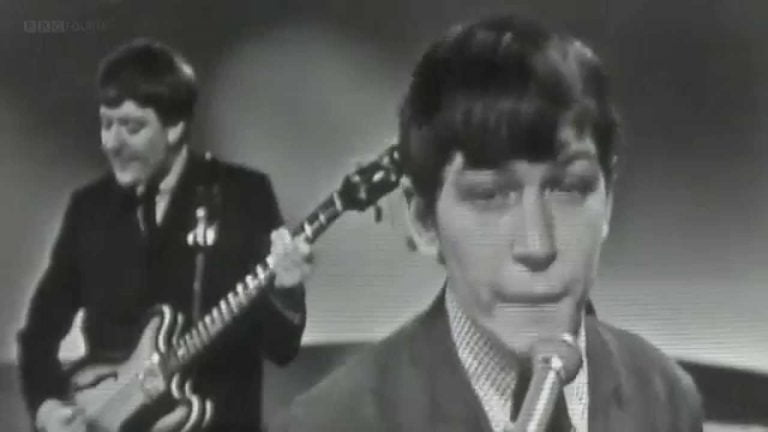
Like many classic folk ballads, the authorship of “The House of the Rising Sun” is uncertain. Musicologists say that it is based on the tradition of broadside ballads such as The Unfortunate Rake of the 18th century, and that English emigrants took the song to America where it was adapted to its later New Orleans setting. There is also a mention of a house-like pub called the “Rising Sun” in the classic Black Beauty published in 1877, set in London, England, which may have influenced the title.
The oldest known existing recording is by Appalachian artists Clarence “Tom” Ashley and Gwen Foster, who recorded it for Vocalion Records in 1934. Ashley said he had learned it from his grandfather, Enoch Ashley….
An interview with Eric Burdon revealed that he first heard the song in a club in Newcastle, England, where it was sung by the Northumbrian folk singer Johnny Handle. The Animals were on tour with Chuck Berry and chose it because they wanted something distinctive to sing. This interview refutes assertions that the inspiration for their arrangement came from Bob Dylan. The band enjoyed a huge hit with the song, much to Dylan’s chagrin when his version was referred to as a cover. The irony of this was not lost on Dave Van Ronk, who said the whole issue was a “tempest in a teapot,” and that Dylan stopped playing the song after The Animals’ hit because fans accused Dylan of plagiarism. Dylan has said he first heard The Animals’ version on his car radio and “jumped out of his car seat” because he liked it so much.
Millennials will pay for entertainment, but not news
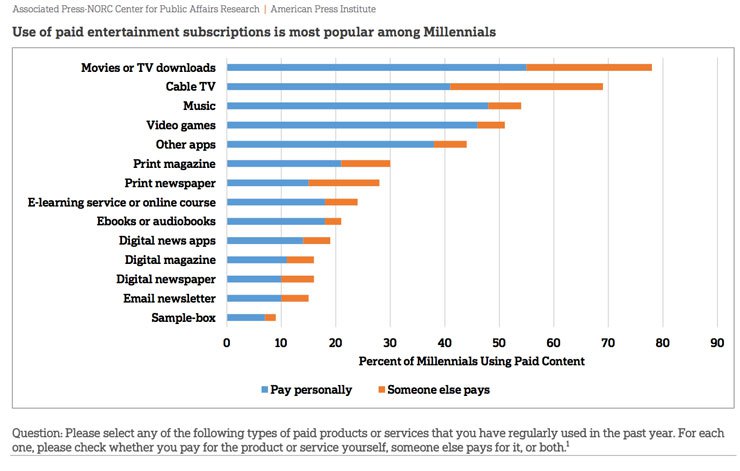
The findings come from the Media Insight Project, a joint initiative of the American Press Institute and the Associated Press-NORC Center for Public Research at the University of Chicago. The researchers surveyed 1045 millennials in January and February of this year, supplemented by focus groups.
The survey found 77 percent had paid in the last year for movies and television, 69 percent for cable, 54 percent for music and 51 percent for video games. Roughly 30 percent had paid for print magazine or newspaper subscriptions. Adding in various digital options, 53 percent pay for some sort of news.
Even among those who say keeping up with news is important to them, only half pay for content, the rest getting what they need free. And even among those who do pay, the largest source of news is free service like Facebook or Google.
Via Poynter
Rush Releases Tom Sawyer Megamix Video To Celebrate 35 Years Of Moving Pictures
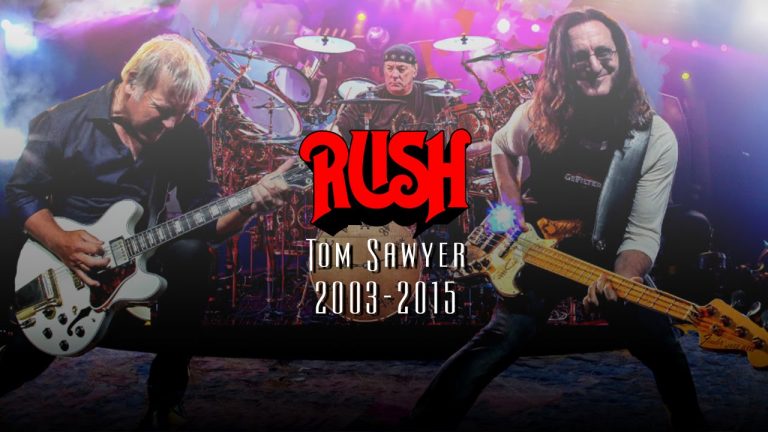
This month marks the 35th anniversary of Rush’s landmark album ‘Moving Pictures,’ and to celebrate the band unveiled a live “megamix” of “Tom Sawyer”
Rock Candy Introduces DC Heroines And Villains
Funko’s newest line was launched at New York Toy Fair with DC heroines and villains features 5-inch vinyl figures!



Demi Lovato’s Christina Aguilera Impression Is Absolutely Dead-On

Jimmy Fallon challenges Demi Lovato to a game of random musical impressions, such as Fetty Wap singing “Twinkle Twinkle Little Star,” and absolutely nails Christina Aguilera’s voice.
Infographic: The Essential Guide To Social Media Trends

Through social media, music and fans continue to rely on each other like the industry have never seen before. This infographic from Fanbridge shows where we are now, and what the road to success might look like in the future.
A Dive Into Jazz Slang (You Dig?), Man?
“Shedding.” “Chops.” “Rataricious.” Sometimes it seems like jazz cats have their own language. Of course, many times those words also end up in other people’s mouths: Terms like “hipster,” “crib” and “the man” all came from the jazz world more than 70 years ago. You dig? Here, Jazz Night In America takes a brief look at where jazz slang came from, with lots of colorful language along the way.