


5:37 AM
Claude responded: Happy birthday to George Lucas, who turns 82 today, born May 14, 1944, in Modesto, California.
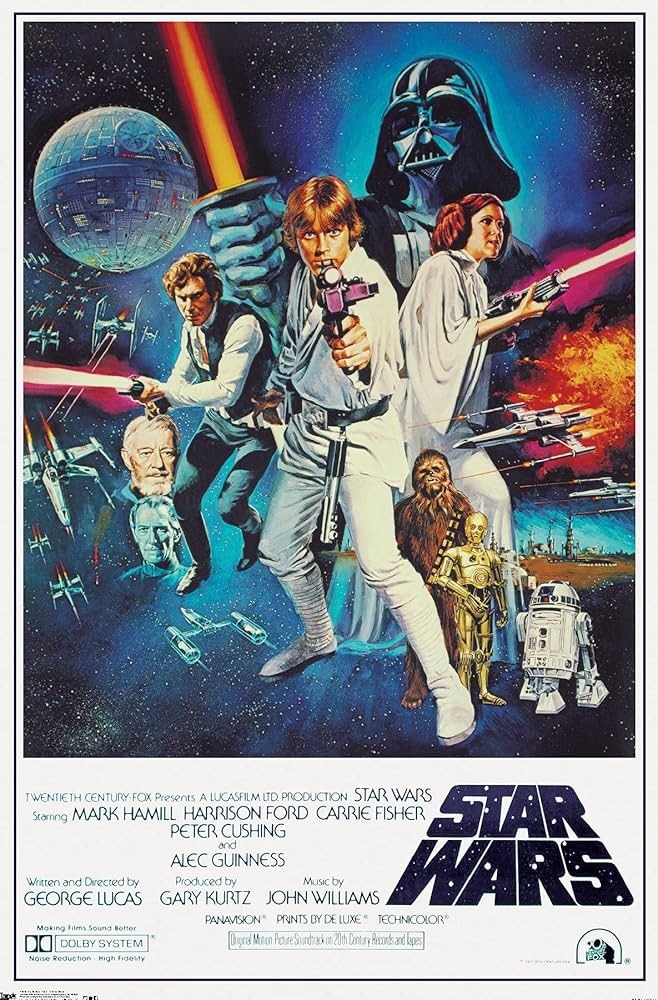
Happy birthday to George Lucas, who turns 82 today, born May 14, 1944, in Modesto, California. He is the man who created Star Wars, co-created Indiana Jones, founded Lucasfilm, Industrial Light & Magic, LucasArts, and THX, and in doing so didn’t just make movies but rebuilt the entire infrastructure of modern cinema from the ground up. His decisions were consistently contrarian: he traded a director’s fee for merchandise rights, self-funded films that studios refused to touch, invented the companies that invented the tools every blockbuster now depends on, and ultimately walked away from the franchise he built rather than lose control of it. Few filmmakers have left a mark so deep and so wide. Here are 82 facts in his honour.
82 Facts About George Lucas
In honour of his 82nd birthday, May 14, 2026
- George Walton Lucas Jr. was born on May 14, 1944, in Modesto, California, a small agricultural city in the Central Valley.
- Before film, his great passion was cars. He spent most of his high school years racing on underground circuits at fairgrounds and hanging around garages.
- On June 12, 1962, just days before his high school graduation, Lucas was broadsided while driving his Autobianchi Bianchina. His seatbelt snapped and ejected him, which saved his life.
- The crash left him with a punctured lung, severe internal injuries, and a temporary loss of heartbeat. He was initially presumed dead and required four months of recovery.
- The accident ended his racing ambitions entirely and redirected his energy toward filmmaking as a safer outlet for his drive and creativity.
- His father, George Sr., owned a small office supply business and expected his son to take it over at 18. Lucas refused flatly and declared he would be a millionaire by 30.
- He made that deadline early, becoming a millionaire at 28 after the success of American Graffiti, which grossed over $140 million on a budget of $777,000.
- Lucas attended Modesto Junior College, where he studied anthropology, sociology, and literature, and began shooting with an 8mm camera, including footage of car races.
- He transferred to the University of Southern California School of Cinematic Arts, one of the earliest universities to have a dedicated film school, on the recommendation of a childhood friend.
- At USC, he shared a dorm room with Randal Kleiser and became part of a tight clique of film students known as The Dirty Dozen, which included Walter Murch, Caleb Deschanel, John Milius, and Matthew Robbins.
- He met Steven Spielberg when Spielberg attended a USC screening in early 1968 and was impressed by Lucas’s student short Electronic Labyrinth: THX 1138 4EB.
- One of his earliest student films, Freiheit (1966), was a 2-minute-48-second silent short depicting a lone figure’s futile dash across a fortified border inspired by the Berlin Wall.
- His 1967 student short The Emperor was a 20-minute black-and-white documentary about a San Francisco radio DJ, produced in ten weeks using purely observational footage.
- Electronic Labyrinth: THX 1138 4EB won first prize in the dramatic category at the 1967 to 1968 National Student Film Festival, earning Lucas a scholarship from Warner Bros. to observe a film of his choosing.
- The film he chose for that scholarship was Finian’s Rainbow (1968), which happened to be directed by Francis Ford Coppola, who was already revered among film students as someone who had made it in Hollywood.
- In 1969, Lucas was one of the camera operators on the Rolling Stones concert film Gimme Shelter.
- He co-founded American Zoetrope with Coppola in 1969, intending to create a liberating environment for filmmakers outside the perceived oppressive control of the Hollywood studio system.
- His feature debut, THX 1138 (1971), was produced on approximately $777,000, a budget that Coppola reportedly chose partly because of his affection for the number seven.
- THX 1138 was shot entirely on location in the San Francisco Bay Area using industrial spaces to evoke a sterile, subterranean dystopia, with no studio sets.
- The film grossed only about $2.4 million worldwide, making it a commercial failure despite considerable critical praise for its atmosphere and formal ambition.
- The sound design for THX 1138 was crafted by Walter Murch, who layered mechanical drones, distorted voices, and amplified environmental noises to create a sense of alienating immersion.
- Lucas married film editor Marcia Lou Griffin on February 22, 1969, after they met while he was working at the United States Information Agency. She later won an Academy Award for editing Star Wars.
- American Graffiti (1973) was directly autobiographical, inspired by Lucas’s own teenage years cruising the streets of Modesto in hot rods, listening to rock and roll radio, and racing at drive-ins.
- The film’s soundtrack featured over 40 authentic early rock hits licensed for roughly $90,000 through flat-fee deals with record labels, and the soundtrack album sold millions of copies separately.
- American Graffiti earned five Academy Award nominations including Best Picture and Best Director for Lucas, and introduced Harrison Ford to the world in one of his earliest significant roles.
- Lucas used his profits from American Graffiti, along with a mortgage on his home, to fund post-production on Star Wars, bypassing studio interference by financing it himself.
- He originally wanted to adapt the Flash Gordon serials he loved as a child. When he couldn’t secure the rights, he created his own space opera instead.
- Lucas drafted a 13-page treatment titled The Star Wars in April 1973, which he then pitched to multiple studios, receiving rejections from nearly all of them.
- Only Alan Ladd Jr. at 20th Century Fox, who admired American Graffiti, pushed through a production and distribution deal. It would go on to restore Fox to financial stability after a string of failures.
- Star Wars was heavily influenced by Akira Kurosawa’s samurai films, particularly The Hidden Fortress (1958), as well as Spaghetti Westerns and classic sword-and-sorcery fantasy.
- Lucas drew on Joseph Campbell’s monomyth framework in The Hero with a Thousand Faces when structuring the Star Wars saga, particularly the hero’s journey that drives Luke Skywalker’s arc.
- Rather than take a higher director’s fee, Lucas negotiated to retain ownership of licensing, merchandising, and sequel rights. That single decision generated billions of dollars over the following decades.
- Lucasfilm’s licensed games, toys, and collectibles from the Star Wars franchise have earned hundreds of millions of dollars, with the original trilogy’s merchandise alone eventually totalling over $12 billion.
- ILM was founded on May 26, 1975, in an empty warehouse in Van Nuys, California, staffed initially by college students, artists, and engineers assembled by effects supervisor John Dykstra.
- The name Industrial Light and Magic came from a zoning map. When Lucas saw the warehouse location was classified as light industrial, he simply named his new effects company accordingly.
- ILM pioneered the Dykstraflex, the first computer-controlled motion-control camera system for film, which enabled precise, repeatable model movements that produced the dynamic space battle sequences in Star Wars.
- Star Wars (1977) required over 360 visual effects shots, which ILM completed under intense time and budget pressure. The effects alone cost around $750,000 of the film’s total budget.
- The lightsaber sound was created by sound designer Ben Burtt by combining the hum of an old projector motor with interference feedback from a television set near a microphone.
- The blaster sound effects were made by hitting the guy-wire of a radio antenna with a hammer, recorded and manipulated by Burtt into the distinctive laser zap heard throughout the films.
- Star Wars won six Academy Awards at the 50th Oscars in 1978, including a Special Achievement Award for visual effects, recognising ILM’s groundbreaking work on the film.
- During the editing of Star Wars, Lucas suffered chest pains that were initially feared to be a heart attack. They turned out to be hypertension and exhaustion caused by the pressures of post-production.
- He also contracted stress-induced pneumonia during the production of Star Wars, which contributed to his decision not to direct the sequels, citing the toll it had taken on his health.
- Lucas received an initial $50,000 advance from 20th Century Fox to develop his Star Wars treatment into a full screenplay, with a development contract signed on August 21, 1973.
- Marcia Lucas co-edited Star Wars (1977) and won a shared Academy Award for Best Film Editing, one of the most significant contributions to the film’s pacing and emotional rhythm.
- Marcia and George divorced in 1983, after the completion of the original trilogy. The strains of production on the Star Wars films were a contributing factor to the breakdown of their marriage.
- Lucas adopted his first child, daughter Amanda Lucas, in 1981. Following his divorce he adopted two more children as a single parent: daughter Katie Lucas in 1988 and son Jett Lucas in 1993.
- He has no biological children. His youngest daughter, Everest Hobson Lucas, was born via surrogate in August 2013, with his second wife Mellody Hobson.
- The THX sound system was developed at Lucasfilm in 1983 by Tomlinson Holman to standardise cinema playback quality for Return of the Jedi, imposing rigorous criteria on speaker calibration, noise floors, and frequency response.
- By the late 1980s, THX certification had been adopted by over 2,000 theatres worldwide, measurably improving dynamic range and spatial accuracy in cinema sound reproduction.
- Pixar began as the Graphics Group, the computer division of Lucasfilm, founded in 1979. Steve Jobs purchased it in 1986 for $5 million, plus a $5 million capital injection into the company.
- Lucas sold Pixar partly because he needed to stop funding expensive long-term research projects and wanted his company to focus on entertainment production rather than technology tools.
- Lucasfilm’s EditDroid, launched in the mid-1980s, was a pioneering non-linear video editing system using laserdisc storage that allowed random access to footage, foreshadowing the digital editing workflows that now dominate the industry.
- LucasArts, originally called Lucasfilm Games, began releasing titles in 1984 and became celebrated for adventure games including the Monkey Island series, built on the innovative SCUMM scripting engine.
- Skywalker Ranch, Lucas’s 4,700-acre creative compound in Marin County, was developed after the release of The Empire Strikes Back in 1980 and designed as a secluded, pastoral retreat for film production and post-production work.
- The ranch features Victorian-style architecture blended with state-of-the-art production facilities and is not Lucas’s primary residence but a working creative hub and private sanctuary.
- Lucas was rejected by the United States Air Force after graduation because of his numerous speeding tickets. He was later drafted by the Army but exempted after medical tests revealed he had diabetes.
- He produced and served as executive producer on Kurosawa’s Kagemusha (1980), helping to bring the Japanese master’s work to international audiences at a point when Kurosawa was struggling to secure funding.
- He was executive producer on Jim Henson’s Labyrinth (1986), Ron Howard’s Willow (1988), and Don Bluth’s The Land Before Time (1988), among many other projects during his hiatus from directing.
- His biggest producing flop was Howard the Duck (1986), directed by Willard Huyck, which became one of the most notorious box office failures of the 1980s and remains a cult object for that reason.
- Lucas returned to directing in 1999 for the first time in over two decades with Star Wars: Episode I, The Phantom Menace, which opened to $64.8 million domestically and grossed over $1 billion worldwide.
- The Phantom Menace contained over 2,000 visual effects shots, including 448 fully CGI sequences, representing a fundamental shift away from the practical effects that defined the original trilogy.
- Jar Jar Binks is Lucas’s own favourite character in the Star Wars saga. He has stated this publicly on multiple occasions, including to the BBC, to the bafflement of much of the fanbase.
- The prequel trilogy collectively grossed over $2.5 billion worldwide, making it a commercial success despite the persistent and vocal critical disappointment from many fans of the originals.
- Lucas hired Jonathan Hales, a writer from The Young Indiana Jones Chronicles, to polish the first draft of Attack of the Clones, which was completed just weeks before principal photography began.
- By the early 2000s, reevaluations of the prequel trilogy began to emerge among younger viewers who had grown up with them, and by the 2020s, the prequels had undergone a substantial critical rehabilitation.
- Lucas co-wrote the story for Raiders of the Lost Ark (1981) with Steven Spielberg and Lawrence Kasdan. The character was originally called Indiana Smith before the name was changed to avoid similarity to Nevada Smith.
- Raiders of the Lost Ark grossed approximately $390 million worldwide on a $20 million budget and was the highest-grossing film of 1981, earning Academy Awards for Best Visual Effects, Best Sound Editing, and Best Sound.
- Indiana Jones and the Temple of Doom (1984) was so violent that it prompted the Motion Picture Association to introduce the PG-13 rating, a direct consequence of its scenes of human sacrifice and child labour.
- Indiana Jones and the Last Crusade (1989) is the highest-grossing of the original Indiana Jones trilogy, earning $474 million worldwide and ranking as the top film of 1989.
- In 1997, to celebrate the 20th anniversary of Star Wars, Lucas re-released the original trilogy as Special Editions with CGI enhancements, new scenes, and alterations including the infamous change to the Han and Greedo confrontation.
- The phrase “Han shot first” emerged from fan backlash against that edit and became a rallying cry for resistance to Lucas’s retroactive alterations, spawning fan-edited restorations using pre-1997 footage.
- Lucas defended all revisions consistently, stating that his films with his name on them need to be the way he wants them, and that authorial intent takes precedence over the versions audiences originally experienced.
- He donated $175 to $180 million to USC in 2006, the largest single gift ever made to a film school anywhere in the world, to expand the School of Cinematic Arts.
- Lucas founded the George Lucas Educational Foundation in 1991 to advance K-12 education through project-based learning, and its media outlet Edutopia launched in 1999 and has since influenced teacher training programmes internationally.
- He testified before the United States House of Representatives in 2008 as head of his foundation, advocating for a free wireless broadband educational network for schools.
- Lucas joined the Giving Pledge in 2010, committing to donate the majority of his wealth to philanthropic causes, with education as his primary focus.
- He sold Lucasfilm to The Walt Disney Company on October 30, 2012, for $4.05 billion, structured as roughly 50 percent cash and 50 percent Disney stock, making him Disney’s second-largest individual shareholder at the time.
- He stated that the majority of the proceeds would go to his philanthropic endeavours, writing: “For 41 years, the majority of my time and money has been put into the company. As I start a new chapter in my life, it is gratifying that I have the opportunity to devote more time and resources to philanthropy.”
- Lucas married Mellody Hobson, president of Ariel Investments and chairwoman of Starbucks, on June 22, 2013, at Skywalker Ranch in Marin County, California.
- The Lucas Museum of Narrative Art, self-funded at an estimated cost of $1 billion with a $400 million endowment, houses his personal collection of over 40,000 works focused on visual storytelling, including illustration, comics, and animation. It is due to open in Los Angeles in 2026.
- In July 2025, Lucas made his very first appearance at San Diego Comic-Con, where he previewed the museum and showcased pieces including original Iron Man comic drawings, Indiana Jones concept art, Frida Kahlo paintings, and Peanuts sketches.
- His net worth is estimated at $5.1 billion, making him one of the wealthiest people in the entertainment industry. He identifies religiously as “Buddhist Methodist,” a term he coined himself to describe the blend of traditions that have shaped his worldview and the mythology of his work.