Beginning with the creation of Bauhaus’s seminal debut hit ‘Bela Lugosi’s Dead’, David J. Haskins, when talking, offers a no-holds-barred account of his band’s rapid rise to fame and glory in the late 70s, their sudden dissolution in the 80s, and their subsequent (and often strained) reunions.
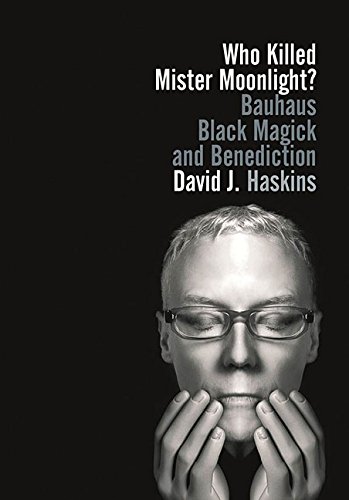
In his new autobiography, Who Killed Mister Moonlight, he explores his work as a solo performer, and with acclaimed trio Love And Rockets—culminating in the devastating fire that ripped through the sessions for their 1996 album Sweet F.A. He also delves deep into his exploration of the occult, drawing together a diverse cast of supporting characters, including William S. Burroughs, Alan Moore, Genesis P. Orridge, and Rick Rubin.
J was a founding member of the highly influential English post-punk band Bauhaus in 1978, playing bass. David J wrote the lyrics of several Bauhaus songs (including their first single, “Bela Lugosi’s Dead”). He sang backing vocals on many songs, and sang lead on “Who Killed Mr. Moonlight?” Bauhaus first broke up in 1983, reforming periodically at later times.
His first venture outside of Bauhaus was a collaborative single, “Armour” / “Nothing”, with artist and poet René Halkett, of the original Weimar Bauhaus school of art and design.
He began writing music for a solo career while still in the band, and continued after the band’s break-up, releasing the dark Etiquette of Violence and Crocodile Tears and the Velvet Cosh, and played bass on two Jazz Butcher albums (A Scandal in Bohemia and Sex and Travel), both of which he also produced. J was also a part of the very short-lived band The Sinister Ducks, which included saxophonist Alex Green and comics writer Alan Moore. J also released an EP that was intended as a soundtrack to Moore’s graphic novel V for Vendetta. In 1996 he once again collaborated with Moore alongside musician Tim Perkins when the trio recorded two spoken word with music CD’s, The Grand Egyptian Theatre of Marvels and The Birth Caul.
In 1985, J, his brother Kevin Haskins, and Daniel Ash, all former members of Bauhaus, formed Love and Rockets; J once again played bass guitar and also shared songwriting and vocal duties with guitarist Daniel Ash. His most notable lead vocal from this period was the minor hit “No New Tale to Tell”. J maintained his solo career during breaks from Love and Rockets, releasing Songs from Another Season and Urban Urbane after his band’s success with the single “So Alive”. He also released one of the first No. 1 hits from the newly created Modern Rock Tracks charts, with “I’ll Be Your Chauffeur.” J participated in a Bauhaus reunion in 1998. Love and Rockets broke up in 1999, after seven albums. Following what was billed as a one-off performance of Bauhaus at the 2005 Coachella concert festival, Bauhaus reformed for a successful tour of the Americas in late 2005 and Europe in early 2006 as well as a final album, Go Away White.
J has a brand new album, An Eclipse of Ships, which brought him to Toronto, and the SiriusXM studios.
Eric: I’ll start with the most “what!” thing I’ve seen all year.
David: I think I know where youre going.
Eric: You did a cover of Britney Spears “Toxic” with Sasha Grey in the video.
David: Yeah, I changed the gender and slowed it down and injected a good measure of sleaze into it.
Eric: There wasn’t enough when Britney did it?
David: I love that version and it was actually Daniel Ash from my previous bands who turned me onto that track when it came out. He said I know this isn’t your cup of tea, mate, but just sit down I want to play you this track. I said, what is it? He said Brittany Spears. I said, really? He played me the original “Toxic” and I was knocked out by it. I love it. I loved the production and the song. Yeah, then it was like, recently I was in the supermarket and it came over the PA system and it just made this connection. I was on my way to rehearsal, I was up in Portland rehearsing with this band Adrian H and the Wounds for a gig out there. I called them up and said you might think I’m crazy but I’ve got this mad idea. Let’s do a version of “Toxic” and play it at the gig. By the time I got to rehearsal they had worked up a version and then we just honed it and it clicked. We decided to recorded it the next day and then we played it that night as well.
Eric: How do you get someone like Sasha Grey in the video?
David: Well, I met her when – another thing I do, I’m writing screenplays and I had Sasha in mind for a part in one of these films and met her with that in view. If that film ever gets made, she’s gonna play this role. That’s how we connected. Then we became friends and she was telling me her about her music, which she’s really into and she said she’d love to have me play on a track. So, when the idea to have Sasha in the video came up, I thought well maybe we can do a trade here, which is exactly what we did. I played bass on this track and then she did the video.
Eric: The album it comes from An Eclipse of Ships hit its goal pretty quickly when you first launched it on Kickstarter, which is your second consecutive album that you put on the crowdfunding site. More and more people are using the site. How does the collapse of the industry change your perception of recording music? Does it force you, even a little bit, to change the way you produce and release music now that you know for sure that you have owners of the music when you’re ready?
David: Not in the way I produce it, but certainly in the way I release it. I’m not going through a record label, so it’s bypassing the middleman. It’s very direct and I really like the interaction between myself and the pledgers, listeners, supporters. Its a community. They come out to the gigs, I meet them and some of them become good friends. I think that sense of involvement is great. I’ve supported other projects as a pledger and have been on the other side and I’d love to do that.
Eric: You did it right. You weren’t asking for $300,000 and putting this goal of 10,000 pledges. You got it with 312 pledges, and with a goal of $30,000. Certainly you left it open to raise more, but you played to your core.
David: I just estimated what it would cost to make the album and pay the musicians, go on this tour, go to SXSW, which we did to do the video. We hit that goal and thank you very much to everybody that made a contribution.
Eric: With the new album An Eclipse of Ships that came out this month, where does an album like that begin for you? How many of the songs are holdovers or bits and pieces. Where does a new album start for you and when do you decide that you may have a –
David: It’s a mysterious process. Again, I never set out to write a song. I never set out to make an album. It’s different with a band, because you do.
Eric: Do you miss being in a band? It’s not David Jay will always be front and center. Do you miss having people?
David: I have this with this current band, it’s very much a band. I have that camaraderie. I do love that. I play with other bands as well, I have unfortunate in that I have different bands at my disposal. The band that played at SXSW is basically the band that played on the album, which is more of an acoustic band. The songs, there’s a theme to this album which is basically an homage to women. I adore women. I’ve been fortunate enough to have known some inspirational beauties. These were my muses, whilst making this album.
Eric: Are they all real women? Are they people in your life?
David: Yes. All real. Very real.
Eric: Do each of them know what song might be for them?
David: Some of them do. That last one is for my very understanding wife.
Eric: The album is far more organic, country, folkish. I don’t want to say that it could be a reaction to something. I don’t think artists work like that. But in a world that’s dominated by electronica and EDM, this was kind of a step back for a minute. It seemed more real, it seemed like you were allowing the music to breathe a lot more.
David: I just feel it come through me. I don’t decide. I love electronic music, I really do. But, this is what came through. There are all theses muses that I mentioned but there is the pervasive, more ethereal classical muse. She whispers in my ear if I’m lucky and guides me. I have to listen and be attentive to that voice. But I’ve always been into acoustic music, folk music in that I hear the influence of some very early favorites coming through on this record. Not that I was consciously doing it, but like John Martin. Kevin Ayers. NIck Drake. My love for those artists goes back to pre Bauhaus when I was a teenager. Neil Young. Leonard Cohen.
Eric: Is that how you got into loving music to begin with?
David: Bob Dylan. When I first started to play guitar, I had an acoustic guitar and I learned Bob Dylan songs and Beatles songs. That’s where it started.
Eric: Does it drive you mad sometimes if you always, as a true artist, who finds inspiration anywhere? Are you always on?
David: Sure, absolutely! I love it. Its a real turnon to me. Certainly this album I have to doth a cap to the ladies because I was listening very intently to [laughs] once I realized, there’s a song here, then I have to confess I would be in conversation them and I’d be listening. One ear would be the songwriter ear and I’d be taking notes.
Eric: In your autobiography, Who Killed Mister Moonlight, was it tough for you to remember certain things, or were you as honest as you could be?
David: It wasn’t and I’ve always kept diaries and journals so i’ve had the diaries going back to when the band started. I had great support from a guy called Andrew Brooksbank, who’s also an author and an authority on – he came up with this amazing timeline for me. He knows the minute. He knows where I was in 1981 on a Thursday at 2PM, its a bit scary actually. He’s great, Andy. That was my Skeleton which I dressed with referring to my diaries and the odd journal here and there. So, I was able to put it together. Once I started the process, the memories started to flood back. The way I wrote this was very disciplined. I’d go in and do office hours. I’d start at noon every day and write for two hours and then stop, even if I had a flow going. I’d have a break for a few hours and go back to it for an hour and then have a cocktail.
Eric: Whats the one thing, if anything, that surprised you about a young David Jay that you look back at the notes and diaries?
David: I’d also make notes about music I had loved and the records I needed to get, films I wanted to see. Those have continued all the way through and its that curiosity is as keen as, even more keen now than it was. The experience of life becomes richer the older you get. But the germ of that curious nature is there right in that first diary. That was interesting to see that. I hadn’t looked at those diaries until I decided to do this book. They were just in a box. I’m really glad I did those, I have the dates of course. I’d put the details of the gigs, the sessions and little incidents that happened on tour, I also kept – I’ve got every itinerary from every tour. They’re filled with details of stuff that happened on the road. Conversations, so it’s verbatim going back and drawing on that source material.